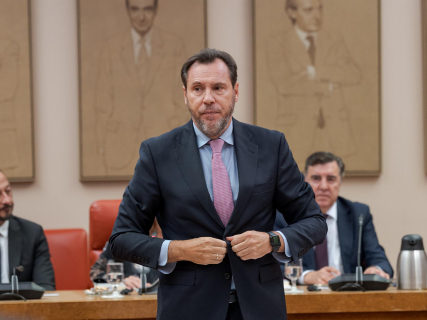

The PP and Vox have again demanded this Tuesday in Congress the resignation of the Transport minister, Óscar Puente, whom they politically hold responsible for last week’s rail accident in Urda (Toledo), in which 69 people died and there were numerous injured. Both parties argue that, even though it is not "sufficient," his exit from the Government is essential, even more so after this disaster occurred only nine months after the one that took place in January in Adamuz (Córdoba). In contrast, the partners of the Executive, despite continuing to maintain their criticisms, have chosen to soften the harshness of their interventions compared with previous days.
The PP spokesperson, Ester Muñoz, has sharply attacked the minister in the Permanent Deputation of Congress with phrases such as "How well he is able to explain why people die on trains and how badly he is able to prevent people from dying on trains," reproaching him for trying to "cynically confuse public exposure with the assumption of responsibilities," and for having spent nine months acting as if the Adamuz accident had never happened, without adopting concrete decisions.
Muñoz has gone so far as to define him as "negligent, frivolous, incompetent, and unable to empathize with other people’s pain," has branded his management as "nauseating," and has thrown questions at him such as "how many mobile phones were desperately ringing" in the wrecked carriages in Urda while he "was with his team building a story and filtering audios." In her view, "Everything that could have gone wrong went wrong. It’s not a one-off failure; it’s systemic. And it’s not a coincidence; it’s the consequence of all his decisions, his actions, and his omissions," which is why she demands that he take responsibility politically for not having yet implemented the new safety system when "the old one suffers constant falls," for ignoring the warnings from the CIAF, and for having put "safety behind his interests, raising speed to 350 kilometers to make a video handing out a pin to his colleagues."
From Vox, its spokesperson, Pepa Rodríguez de Millán, has questioned the minister about whether he can sleep soundly with "116 deaths on his back" and "how many more deaths are needed for someone to take any responsibility." In her view, "in the charred heap on the embankment of Urda, all the degradation to which this Government has brought us is concentrated." She accused Puente of lacking "neither dignity nor shame," as well as "humanity and heart," and of acting as a "puppet" of his "master," referring to President Pedro Sánchez, whom she sees as "desperate" but "not for seeking the truth," but rather to manufacture a story that "at least saves the electoral campaign." After warning that they will not stop until the minister answers criminally for the incidents in Adamuz and Urda, all Vox lawmakers left the chamber.
Criticisms from Sumar, IU and ERC of railway liberalization
The Izquierda Unida lawmaker and number three of Frente Amplio for Madrid, Toni Valero, has considered Puente’s appearance "insufficient" for not questioning the liberalization of the railway system, which, as he has denounced, has turned Spain into the European Union country "with the most deaths in train accidents in the last 25 years."
For her part, the Sumar spokesperson, Verónica Martínez Barbero, has emphasized that the existence of two serious high-speed accidents so far this year justifies the minister’s resignation. "From Frente Amplio we ask him to resign, we ask him respectfully, recognizing his record and convinced that taking on that responsibility would be a final valuable service from his ministry. And believe me when I tell you that we say it for real because we think it is also the best thing for you," she concluded.
ERC spokesperson Gabriel Rufián has described Puente as a "good politician" who at least "faces up to it," although he has insisted that "someone has to take charge" and has questioned the PSOE about what it would demand if the Transport portfolio were held by the PP. Even so, he has warned that the debate about the minister’s continued stay is "incidental" and a "distraction," since, after the "wild liberalization," the price of tickets fell by 24%, traffic increased by 47%, and investment only by 9%, resulting in 115 fatalities.
PNV, Bildu, Podemos and BNG call for accountability
The PNV deputy Mikel Legarda has also called for Puente’s resignation, noting that Spain already has 54% of the victims in high-speed accidents and that in 2026 there will be “more probability of dying in Spanish high-speed travel than while traveling by car.” He has stressed that he is not looking for “political fodder,” but to defend a “culture of political responsibility,” and he has delivered a verdict: “We believe you have missed the train of trust and there is no remedy anymore.”
Bildu spokesperson Mertxe Aizpurua has said that her formation will not prejudge the causes or assign blame for the accident, nor will it participate in dynamics “tinged with political and electoral overtones,” appealing to “prudence and responsibility.” However, she has warned that she will not allow blame to be placed on the sector’s employees.
Podemos Secretary General Ione Belarra has said that “the true human error” of the Urda accident is the “deregulation” of the railways, which prioritizes “business over the safety of people.” For this reason, in addition to reiterating that her departure is “a social outcry,” she has called for the service to be renationalized. From the BNG, Néstor Rego has been more nuanced and has limited himself to pointing out that Puente himself is “aware” that it is “inevitable to assume responsibilities” and that broad sectors are demanding his exit from the Executive.
Controversy over the recordings and PSOE’s defense
Several groups have agreed in reproaching the minister for the leak of recordings from the day of the accident—recordings “biased,” according to the PP, with which, in Vox’s view, the Government would have tried to “blame some poor workers” for a responsibility that falls on the ministry.
Rufián has denounced that the PSOE is acting in a similar way to the PP when it “made life worse” for the Angrois accident train driver, something that the BNG has also recalled, describing it as “unacceptable” for the same situation to repeat. Belarra, for her part, has criticized that blame has been made to fall on “the weakest link in the chain” by disseminating data from the deceased train driver, which she considers “a moral baseness.”
The Socialist spokesperson, Patxi López, has recalled the pointing out to the driver of Angrois by today’s PP leader, Alberto Núñez Feijóo, then president of the Xunta, and has regretted that Puente’s resignation is being demanded when, in his view, he has limited himself to setting out "the facts as they were" and has been "infinitely more prudent and sensible" than the popular party leader.
López has criticized that "The minister must resign for being where he had to be, for showing his face and not doing what others did in an exercise in escapism," and he has acknowledged that asking for accountability is "legitimate," although he has called for it not to be "confused" with "the rush to find culprits." According to his position, "pointing at the minister and asking for his resignation neither clarifies the accident nor protects the next passenger." In his view, "The minister’s responsibility is not to get out of the way; it is to explain what happened and ensure the implementation of concrete measures, as has already begun to be done today."