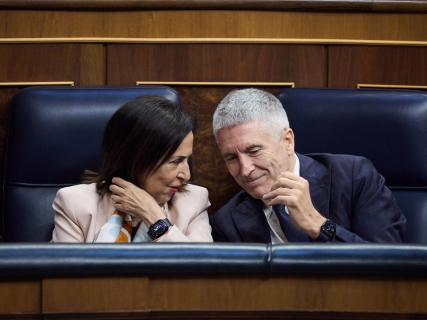

The Minister of the Interior, Fernando Grande-Marlaska, has again denied this Tuesday that there was a report from the National Intelligence Center (CNI) that anticipated the massive entry of migrants in Ceuta on July 30. "There was no report that foresaw that on July 30 what ultimately happened would occur," the Interior Minister pointed out during the press conference following the Council of Ministers.
An assertion that clashes with the version of the Minister of Defense, Margarita Robles, who defended this Tuesday before Congress that the Spanish intelligence services "shared and analyzed with the State Security Forces". "Intelligence services and obviously the CNI carried out the work that was and is required of them," the minister asserted.
For his part, Marlaska has reinforced his argument by suggesting what would have happened if the intelligence services had previously detected a risk of that magnitude. "Can anyone understand that if something similar to what happened had been glimpsed, considering what had happened in May 2021, it would not have been raised to the highest levels?", he asked.
The head of the Interior has extended that absence of a specific alert beyond the CNI. As he explained, no Spanish information service, allied country service, or other intelligence agency anticipated "anything similar" to what ultimately happened.
Robles assures that the CNI shared information
Her statements came shortly after Robles' appearance before the Defense Commission of Congress, where the minister expressly defended the work carried out by the intelligence services in the days leading up to the crisis.
Robles revealed that 25 members of the CNI are stationed in Ceuta and permanently monitor issues ranging from relations with neighboring countries and the geopolitical situation of the southern flank to mafias, jihadist terrorism, hybrid threats, and irregular immigration.
Thus, the Minister of Defense also defended the CNI agents in light of the criticisms received after the massive entry and pointed out that the duty of secrecy that weighs on their actions "often operates like a slab" because it prevents making their work public.