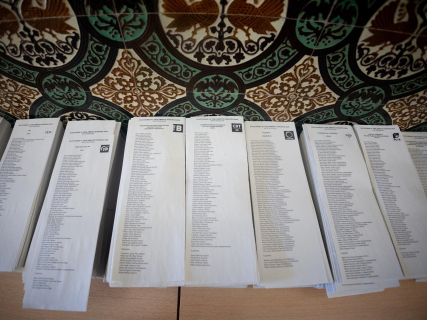

The parties and coalitions have registered a total of 929 candidacies for the Congress and the Senate for the general elections next November 29, according to the Official State Gazette (BOE) this Wednesday, which represents almost 15% less than in the legislative elections of 2023.
In detail, 556 lists have been submitted to the Congress, where 350 deputies are elected in 52 constituencies, and 373 to the Senate, a chamber in which 209 seats are distributed. In total, there are 161 fewer lists than the 1,090 that ran in the 2023 general elections, which implies a drop of 14.77% in the number of candidacies. Despite this, there are now six more lists running for the Congress than then, while in the Upper House there are 167 fewer.
The collapse of close to a third in the number of lists for the Senate is explained mainly by the alliance sealed in most constituencies between the PSOE and the Frente Amplio, who are running under the Senate of Progress brand, as well as by the decision of the PP and Vox not to stand in certain provinces.
In the list of candidacies published in the BOE, collected by Europa Press, appear the main state political forces, such as PP, PSOE, Vox, the Frente Amplio which succeeds Sumar, and Podemos, together with the territorial-based formations with representation in the Congress (ERC, Junts, Bildu, PNV, BNG and CC, among others).
Also appearing are lists from non-parliamentary parties that have already participated in previous electoral contests, such as Se Acabó la Fiesta (SALF) of MEP Luis "Alvise Pérez", the animal rights activists of PACMA, the Frente Obrero or the recently created Democracia 21, led by the lawyer Miriam González.
To be able to run, these formations without previous representation in the Cortes have had to obtain the endorsement of at least 0.1% of the voters registered in the census of each constituency in which they present a list.
In any case, the candidacies published this Wednesday by the BOE are not yet definitive. From now on, the electoral boards will have two days to point out the irregularities detected or reported in the lists, which the parties may correct within 48 hours of their notification. After that procedure, the boards will have until next Monday to proclaim the valid candidacies, which will be made public in the BOE the following day, November 3.
Review of endorsements and application of the new parity
One of the aspects that the boards will have to verify is the validity of the signatures submitted by the parties that did not win seats in either chamber in the last general elections, since the law establishes, among other requirements, that the same person cannot endorse more than one candidacy.
The provincial electoral boards will also have to verify compliance with the new principle of electoral parity, which for the first time in a general election requires that the lists to the Congress and the Senate be made up of women and men arranged alternately.
In 2023, the regulations required that each list have at least 40% candidates of each sex and that neither exceed 60%, a requirement that had to be respected in each block of five positions. However, the reform introduced by Organic Law 2/2024, on parity representation, has replaced that model with the so-called gender zipper lists.
Comparison with the 2023 general elections
In the July 2023 elections, the Provincial Electoral Boards admitted a total of 1,090 lists to the Cortes Generales (550 to the Congress and 540 to the Senate), 186 fewer than in 2019. In the review process, 66 candidacies from extra-parliamentary parties were left out due to formal errors, for not complying with legal requirements or, above all, for not presenting the required endorsements.
In total, 4,892 candidates competed on July 23, 2023 for the 350 seats in the Congress and the 208 in the Senate —this year one more is elected, after the constitutional reform that allowed the island of Formentera to have its own senator—, which represented an average of ten candidates for each seat in the Lower House and 5.5 per seat in the Senate.