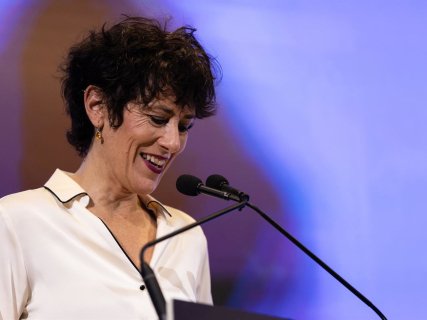

The Government spokesperson and head of the PSOE list in Navarra for Congress, Elma Saiz, defended in Tudela that public pensions "are sustainable" and held PP, Vox and UPN responsible for maintaining a "hidden agenda that talks about privatizing and cutting back".
Saiz spoke this Saturday at an event of the PSOE in Tudela, under the slogan 'The strength of the people', accompanied by the third vice president and minister for Ecological Transition and the Demographic Challenge, Sara Aagesen, and by the general secretary of the PSN-PSOE and president of Navarra, María Chivite.
The candidate criticized the "lack of respect" of PP and Vox when they say that the public pension system "is going to burst" or when they reduce the revaluation to "technical issues". Faced with that message, she stressed that these are "political decisions" and accused Vox of placing itself "against strengthening our jewel in the crown, which is the public pension system".
In this context, she celebrated the "success of the country" that the "historic record" in affiliation to Social Security represents, with 22.6 million contributors, of whom 10.7 million are women. Addressing PP leader Alberto Núñez Feijóo, she said that "being a feminist is not growing up among women; it is not voting against women’s rights".
Saiz argued that "questioning the revaluation of pensions is attacking women’s rights", noting that the lowest benefits are usually for women because they "come from times of cuts and labor markets that removed women from the labor market". She also added that "being against raising the Minimum Interprofessional Wage is being against women because there are 1.5 million women who receive the SMI".
The Socialist leader insisted on the "lack of respect" of PP and Vox when speaking about the pension system and warned that, behind those "questionings", there is a "hidden agenda" of "cuts and privatizations". She recalled that with a PP government there was a "freezing" of pensions and the sustainability factor was approved, which "took a bite out of the pensions of the youngest".
Faced with that model, he claimed that “we have strengthened the income side” with a reform that introduces a “solidarity contribution so that the highest salaries contribute a little more,” along with an increase in employment and the rise in the minimum wage “by 66% and we are going to raise it again.” In this line, he defended that “pensions are sustainable and whoever says otherwise has a hidden agenda, what they talk about is privatizing and cutting back.”
Saiz also denounced Vox’s “xenophobia and racism” in migration policy and defended the Executive’s strategy aimed at “regular, orderly and safe migration.” He mentioned the extraordinary regularization, which has made it possible to “remove from invisibility people who live among us but who were with fears and who now have rights and obligations.”
In his address, he set out the next general elections as a choice between “involution or progress, or hope and continuing to be a country open and prosperous, or fear, cuts, and being a closed and poor country.”
Ecological transition as a driver of prosperity
Minister Sara Aagesen defended that the ecological transition policy “is a prosperity policy, a competitiveness policy, and it is already delivering results.” She explained that when the PSOE came to Government in 2018 “there was no energy policy” and the country “was going to fall off the cliff” because of its heavy dependence on fossil fuels.
Since then, she stressed, work has been done “with foresight, with clarity about where we want to get to in 2030 and beyond,” with a “real policy.” She recalled that, after the start of the war in Ukraine, “in Europe we live the harsh reality” of dependence “for 40% of all the gas it consumes from Russia,” which highlighted a “vulnerability” that translated into “outrageous prices” for European citizens.
In that situation, she said, the Executive acted “protecting the most vulnerable” by preventing cuts to gas, electricity and water and by expanding access to the electric social bonus, in addition to supporting productive sectors and “accelerating” the rollout of renewable energies.
Aagesen recalled that between 2012 and 2018, “nothing was installed in Spain” due to “regulatory uncertainty,” while since then there has been “exponential growth” by providing “certainty” to the sector. He said that Spain “is much better prepared than our European partners” to face the new crisis stemming from the conflict in the Middle East and the war in Ukraine, thanks to the increased integration of renewables, which reduces “our dependence on gas and that means that our prices are less exposed.”
Regarding the rural environment, the minister said that there has been a shift from “disastrous” governance to a model with “direct contact” with autonomous communities and town councils. She highlighted improved connectivity in the countryside, which has gone from 30% in 2018 to 94% today.
She said that a new strategy for demographic challenge is already being drafted, with priorities such as guaranteeing services in towns “that make it possible to keep the population in place,” mobility “accessible and affordable” that does not depend on a private car, facilitating access to housing and promoting public construction, as well as supporting entrepreneurship.
Chivite sets PSN’s model against Milei’s
The president of Navarre and leader of PSN-PSOE, María Chivite, stressed that in the general elections people have to “choose between two models.” On one side, that of the PSN, “with a record in employment, progress in rights, and reducing inequality and poverty.”
On the opposite side she placed the model of Argentina by Milei, “which Ayuso likes so much” and which she has been able to get to know during her institutional trip. She said that its macroeconomic indicators “maybe are better” but “at the cost of higher unemployment and higher poverty.”
Chivite highlighted the evolution of Navarre and its self-government under socialist executives, noting that “five competences have been achieved, not attained in the previous 20 years.” She attributed these advances to the fact that “on the other side we had a government that understands what it is to be foral in Navarre” and to “institutional respect.”
She also emphasized the “millions of euros that the Government of Spain has allocated to improve the infrastructure of Navarre” and said that “in a few days we will have good news that will have to do with the second phase of the Canal de Navarra.”