Sánchez proposes to Brussels that Mallorca hosts the European center against fires

The president conveys to Ursula von der Leyen the candidacy of the island to host a 'hub' against fires in the western Mediterranean, demands a state pact for climate emergency, and defends that the pardon for the former president of the Parliament "complies" with the ruling of the TSJC.

2 minutes

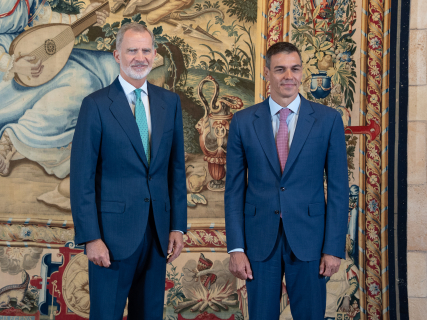
EuropaPress 7694328 rey felipe vi despacho presidente gobierno pedro sanchez palacio real

EuropaPress 7694328 rey felipe vi despacho presidente gobierno pedro sanchez palacio real

Add DEMÓCRATA to Google

Ask FREN

Published

Last updated

2 minutes

Most read

The President of the Government, Pedro Sánchez, announced this Wednesday that he has requested the President of the European Commission, Ursula von der Leyen, that Mallorca be the headquarters of the future European center for fighting fires in the western Mediterranean. The announcement was made after the traditional summer meeting held with King Felipe VI at the Palace of Almudaina, in Palma, a meeting marked by the crisis of forest fires affecting various points in Spain.

Sánchez explained that the initiative arises after the European Commission decided to locate the coordination center for fighting fires in the eastern Mediterranean in Cyprus, so the Government considers that the Balearic Islands meet the conditions to host a similar infrastructure intended for the western flank.

"I have sent a letter to the President of the European Commission so that the chosen location to create a 'hub' in the fight against fires in the western Mediterranean is located on the island of Mallorca", the president pointed out, who specified that he previously shared this proposal with Felipe VI and with the President of the Balearic Government, Marga Prohens.

The fires focus the meeting with the King

During his appearance, Sánchez explained that the evolution of the fires occupied a good part of the conversation held with the head of State.

"We are in a critical, very complex situation", the president stated, who insisted on the need to exercise extreme caution in the face of an especially intense fire campaign.

In this context, he reiterated his call for a state pact against climate emergency, considering that the increase in large fires requires a coordinated response among administrations and a long-term strategy to improve prevention and response capacity.

Defends the pardon for Laura Borràs

In addition to the situation of the fires, Sánchez has also spoken out about the partial pardon granted by the Government to the former president of the Parliament of Catalonia, Laura Borràs, approved this Tuesday by the Council of Ministers.

The head of the Executive defended that the measure "complies" with the ruling of the High Court of Justice of Catalonia (TSJC) and rejected that it responds to a political negotiation with Junts.

"Nothing has to do with a budget negotiation", he assured, when asked about the possibility that the measure of grace is linked to the conversations to advance the upcoming General State Budgets.

Sánchez has insisted that the decision of the Executive responds to the terms set out in the judicial resolution itself and not to political agreements.

Last act before the holidays

The meeting held at the Palace of Almudaina constitutes the last official act of Pedro Sánchez before the start of his summer holidays. It is expected that the president will enjoy a period of rest, largely, at the official residence of La Mareta, in Lanzarote, before resuming institutional activity with the first meeting of the Council of Ministers scheduled for August 25.

For his part, Felipe VI continues to carry out his institutional agenda in Mallorca, which began on July 24 with the traditional audiences with the main authorities of the Balearic Islands. During his stay on the island, the monarch also traveled with Queen Letizia to visit the neighbors displaced by the fire in the Sierra Oeste of Madrid and later traveled to Lima to attend the inauguration of the president of Peru, Keiko Fujimori. Among the upcoming commitments of the Royal Family is the closing of the Atlàntida Mallorca Film Fest, which Queen Letizia will preside over this weekend.

More key points, information and questions with FREN

AI-GENERATED CONTENT

What is the status of the proposal for Mallorca to host the European center for firefighting, and what steps must be taken for its approval by the European Commission?

Based on the available information, the proposal for Mallorca to host a European firefighting center is clearly in a political and exploratory phase, driven by the Spanish Government, but it is not yet recorded as a formal decision or an approved project by the European Commission. The current EU architecture for forest fires is based on the European Civil Protection Mechanism and the rescEU reserve, whose major novelty is the regional station and coordination center being deployed in Cyprus, not Mallorca. None of the official Brussels notes consulted mention Mallorca as a future headquarters or as a candidacy under evaluation. From there, any progress would require Spain to formalize the proposal before the Commission and for it to be assessed politically, technically, and financially, something for which there is no evidence in the sources consulted.

What is known about the proposal regarding Mallorca

The newspaper Demócrata headlines the news titled “Sánchez proposes to Brussels that Mallorca host the European center against fires”, indicating that the initiative comes from the Spanish Government and is framed directly in relation to the community institutions.

In parallel, the Balearic Government has been strengthening its profile as a territory especially active in fire prevention and extinction (new operational bases, expansion of aerial means, deployment of the inter-island operation, etc.), as seen in notes such as the presentation of resources for the 2024 and 2025 campaigns in the Balearic Islands ([link] and [link]). This context helps to understand why Mallorca offers itself as a European node, but it does not yet equate to formal recognition by Brussels.

What is the EU actually doing regarding firefighting centers

The European Commission has announced that, by summer 2026, the main institutional novelty is the regional firefighting station in Cyprus, linked to the rescEU fleet. According to the official note “The EU deploys the largest ever response against forest fires for summer 2026” ([link]), Cyprus will host:

  • The pre-positioning of six planes from the European reserve.
  • Training and exercises for civil protection professionals, to share knowledge and best practices.

Similarly, information released by the Commission Representation in Spain about the preparation of firefighting teams and aerial fleets ([link]) details the progressive reinforcement of rescEU and the role of the Emergency Response Coordination Centre (ERCC), but also does not include any reference to Mallorca as the seat of a new European center.

In the media, Demócrata had already reported that the Commission President, Ursula von der Leyen, proposed in her State of the Union speech the creation of a European firefighting center based in Cyprus, conceived as a coordination point for assistance among Member States (article about Cyprus). The Commission's political decision, therefore, has initially been oriented towards the Eastern Mediterranean.

Commission's position on Mallorca

In the official Brussels notes consulted and in Demócrata's analyses focused on the European Civil Protection Mechanism and rescEU (explanation about the Mechanism and report on Canadair planes) there is no mention of a specific evaluation of Mallorca as a European hub, nor of a formal file opened about its candidacy.

The Commission does emphasize that:

  • The European response is structured around the ERCC (based in Brussels) and rescEU capacities distributed among several States.
  • That network is being reinforced, including the Cypriot regional station and shared fleets of aircraft and ground equipment.

In parallel, other States — such as Spain — actively participate in international missions under the rescEU umbrella, as reflected in the MITECO note about sending amphibious planes to Madeira in 2024 ([link]), which strengthens its profile as a relevant partner but does not automatically entail the assignment of a headquarters.

What steps would be necessary for the candidacy to advance

Since there is no specific published procedure to “move” the center announced in Cyprus to another location, nor formal references to Mallorca in Commission documents, only a generic description of the steps that would likely need to occur can be made:

  • Formal proposal from the Spanish Government to the European Commission, detailing the offer of infrastructure, co-financing, connection with the National Civil Protection System and with regional devices (in this case, the Balearic operation).
  • Political and technical assessment by the Commission, which would have to fit the proposal into the already decided architecture (ERCC in Brussels, regional station in Cyprus, rescEU fleet bases in various States) and within the budget limits of the multiannual financial framework.
  • If it involved creating a new stable structure or agency, possible legislative decisions by the Council and the European Parliament to modify relevant regulations or create a specific body.
  • Administrative agreements between the EU and Spain/Balearic Islands on the center's status, personnel, security, co-financing of facilities, and legal regime.

However, there is no further information in the sources consulted indicating that this process has started beyond Pedro Sánchez's political announcement and the expressed willingness of the Balearic institutions to strengthen their role in firefighting.

What arguments is the Government using to defend Mallorca as the seat of this European center against the option of Cyprus? Has there been any public reaction from the European Commission or MEPs regarding the specific proposal for Mallorca? What economic and infrastructure impact would hosting a European firefighting center have for the Balearic Islands?

What are the powers and attributions of the President of the Government of Spain according to the Constitution and current legislation?

The President of the Government is the head of the executive power and the political leadership center of the Spanish constitutional system. His powers combine strictly legal functions (defined by the Constitution and the Government Law) with a broad margin of political leadership. He assumes responsibility before the Congress, coordinates the rest of the Cabinet, institutionally relates to the King, and represents the Government inside and outside Spain. Additionally, he has specific powers regarding Government organization, defense, crises, and the exercise of regulatory authority.

Constitutional and legal basis of the office

The Constitution establishes the Government as the body that directs internal and external policy, the civil and military Administration, and the defense of the State, and attributes to the President the direction of governmental action and coordination of its members. The Government Law develops this framework, emphasizing the so-called “principle of presidential direction”: the President sets the Government's political program and the main guidelines of action, which bind the Council of Ministers and each ministry, while maintaining the direct responsibility of ministers in their scope. These rules can be consulted in the Spanish Constitution and in Law 50/1997, of the Government.

Appointment, dismissal, and caretaker government

The President is proposed by the King, after consultations with parliamentary groups, and requires the confidence of the Congress through the investiture procedure. He ceases office upon general elections, loss of that confidence (defeat in a confidence vote or approval of a motion of censure), resignation, or death. Once dismissed, he continues leading a caretaker government, which must limit itself to the “ordinary dispatch of affairs” and is prohibited, among other things, from proposing the dissolution of the Chambers, raising confidence issues, or proposing consultative referendums. The Government Law also specifies the substitution regime, so that in case of vacancy, absence, or illness, his position is assumed by the vice presidents according to their precedence, and failing that, by the ministers.

Political direction of the Government and relationship with the Cortes

As director of Government action, the President:

  • Establishes the political program of the Executive and the guidelines of internal and external policy, ensuring their fulfillment.
  • Convenes, presides over, and sets the agenda of the Council of Ministers, granting him decisive control over the governmental agenda.
  • Issues instructions to the other Government members and resolves conflicts of attributions between ministries.

In his relationship with the Cortes Generales, the President is politically accountable before the Congress, can raise a confidence question on his program or on a general policy declaration, and is subject to control through interpellations, questions, and possible investigative commissions. In turn, the Congress can demand his responsibility through a motion of censure, which must always include an alternative candidate for the Presidency.

Relationship with the Crown

The President is the key piece of the “parliamentary monarchy” system in the Government–Crown relationship. The King proposes the candidate for President and, once confidence is obtained from the Congress, appoints and dismisses him under constitutional terms. At the same time, the President endorses many acts of the King and performs specific functions, among which stand out:

  • Proposing to the King the dissolution of the Congress, the Senate, or the Cortes Generales, after deliberation of the Council of Ministers.
  • Also proposing, after deliberation of the Council of Ministers and authorization from the Congress, the calling of a consultative referendum.
  • Endorsing certain royal acts and submitting laws and other norms with the force of law to the King for sanction.

Regulatory authority and Government organization

The Government's regulatory authority is mainly exercised through the Council of Ministers, which approves general regulations and other royal decrees developing laws. The Government Law recognizes a specific regulatory area for the President regarding the “functional and operational matters” of the Government itself and, in particular, attributes to him:

  • The creation, modification, and suppression of ministerial departments and Secretariats of State by royal decree.
  • The approval of the organic structure of the Presidency of the Government.
  • The power to issue internal organizational and operational provisions of the Government.

This capacity is reflected in recent government organization rules, such as the royal decree on the structure of the Presidency of the Government or the one establishing the Government Delegated Commissions, for example Royal Decree 51/2026, Royal Decree 1081/2025, Royal Decree 676/2025, Royal Decree 954/2024, or Royal Decree 1/2024.

Other relevant powers: defense, crises, and external representation

In matters of defense and security, the Government Law attributes to the President the direction of defense policy and the functions that national defense legislation recognizes regarding the Armed Forces. In extraordinary situations, the Government as a whole, under the President's leadership, declares states of alarm and exception and proposes to the Congress the state of siege, according to specific crisis state regulations. Likewise, the President represents the Government abroad, leads foreign policy in coordination with the relevant minister, and can promote the signing and provisional application of international treaties through the Council of Ministers. Finally, he has the initiative to file constitutional challenges and participates centrally in mechanisms of cooperation and competence conflicts with autonomous communities, as reflected in various Constitutional Court rulings promoted by the Government published in the BOE (for example, Ruling 97/2018, Ruling 71/2014, or Order 144/2017).

Beyond these basic rules, the President's central position is projected in many sectoral provisions that refer to the Government Law or the Presidency's structure, among others: labor agreements and ministerial orders ([link], [link], [link], [link], [link], [link]), Treasury resolutions ([link], [link], [link], [link], [link], [link], [link], [link]) or international instruments promoted by the Government itself ([link], [link], [link]). All this reflects how much the figure of the President of the Government legally underpins the functioning of the executive power in Spain.

How does the investiture procedure of the President of the Government in the Congress work in detail? What specific limitations do the Government and the President have when they are in caretaker status? What role does the President of the Government have in managing states of alarm, exception, and siege?

What requirements and criteria does European legislation establish for selecting the seat of an emergency coordination center like the one proposed for Mallorca?

Based on the information available in the sources consulted, there is no European Union regulation that expressly and generally establishes legally binding requirements or criteria to select the seat of an emergency coordination center comparable to the one proposed for Mallorca. The documents found in the Official State Gazette reproducing European legislation (OJ EU) do not contain specific rules about “seat selection” of civil protection coordination centers. Therefore, from a strictly legal point of view, it is not possible to identify a closed catalog of mandatory European criteria that Spain must follow to propose or host such a seat.

1. Limitations of the available information

Searches on the European Union Civil Protection Mechanism or centers like the Emergency Response Coordination Centre (ERCC) have only returned indirect references to European legislation within Spanish provisions, but without reproducing location or seat criteria. The OJ EU texts cited in the BOE (Council and Commission decisions, treaties like the Treaty of Nice, etc.) do not include, as far as can be seen, specific clauses on how to choose the host city or region of an emergency coordination center.

Moreover, most references found relate to other areas (ECB monetary policy, pre-accession aid, export control, air safety, trade agreements, etc.), contained in decisions such as the Commission Decision of 31 July 2002 or the Council Decision of 22 May 2000, but without regulation on emergency center seats.

Consequently, there is no further information in the sources consulted about specific European criteria for seat selection for emergency coordination centers.

2. Spanish civil protection framework (indirect reference)

In the absence of explicit European criteria, Spain does have a detailed framework on how civil protection and emergency systems are organized and planned, which serves as context regarding the technical and operational requirements any coordination infrastructure must meet:

  • Law 17/2015, of 9 July, on the National Civil Protection System, available in the BOE: Law 17/2015. It establishes coordination principles, planning criteria, and the need to guarantee communications, service interoperability, accessibility, and response capacity against risks of different nature.
  • Basic Civil Protection Standard, approved by Royal Decree 524/2023. It defines requirements for planning against major emergencies, including coordination centers, although designed for the national scope.
  • Specific state plans (seismic risk, floods, forest fires, volcanic risk, radiological emergencies, etc.), published by Council of Ministers resolutions, such as the General State Emergency Plan, which detail command and control needs, redundant communications, accessibility to critical infrastructures, and coordination among administrations.

These instruments do not set criteria to choose a European seat, but they do describe the type of capabilities considered necessary in an advanced coordination center (secure communication infrastructures, integration with national and European networks, physical and logistical accessibility, energy and technological redundancy, etc.). In a possible European seat selection process, these elements would likely be relevant, although EU law, as far as checked, does not include them as legal territorial selection requirements.

3. Scope of specialization and warning about the European scope

The analysis is mainly based on Spanish legislation that incorporates or mentions EU law. No regulation, Council decision, or interinstitutional agreement of the Union establishing a general procedure and fixed criteria to designate the seat of European emergency coordination centers has been found in these sources. Therefore, it is not possible, with legal rigor, to detail European requirements on territorial distribution among Member States, specific geographic parameters, infrastructure density, or other location criteria.

Furthermore, the specialization scope of this assistant is Spanish politics and legislation. When the question moves to the European level and references in the BOE/OJ EU are insufficient, as in this case, it is necessary to warn that an expert response on the internal functioning of EU institutions is not offered, beyond what literally appears in the norms published in Spain.

In summary: there is no record, in the sources consulted, of European legislation imposing specific legal criteria to choose the seat of an emergency coordination center like the one proposed for Mallorca. The debate about its location thus moves more in the political and strategic plane than in that of explicit European legal requirements.

What requirements does Law 17/2015 establish for emergency coordination centers within the National Civil Protection System? What position have the central Government and the Balearic Government expressed about Mallorca's candidacy to host a European emergency coordination center? How is Spain's cooperation with the European Union Civil Protection Mechanism currently articulated, and what role do the Balearic Islands play in that structure?

Play

Test your knowledge with FREN!

How much do you know about this topic? Answer the following 3 questions.

What proposal has Pedro Sánchez made to the European Commission regarding the fight against fires?

Question 1 of 3

What has Pedro Sánchez defended about the partial pardon for Laura Borràs?

Question 2 of 3

Where did Pedro Sánchez hold his last official act before the holidays?

Question 3 of 3

Hola, soy Fren. ¿Cómo te ayudo?