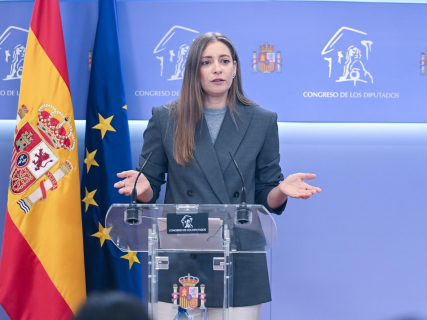

The spokeswoman for the Popular Group in the Congress, Ester Muñoz, has said this Wednesday that Óscar Puente’s resignation from the post of Minister of Transport responds to “pure electoral calculation” and that it comes “116 lives late”. At the same time, she has attacked the left for equating the Urda (Toledo) rail disaster with the dana that hit Valencia in October 2024.
“What I believe is that things have to be compared that are comparable,” Muñoz said, criticizing that the PSOE has decided to use the dana tragedy as the axis of its campaign narrative to “confront” Spaniards until the next general elections.
In an interview on ‘Cuatro’, collected by Europa Press, Muñoz pointed out that if Carlos Mazón had to leave his post because of the dana, then Sánchez “should have resigned long ago because of railway accidents”. She also emphasized that Sánchez’s government did not carry out any structural action in the Barranco del Poyo which, in her view, would have prevented the tragedy in the Valencian Community.
Remembers resignations in the PP due to previous crises
Muñoz has said that she does not give “credit to everything the left is saying these days”. “First, because they are with lies, as if in the Partido Popular there hadn’t been managers or advisers or ministers who resigned when there were crises,” she stressed.
In this context, she recalled that Ana Mato, Minister of Health with Mariano Rajoy, “resigned after the Ebola crisis”, and that “in the case of breast cancer screenings in Andalusia, the adviser was dismissed”. In the dana, she added, 22 days later “the adviser responsible during that crisis was dismissed”.
The Popular spokeswoman stressed that Puente stated from the very first moment after the Urda accident that he did not intend to resign and that he would only leave if his continued tenure generated a problem for the PSOE’s political project. For this reason, she interprets that “at the moment in which he resigns, it is clear that it is because he poses a problem for the Partido Socialista and he does it out of pure electoral calculation”.
Criticism of Sánchez for keeping Puente in office
In Muñoz’s view, Puente should have left the Ministry after the first incident in Adamuz and, however, he has acted for nine months “as if absolutely nothing had happened.” He has recalled that then “an audit” was already demanded “on the oldest road in Spain, where there were incidents practically every day,” but, as he said, he “laughed” at the PP and “insulted” them.
The Popular Party leader considers it “incomprehensible” that Pedro Sánchez has backed Puente throughout all this time, when, in her opinion, “he has devoted himself to everything except his Ministry.” She has also recalled that the president appointed José Luis Ábalos as Minister of Transport in his day, now in prison.
At this point, she has reproached the head of the Executive for having had “the nerve to go out today to say that the resignation (of Puente) has been a matter worthy.” “Really, he is responsible for having had ministers like Ábalos and Puente,” she has emphasized.
After defending that the PP, unlike the PSOE, does not seek “confrontation,” Muñoz has pointed out that her party aims to “recover a government of management and not of politics and propaganda, where there will again be technicians” and “people devoting themselves to managing public resources and those of all Spaniards.”
Along these lines, she has stated that “all those bricks with which Pedro Sánchez built his wall of division, of hatred, of confrontation, of propaganda are falling one by one and the Partido Popular campaign is telling Spaniards that all those who want to finish bringing down the wall next 29 November have to vote for Alberto Núñez Feijóo.”
Montserrat links Puente’s departure to the polls
On the other hand, the PPE general secretary and PP MEP Dolors Montserrat has attributed Puente’s resignation to pre-election surveys and has warned that on 29 November citizens stand to “restore dignity” to the country with a government led by Alberto Núñez Feijóo.
At a rally in Segovia, Montserrat blamed the minister’s departure on Pedro Sánchez’s “electoral panic” and denounced that the Executive “does not care about either Spaniards or the victims.” Immediately afterward, she called for “an audit of all the money spent” and for the rail network to be in the hands of “the best professionals and engineers.”
The MEP has reviewed other episodes of the legislature, such as the situation in Ceuta, where she pointed out that thousands of irregular migrants still remain pending for return, and she brought up the April 2025 blackout and the state of the roads.
According to her assessment, the country “is going through a public health, housing and migration crisis like never before.” In this regard, she asked “where is the money of the Spaniards” and she said that “the Executive collects more than 1,400 million euros every day in taxes, twice the amount needed to repair the Madrid-Seville rail line.”
PP proposals on housing and the management of European funds
In terms of housing, Montserrat has advanced several measures defended by Feijóo. She has said that the PP “will protect private property and will evict the squatters from homes within 48 hours.” For those under 40, she has promised that “by 60 percent” the VAT and the Transfer Tax on Patrimonial Rights will be reduced, and that “a guarantee will be provided to access one hundred percent of the mortgage.” She has also announced tax bonuses for property owners and rental tenants and the construction of one million homes.
Asked about Brussels’ actions after Adamuz and Ceuta, Montserrat rejected that citizens are left unprotected by the EU and stressed that they are “by the worst Government of the democracy.”
In this context, she recalled that Spain has received more than 140,000 million euros in European funds and that Adif was the first entity to benefit, without, in her view, having executed those resources. She specified that those funds are being supervised because the Next Generation program concludes this year 2026.
The leader emphasized that Sánchez’s is the only Executive of the European Union that has not passed budgets in four years. She defended that in other countries “a president in that situation resigns” and cited as an example the recent fall of the Government of Belgium.
Ceuta and the European Union’s response
Regarding Ceuta, she pointed out that European institutions offered from the start the deployment of Frontex and of the Asylum agency on the ground, but that in order to activate that aid it was essential that the head of government request it formally.
He has countered that lack of a request with the request for European aircraft to fight the fires, which the Spanish Executive did file, and for that reason he has concluded that "Europe has always been where it had to be, and the one who has not been up to the task has been Sánchez".