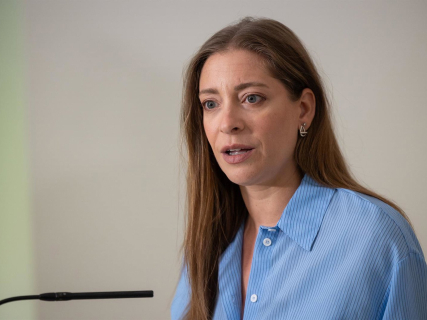
The PP criticizes Sánchez for not attending the religious funeral for the victims while he turns to the Pope when it suits him.

Ester Muñoz accuses Sánchez of making excuses in terms of non-confessionalism in order not to go to the funeral of Urda while using "the Bible, Catholicism and the Pope" when it suits her.

fotonoticia 20260916122354 1920

fotonoticia 20260916122354 1920

Add DEMÓCRATA to Google

Ask FREN

Published

Last updated

1 minute

Most read

Elecciones 29N · Encuestas

La media de las encuestas

Media a 7 de noviembre de 2026 · 11 institutos

  • PP31,0 %
  • PSOE26,2 %
  • Vox19,5 %
  • Frente Amplio6,6 %
  • ERC2,4 %
  • SALF2,2 %
  • Podemos2,1 %
01020304050ene 2024jul 2024ene 2025jul 2025ene 2026jul 2026

Media del último estudio de cada instituto en 30 días y su evolución semanal desde el 23J. Partidos con al menos un 2 %.

Todas las encuestas

Elecciones generales del 29 de noviembre · Demócrata

The PP spokesperson in Congress, Ester Muñoz, has censured this Saturday that the President of the Government, Pedro Sánchez, has decided not to attend the funeral for the victims of the Urda (Toledo) rail accident, arguing that he does not take part in religious ceremonies, despite the fact that, in her view, he has used “the Bible, Catholicism and the Pope” on other occasions when it has suited him.

Muñoz expressed herself in this way in an interview on EsRadio, collected by Europa Press, when she was asked about the absence of the head of the Executive at the ceremony that will be held next Tuesday in the Cathedral of Toledo. At this event, the Government will be represented by the First Deputy Prime Minister, Carlos Cuerpo, and the Minister of Education, Milagros Tolón.

The also PP campaign spokesperson maintains that the religious nature of the tribute “is an excuse” used by Sánchez, the same one, as she recalled, that he cited for not attending the funerals for the victims of the rail incident in Adamuz (Córdoba). “Sánchez has used Catholicism, the Pope and the Bible and it has been exactly the same to him,” she said.

Criticism of Sánchez’s attitude toward the victims

From her perspective, the President of the Government should “show respect” for the people “who have any kind of confession” and attend this type of ceremonies, since, although Spain is a non-denominational State, “most Spaniards consider themselves Catholic.”

“It’s clear that he doesn’t go because he has no affection or empathy toward the victims and because he thinks that electorally, if someone there reproaches or confronts him about something, it could turn out badly for him. It’s a moral demonstration of the person, something that doesn’t surprise anyone,” Muñoz concluded.

More key points, information and questions with FREN

AI-GENERATED CONTENT

What is the status of the parliamentary processing of the proposed measures following the recent railway accidents?

As of November 7, 2026, the situation is marked by the dissolution of the Cortes on October 6: the pending bills and control initiatives expired. Therefore, it is necessary to distinguish between the already ratified aids, the proposals that did not come to fruition, and the new actions following the Urda accident on October 28. The dissolution is recorded in Royal Decree 806/2026.

Victim aid: ratified decree, expired bill
  • Aid for Adamuz and Gélida. The Congress ratified Royal Decree-Law 1/2026, of January 27, on February 26: that is, it agreed to maintain it. It also decided to process it as an urgent bill to allow parliamentary amendments. This bill, 121/000085, expired on October 6 without becoming a new law; this expiration should not be confused with the repeal of the ratified decree. (Congress Agreement).
  • Additional economic and labor protection. Bill 121/000095, derived from Royal Decree-Law 10/2026, of April 28, included considering certain sick leaves and pensions of victims as work accident-related for economic purposes. The decree was ratified on May 20, but its subsequent processing as a bill also expired on October 6. (Parliamentary processing).
Railway safety: approved agreements and expired proposals

The main resolution approved was the Popular Group's motion in the Senate 662/000181, debated on February 4. It demanded a provincial shock plan, updating safety and maintenance protocols, real-time train location and communication, public analysis of incidents, and urgent passenger assistance. It also called for approving the statute of the independent investigation authority, transposing the directive on critical entity resilience, restoring the emergency unit, and the minister's resignation. It is a political impetus resolution, not a law nor proof of execution of those actions. (Approved text).

The Vox non-legislative proposal 162/000679, published on January 30 to reinforce safety and promote the minister's dismissal and censure, expired. The equivalent motion from the Mixed Group in the Senate, 661/001717, proposed cumulative alerts, comprehensive audits, and budget priority for maintenance; it also did not culminate before dissolution. (Congress proposal; Senate motion).

Investigation and control: interrupted work and new requests

The Senate investigation commission was approved on February 18 and held hearings, including those of the presidents of CIAF and Adif on April 27. Its work was affected by the dissolution; no final approved report is recorded in the consulted sources. Pending questions about rail breaks, additional inspections, labor prevention, and accident management also expired. (Commission creation; Initiatives expiration).

After Urda, the hearing of Óscar Puente, file 210/000165, was convened for November 3 before the Permanent Deputation; its outcome is not recorded here. The PP also requested Sánchez's urgent hearing on October 29. No new safety law specifically approved after that accident has been located. (Official call; Hearing request).

What are the powers and functions of the Prime Minister in institutional acts according to Spanish legislation?

The Prime Minister exercises in institutional acts functions of government representation, political leadership, and protocol participation. Their powers depend on the nature of the act: attending a ceremony does not equate to presiding over it, and occupying a preferred place does not allow assuming the powers of other authorities. The main references are the Constitution, Law 50/1997, on the Government, and Royal Decree 2099/1983, which approves the General Order of Precedences in the State.

1. Representing the Government and directing its action

Article 98.2 of the Constitution assigns the Prime Minister the direction of the Government's action and coordination of its members. Article 2 of the Government Law specifies that they are responsible for representing the Government, establishing its political program, and determining the guidelines of domestic and foreign policy.

In an institutional act, they can therefore express the Executive's position, announce its priorities, and lead its representation. However, a ceremonial intervention does not replace the legal procedures necessary to approve regulations, adopt agreements, or commit public expenditure.

2. Presidency of acts and order of precedence

Royal Decree 2099/1983 distinguishes general official acts from special acts. The former are held on the occasion of national, regional, provincial, or local events; the latter correspond to activities specific to an institution or service.

  • Presidency: as a general rule, it corresponds to the authority organizing the act. When this authority cedes the presidency, it occupies the place immediately next to it.
  • Precedence: in general acts organized by the State, the Prime Minister occupies the position after the king, the queen consort or the queen's consort, and the Prince or Princess of Asturias.
  • Representation of another authority: one who represents a superior authority does not automatically acquire their precedence. The order establishes an exception for the express representation of the king or the Prime Minister.

These rules do not mean that the Prime Minister must lead any ceremony they attend. Also, protocol precedence does not by itself confer hierarchy or powers outside the protocol.

3. Relationship with the king: proposal and countersignature

The Constitution reserves the king the headship of the State and its highest representation in international relations, especially with the nations of its historical community. The Prime Minister represents the Government, not substituting that constitutional position.

In certain acts of the king, the Prime Minister intervenes through the countersignature: according to article 64, the monarch's acts are countersigned by the Prime Minister or the competent ministers, with constitutional exceptions. The countersigning party assumes responsibility for the act. This must be distinguished from the mere presence of the Prime Minister alongside the king in a ceremony.

4. Acts with constitutional effects

Some institutional actions of the Prime Minister have specific legal consequences. Among them are proposing to the king the dissolution of the chambers, after deliberation by the Council of Ministers and under their exclusive responsibility, or proposing a consultative referendum, previously authorized by the Congress. Their scope derives from the Constitution, not from the solemn nature of their celebration.

5. Limits of their intervention

The Prime Minister must respect the powers of the Cortes, the autonomous communities, local entities, and other institutions. They cannot turn a ceremonial presidency into a directing power over them. Nor does every attendance require a speech, a signature, or a countersignature: each intervention depends on the rules applicable to the act.

In short, to determine their specific function, it is necessary to distinguish who organizes, who presides, and what legal effects the act produces.

What results did the Popular Party obtain in the last general elections in Toledo?

In the last general elections held, those of July 23, 2023, the Popular Party obtained in the Toledo constituency 146,036 votes, 37.9%, and 3 deputies, according to the results published by RTVE based on data from the Ministry of the Interior. These figures correspond to the Congress of Deputies and the entire province, not exclusively the city of Toledo. (RTVE Results).

The PP result, broken down
  • Votes: 146,036 supports for the Popular Party candidacy in the province of Toledo. This is the figure recorded on RTVE's provincial results page. (Provincial count).
  • Percentage: 37.9% of the votes, expressed with one decimal in that same publication. This percentage describes its electoral support, while the number of deputies indicates the representation obtained. (Vote percentage).
  • Seats: 3 of the 6 deputies elected in the constituency. Therefore, the PP obtained half of Toledo's representation seats in Congress. (Distribution of deputies).
What "in Toledo" means

Territorial precision is important to correctly interpret the result. The above data groups the votes of the province; they are not the municipal result of the capital. Therefore, if your question refers only to the voters of the city of Toledo, it is not advisable to use the 146,036 votes as if they all came from there. The cited page explicitly identifies the provincial scope of these results. (Constituency results).

Votes and representation must also be distinguished: 37.9% expresses the support received by the candidacy, while the three seats represent half of the six seats corresponding to Toledo. Consequently, obtaining half of the deputies does not mean having received half of the votes. They are two different ways to describe the same electoral result. (Votes and seats).

Why you may find slightly different figures

There is a difference between the consulted publications worth noting. While RTVE records 146,036 votes and 37.9%, El País's results information presents 146,533 votes and 37.84%. It is not advisable to mix the number of votes from one publication with the percentage from another, as this would construct a figure that neither offers jointly. (El País Results).

The consulted information attributes these small differences to different consolidation criteria of the count but does not detail the adjustment sufficiently to explain it more precisely. Therefore, the figures in the first paragraph are expressly presented as those published by RTVE, not as a combination of sources. This caution allows exactly identifying which result is being cited.

Which call it corresponds to

The reference election is that of July 23, 2023, called by Royal Decree 400/2023, of May 29. As of this response date, the elections announced for November 29, 2026, have not yet been held: their candidacies or forecasts should not be confused with electoral results already obtained. (Upcoming call in Toledo).

Play

Test your knowledge with FREN!

How much do you know about this topic? Answer the following 3 questions.

Why has the PP criticized Pedro Sánchez in relation to the Urda funeral?

Question 1 of 3

Which government officials will attend the funeral representing the Executive?

Question 2 of 3

What argument has the Government used to justify Pedro Sánchez's absence from the ceremony?

Question 3 of 3