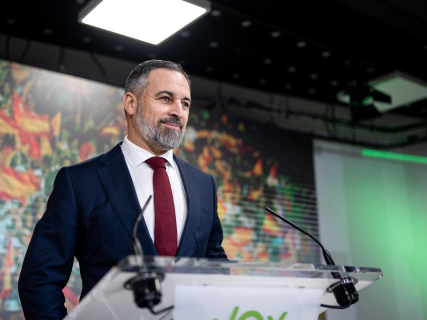










Vox has presented this Saturday, during its Ordinary General Assembly, its new Deregulation Program, a package of measures with which the party of Santiago Abascal intends to place the fight against bureaucracy at the center of its economic, labor, and territorial agenda.
Under the slogan “Let’s get to the point! A simpler life”, the party maintains that Spain is trapped in an “over-regulation” that, in its opinion, is behind the “decline, dismantling, or decadence” of numerous sectors. The criticism is directed especially at the primary sector, energy, industry, housing, the autonomous system, and mass immigration.
The document starts from a very clear idea: Vox wants to review in a “profound” way all the regulations and bureaucracy that affect companies, workers, farmers, self-employed, families, and administrations. The party states that laws, born to order coexistence, have ended up becoming a “regulatory chaos” that penalizes initiative, slows growth, and blocks the future.
Four sectors in the crosshairs
Vox's plan identifies four major areas where, according to the party, regulation has become an excessive burden.
The first is business and labor, where the party proposes to eliminate regulatory disparity, reduce bureaucratic hurdles, and return decision-making power to companies and workers. The second is energy, with a policy oriented towards energy sovereignty and accelerating investments in networks, storage, and infrastructure.
The third axis is industry, which Vox directly links to the need to move towards the reindustrialization of Spain. The fourth is the primary sector, where the party promises to confront the “national hurdles and those from Brussels” that, it claims, are suffocating farmers, ranchers, and producers.
Head-on clash with Brussels
One of the most ambitious parts of the document is the one affecting the European Union. Vox proposes to demand the reform or elimination of directives, regulations, and community agreements that it considers detrimental to the Spanish economy.
Among its priorities is the abolition of measures derived from the European Green Deal, which it holds responsible for imposing environmental burdens that, according to the party, harm the countryside, industry, and competitiveness.
It also proposes eliminating the Energy Efficiency of Buildings Directive, suppressing the directives on corporate sustainability reporting, ending the ban on selling combustion cars in 2035, and reversing trade agreements with Mercosur and Morocco.
In the agricultural sector, Vox wants to eliminate the environmental requirements linked to CAP aid, considering that they unfairly condition the work of Spanish producers.
End of mandatory equality and LGTBI plans
In the business sphere, one of the most relevant proposals is the repeal of mandatory equality plans and LGTBI plans in companies.
Vox argues that equality before the law is already protected by the Constitution and maintains that forcing companies to draft, negotiate, register, and review equality plans constitutes "ideological bureaucracy disguised as progress".
Regarding LGTBI plans, the party states that no company should be forced to draft documents to prove its adherence to an agenda or to "certify its political correctness". The measure is part of a broader criticism of what Vox calls ideological regulation within the business fabric.
Suppress universal time tracking
The Deregulation Program also proposes eliminating the universal mandatory time tracking.
Vox considers that this obligation has become "an absurd burden" for teleworkers, professionals who work on objectives, self-employed individuals with employees, and small businesses. The party summarizes its approach with a direct formula: "Whoever wants to clock in, let them clock in" and "whoever works on objectives, let them work on objectives".
The party clarifies that the Administration must intervene when there are "real" indications of abuse, but argues that the same time control model cannot be imposed on very different work realities.
Digital disconnection, sustainable mobility, and occupational risks
The document also proposes eliminating the mandatory digital disconnection protocol. Vox maintains that working conditions must be agreed upon between the company and the worker, always with guarantees of "fair and dignified" conditions. "There is no need for an official protocol registered in triplicate to turn off the mobile phone when leaving work," the text states.
Another proposal is to repeal the mandatory sustainable mobility plan and adapt occupational risk prevention regulations to the real risk of each activity. The party denounces that the universal application of regulations to any micro-enterprise has filled the daily lives of SMEs with courses, protocols, and certifications of no practical use.
VOX links these measures to one of its main denunciations: the so-called “trap” of 50 employees. According to the party, an SME that goes from 49 to 50 workers becomes a “bureaucratic monster” due to the accumulation of plans, audits, committees, internal channels, and new obligations.
An Open Market Law for all of Spain
In the territorial sphere, Vox proposes approving a state-wide Open Market Law. The idea is that any company, professional, or product that already operates legally in an autonomous community can do so in the rest of Spain without additional procedures, licenses, or registrations.
The party connects this proposal with its criticism of the “autonomous chaos”. In its opinion, regulatory differences between communities have fragmented the national market and turned Spain into “seventeen different countries” from a regulatory point of view.
VOX plans to recover the use of Article 150.3 of the Constitution to approve harmonization laws when autonomous communities generate contradictory regulatory frameworks.
The objective, according to the party, is to impose common rules where regional diversity is affecting companies, citizens, or productive sectors. The measure fits with one of the party's traditional lines: recentralizing powers, reducing territorial differences, and reinforcing market unity throughout Spain.
Appointments and Administration: “a wall to avoid attending”
The program also addresses the functioning of the Administration. Vox promises to eliminate the obligation of appointments, which it considers to have become “a wall to avoid attending” to citizens.
The party denounces that today it is almost impossible to enter a public office, renew a document, or carry out a basic procedure without relying on overloaded websites or without available slots.
Vox also recalls that Congress has already approved, with the support of several forces, a proposal to urge the Government to abolish the mandatory nature of appointments and guarantee in-person attention without reservations.
Another of the central proposals is to mandate the repeal of three current regulations for each new law that is approved. According to the document, each new law must identify in its own text which three regulations are eliminated. If it does not, it cannot be processed or approved.
Vox summarizes the measure with a criticism of the constant growth of the Official State Gazette: “Enough of legislatures that add thousands of regulations and remove none: Spaniards cannot continue to bear a Gazette that grows non-stop while their freedom diminishes.”
A single database for the entire Administration
The party also proposes to create a single database for all administrations.
The aim is for citizens not to have to submit documents, certificates, or data that the Administration already possesses. Vox wants to put an end to the “pilgrimage from counter to counter” to obtain papers issued by the State itself.
In the same vein, it proposes extending positive administrative silence and the responsible declaration as a general rule, although it excludes from this formula areas related to national sovereignty and immigration control: nationality, residence, work permits for foreigners, and immigration.
Against the “parasitic markets” of bureaucracy
Vox asserts that bureaucracy has generated what it calls “parasitic markets”. The party maintains that, wherever a procedure does not work, a business emerges that takes advantage of the citizen's difficulty in accessing the Administration.
As examples, it cites the resale of appointments at the Foreigners' Office or for obtaining the National Identity Document (DNI), phenomena that, according to the document, arise from a saturated and inefficient administrative system.
The Deregulation Program also includes measures for trade. Vox proposes total freedom for promotions, sales, and commercial campaigns in physical retail, with the argument that it must compete on equal terms with online commerce, which “sells when it wants and how it wants”. It also proposes to end the dual commercial license and approve a single regulation for all of Spain, aligned with Europe, regarding labeling and packaging.
Energy and water
In the energy sector, Vox demands to accelerate the construction of power lines, substations, and grid connection points.
The party advocates for an express processing of authorizations, effective access to the grid for those who wish to invest in Spain, and a fast track for energy storage projects, with priority for hydraulic pumping. The stated objective is to orient energy policy towards energy sovereignty and prevent regulation from hindering investments considered strategic.
Water occupies a prominent place in the program. Vox maintains that "not one more drop" should go to the sea while the fields dry up. The party states that large quantities of fresh water are wasted each year that could irrigate fields, supply industries, and sustain towns, while other areas suffer restrictions, lost crops, and entire regions in water crisis.
The party argues that there is no lack of water, but rather of infrastructure to take it "from where there is an excess to where it is needed". Therefore, it proposes applying the same express processing to hydraulic infrastructures as to other strategic projects: fixed deadlines, a single environmental assessment, and positive silence.
Laws that VOX wants to repeal
The document includes a list of regulations whose repeal Vox seeks. Among them are the housing law, the climate change regulations, the labor reform, the legislation on sustainable mobility, and the equality plans themselves.
The party presents these repeals as part of an "integral" deregulation strategy, which is not limited to a single area but seeks to review the regulatory framework affecting companies, citizens, farmers, industry, and administrations.
The primary sector, a political priority
The countryside appears as one of the main beneficiaries of the program. Vox promises to confront the "national obstacles and those from Brussels" affecting the primary sector, especially those linked to the Green Deal, the CAP, environmental requirements, and trade agreements with third countries.
The party places the farmer and the rancher as victims of a combination of state bureaucracy, community impositions, and foreign competition that, according to its diagnosis, weakens national production.
A strategy to define its economic profile
With this Deregulation Program, Vox attempts to place bureaucracy at the center of its economic discourse. The party does not present the measures as simple administrative adjustments, but as an amendment to a large part of the Spanish and European regulatory framework.
The political message is clear: fewer business obligations, less regional regulation, fewer community requirements, more energy sovereignty, more national industry, and more support for the primary sector.
Vox seeks to differentiate itself from the PP in the economic and regulatory sphere, presenting itself as the party willing to go further in repealing regulations, in clashing with Brussels, and in recentralizing the national market. At the same time, it tries to connect with business sectors, self-employed individuals, farmers, and SMEs that feel suffocated by the administrative burden.
"To the point": fewer rules and more power to produce
The chosen slogan, "¡Al grano! Una vida más fácil" (To the point! An easier life), summarizes the party's intention: to make deregulation a political banner. Vox maintains that Spain does not need more plans, protocols, registrations, or certificates, but rather fewer obstacles to produce, work, hire, invest, and trade.
The proposal opens a new front in the national economic debate: how far should administrative simplification go and which rules are necessary protection or, as Vox argues, pure ideological bureaucracy.