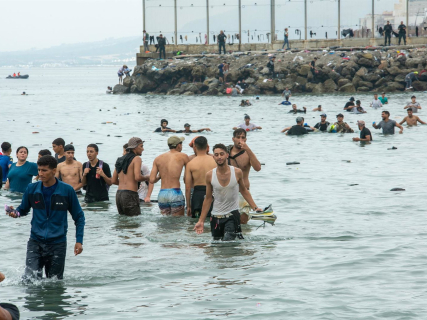

More than 48,000 people have already returned to Morocco after the massive entry recorded in Ceuta during the last hours, according to the latest data from the Ministry of the Interior. The return operation occurs after about 50,000 people, according to the Government, entered the autonomous city irregularly, a figure that the Ceuta authorities raise to 60,000. The crisis has already left 57 deceased and has become the largest migratory emergency experienced by Spain since 2021.
While returns continue through the Tarajal pier, attention is now focused on what caused a migratory movement of such magnitude in such a short time.
Social networks, trigger of the mobilization
The testimonies collected from those who remain in Ceuta point to a common origin. Many claim that they decided to cross after receiving messages and videos spread through social networks stating that the border was open and that it was possible to enter Spain "without restrictions".
Various Moroccan media maintain that hundreds of young people began to gather in the surroundings of Castillejos after these calls went viral. During the night, Moroccan security forces intervened to disperse part of the gathered crowd using tear gas and water cannons.
The dissemination of these messages also coincided with a misinterpretation of the recent ruling by the Spanish Supreme Court regarding the returns of people intercepted at sea, which was presented on social networks as if it prevented any immediate return.
Moroccan press points to political interests
The origin of the crisis also divides Moroccan media.
While some newspapers believe that the massive arrival cannot be explained solely by a spontaneous mobilization of young people, others argue that the crisis responds to a strategy to damage Morocco's image during the celebrations of the 27th anniversary of the enthronement of Mohamed VI.
Some editorials even speak of a "prefabricated narrative" to contrast the official images of the national festivity with those of thousands of people trying to reach Ceuta.
Other media close to the Moroccan Government insist again on the historical claim of Ceuta and Melilla, labeling them as "occupied enclaves" and questioning their belonging to Spain.