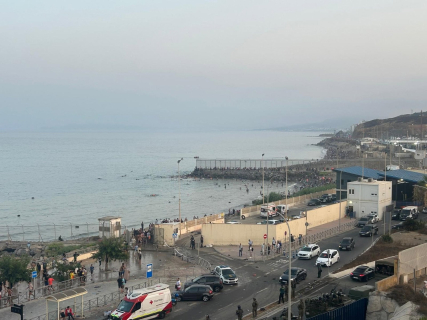
Morocco closes the border of Beni Enzar with Melilla after an attempt to enter

The Government Delegation asks the citizens not to approach the border perimeter while the security forces intervene in the area.

1 minute

fotonoticia 20260730215132 1920

fotonoticia 20260730215132 1920

Add DEMÓCRATA to Google

Ask FREN

Published

Last updated

1 minute

Most read

The border of Beni Enzar, the only one that remains operational between Spain and Morocco in Melilla, has been closed this Thursday, according to the Government Delegation in the autonomous city.

The authorities have asked the population to avoid traveling to the border perimeter so as not to hinder the work of the Security Forces deployed in the area.

Attempt to enter at the border

According to what EFE has been able to verify in the vicinity, the closure would have occurred after a running attempt to enter from Moroccan territory.

During the operation, shots have been heard in the border area, although at the moment the origin has not been specified nor has there been any report of possible injuries.

Intervention of the security forces

Spanish police forces are transferring several groups of people from the vicinity of the border, while the security device continues.

The situation in Melilla occurs in parallel to the migratory crisis that Ceuta is experiencing, where massive entries from Morocco have been recorded during the day.

More key points, information and questions with FREN

AI-GENERATED CONTENT

What legal requirements regulate the closure of land borders between Spain and Morocco?

The total or partial closure of land crossings between Spain and Morocco in Ceuta and Melilla is based on a combination of immigration regulations, national security and states of emergency laws, plus Schengen regulations and bilateral commitments. In practice, the most direct operational legal basis is the Regulation of the Organic Immigration Law, which empowers the Ministry of the Interior (delegated to the Secretary of State for Security) to temporarily close border posts for security reasons. This is supplemented by enabling frameworks such as the National Security Law and the Organic Law on states of alarm, exception, and siege, which allow restricting movement, and a specific regime for Ceuta and Melilla regarding border control. All of this must be applied respecting international human rights law, the right to asylum, and obligations derived from Schengen.

1. Immediate basis for the closure of the Ceuta and Melilla crossings

The key piece is the Resolution of December 13, 2022, from the Secretary of State for Security, which agrees to maintain the partial closure of the land posts of Ceuta and Melilla, allowing passage only through El Tarajal and Beni Enzar to limited categories of people (travelers who meet Schengen requirements and certain cross-border workers). This resolution explicitly states that it is based on:

  • Article 3.1 of the Regulation of Organic Law 4/2000, approved by Royal Decree 557/2011, which foresees the possibility of agreeing to the temporary closure of authorized border posts “in cases where it is required by the security of the State or citizens.”
  • Twentieth additional provision of the same Regulation, which decentralizes the closure competence in favor of the holder of the Secretary of State for Security.

The BOE resolution can be consulted in the Resolution of December 13, 2022. It justifies maintaining the partial closure for reasons of public order, security, elimination of “atypical trade,” and the need for moderate flows while facilities are modernized and the small border traffic regime is updated.

2. State immigration regulations and special regime of Ceuta and Melilla

The Organic Law 4/2000, on the rights and freedoms of foreigners, which regulates visas, entries and exits, and the requirements to cross the Spanish border, is based on this regulation. It can be consulted in the BOE (Organic Law 4/2000), although in the available excerpts there is no specific provision on “border closure,” but rather the regulatory authorization used as a basis in 2022.

Additionally, the Organic Law 4/2015, on the protection of citizen security introduces, via the tenth additional provision added to LO 4/2000, a “special regime for Ceuta and Melilla” that allows the rejection at the border of foreigners detected while trying to overcome containment elements, provided that human rights and access to asylum are respected. The text of this provision is included in Organic Law 4/2015 itself (Organic Law 4/2015) and has been subject to constitutional review, upheld with conforming interpretation in rulings such as STC 172/2020 and STC 13/2021.

3. National Security and crisis management

On a more structural level, Law 36/2015, on National Security (Law 36/2015) regulates the “situation of interest for national security.” Its articles on crisis management establish that:

  • The “situation of interest” is declared by royal decree of the President of the Government, setting geographic scope, duration, possible extension, functional authority, and involved resources.
  • Actions are always taken with ordinary powers of the Administrations, without suspension of fundamental rights, but with enhanced coordination.

This law does not directly mention border closures but serves as a political-legal umbrella for decisions on reinforced control or passage restrictions when a risk (migratory, health, terrorist) is classified as national security, always through sectoral instruments (immigration, health, public order, etc.).

4. States of alarm, exception, and siege

The Organic Law 4/1981, on states of alarm, exception, and siege (Organic Law 4/1981), allows, during the state of alarm, measures such as:

  • Limiting the movement or presence of people or vehicles at certain times and places, or conditioning them on compliance with requirements (articles on the measures of the alarm decree).

In practice, during the COVID‑19 pandemic, these authorizations were used for broad movement and international travel restrictions, coordinated with the EU Council recommendations on travel to the Union, which the 2022 resolution explicitly cites.

5. Schengen, small border traffic, and agreements with Morocco

The European framework comes from the Schengen Agreement and its implementing Convention, which Spain joined through the “Instrument of ratification of the Accession Agreement of the Kingdom of Spain” (Schengen accession). The Final Act includes a Declaration relating to Ceuta and Melilla recognizing a specific small border traffic regime and visa exemption for residents of Tetouan and Nador.

The 2022 resolution explains that the partial closure and limitation of categories of people who can pass temporarily prevent applying that visa exemption, linking its lifting to the approval of a new small border traffic regime and the full normalization agreed in the Spain-Morocco Joint Declaration of April 7, 2022.

6. Guarantees and limits

From this set, several key guarantees emerge:

  • Closure or restriction measures must be based on enabling norms (Immigration Regulation, states of emergency, etc.) and adopted by the competent authority (Government, Minister of the Interior, or Secretary of State for Security, as appropriate).
  • They must be temporary, proportional, and necessary, both according to LO 4/1981 and the principles of the National Security Law.
  • Rejection at the border and restrictions must always respect international protection and human rights, as required by the tenth additional provision of LO 4/2000 as amended by LO 4/2015.

In summary, the closure of the Spain–Morocco land crossings does not respond to a single “border closure article,” but to a framework in which immigration regulations (and their regulation) provide the operational key to closing posts, supported by national security regimes, states of emergency, and Schengen obligations that condition how and to what extent these restrictions can be adopted.

In which specific articles of the Immigration Regulation is the procedure for agreeing the temporary closure of a border post detailed? What role has the Spain-Morocco Joint Declaration of April 7, 2022 played in the gradual reopening of El Tarajal and Beni Enzar? How has the Constitutional Court interpreted the rejection at the border regime in Ceuta and Melilla provided for in Organic Law 4/2015?

What are the competences of the Government Delegation in Melilla regarding border control?

The Government Delegation in Melilla is the body that represents the Government of Spain in the city and, regarding border control, exercises the leadership and territorial coordination of the State Security Forces and Corps and state services at the border. It does not physically control the fence, port, or airport (this corresponds to the National Police, Civil Guard, and other services), but it directs and coordinates their actions within Melilla under the functional dependence of the Ministry of the Interior. Additionally, it has sanctioning powers in citizen security and a key role in organizing immigration and other border control services. All of this is framed within a regulatory framework combining public sector legal regime legislation, citizen security, immigration, and the organic regulations of the Police and Civil Guard.

1. Basic legal framework of the Government Delegation

Law 40/2015, on the Legal Regime of the Public Sector, regulates the peripheral State Administration and establishes that Government Delegates are those who direct and supervise the General State Administration in each territory and represent the Government of the Nation. In the section related to Delegations and Subdelegations, it provides that:

  • Government Delegates must protect the free exercise of rights and freedoms and guarantee citizen security, and for this purpose exercise the leadership of the State Security Forces and Corps in their scope, “under the functional dependence of the Ministry of the Interior” (competence article transcribed in the consultation to Law 40/2015).
  • They direct and coordinate the integrated territorial services in the Delegation (for example, Foreigners Offices, external health, or labor and immigration, when integrated), according to the technical instructions of the competent ministries.
  • They exercise sanctioning power and any others conferred by the rules or delegated or decentralized to them.

In the specific case of Melilla, this figure is the Government Delegate in the Autonomous City, equated to Delegates in autonomous communities.

2. Citizen security and special regime of Ceuta and Melilla

Organic Law 4/2015, on the protection of citizen security, expressly identifies “the Government Delegates in the autonomous communities and in the Cities of Ceuta and Melilla” as competent authorities in citizen security within the scope of the General State Administration (article consulted in LO 4/2015). This same law attributes to Government Delegates the competence to sanction serious and minor infractions in citizen security matters.

Additionally, the same norm adds to Organic Law 4/2000 a tenth additional provision on the “Special regime of Ceuta and Melilla”, which regulates the “rejection at the border” of foreigners detected when trying to overcome border containment elements to enter irregularly. Although this provision defines the legal regime, its material execution falls on the National Police and Civil Guard, under the authority of the Ministry of the Interior and territorially within the coordination framework of the Government Delegate in Melilla. The Constitutional Court has interpreted this provision requiring respect for fundamental rights and judicial control (according to the rulings referred to in LO 4/2015).

3. Immigration and state services at the border

Royal Decree 942/2010 reorganizes the functional areas integrated into the Government Delegations, particularly those of Labor and Immigration and Health and Social Policy, and specifies that the Foreigners Offices “will depend organically on the corresponding Government Delegation or Subdelegation” and functionally on the Ministry competent in immigration and the Ministry of the Interior (text taken from the consultation to RD 942/2010). In Melilla, this translates into:

  • Competence of the Delegation to organize and supervise the Foreigners Office and integrated immigration services.
  • Coordination with Interior and the ministry competent in migrations in processing residence files, authorizations, etc., closely linked to the management of border flows.

Alongside this, other sectoral regulations govern specific border controls (health, veterinary, pharmaceutical, etc.) which, when territorially integrated, are coordinated from the Delegation, although functionally dependent on Health or Agriculture. A recent example delimiting these controls is Order PJC/756/2024, which organizes the “official control services at the border” of Agriculture and Health (applicable to crossings such as port or airport).

4. Distribution with National Police, Civil Guard, Autonomous City, and EU

Regarding the operational execution of border control:

  • National Police: Order INT/859/2023 details the structure of the General Directorate of Police, which includes the General Immigration and Borders Commissariat, immigration units, border posts, and the National Immigration and Borders Center, to which a “Coordination Brigade for the FRONTEX Agency” is attached. The Government Delegation in Melilla does not technically command these units but coordinates territorially their deployment and priorities within the city.
  • Civil Guard: Order PRE/422/2013 assigns to the Fiscal and Borders Headquarters the “custody and surveillance of coasts, borders, ports, airports, and territorial sea and, in this scope, control of irregular immigration,” on which the Ceuta and Melilla Commands depend. Again, the Delegation does not technically direct these units but exercises the territorial leadership of the State Security Forces and Corps in Melilla in coordination with Interior (according to Law 40/2015).
  • Autonomous City of Melilla: Its security competences are limited to local police and urban planning; the management of the State’s external border (fence, port, airport, authorized posts) corresponds to the State through the Ministry of the Interior and the Government Delegation.
  • Frontex and other EU bodies: The main operational relationship is articulated through the Ministry of the Interior and, technically, the National Police and Civil Guard (for example, through the Coordination Brigade for FRONTEX provided in Order INT/859/2023). The Government Delegation in Melilla participates by facilitating deployment and coordination in the territory when there are European operations in the area.

In summary, the Government Delegation in Melilla is the piece of political direction and territorial coordination of border control, while Interior, National Police, Civil Guard, and specialized services (health, customs, immigration) assume the technical and operational execution according to the division of functions established in the cited regulations.

What specific role does the Melilla Foreigners Office play in managing irregular entries and asylum requests at the border? How do the Government Delegation, National Police, Civil Guard, and the Autonomous City of Melilla coordinate in practice in the event of a sudden migratory crisis? What limits has the Constitutional Court set on the special rejection regime at the border in Melilla and how do they affect daily operations at the fence?

How many similar entry attempts have occurred at the Beni Enzar border in recent years?

With the information available from official sources and the consulted political press, it is not possible to provide a specific figure or an annual series of how many irregular entry attempts, fence jumps, or mass assaults have occurred specifically at the Beni Enzar border crossing in recent years. The Ministry of the Interior publishes aggregated data on irregular entries and infrastructure investments but does not statistically break down attempts by specific crossing. Party and media reports mention “massive assaults” and migratory pressure at the Melilla border but without systematic numbering of episodes at Beni Enzar. Consequently, it is only possible to describe the context and evolution of the border, not a precise count of attempts.

Absence of disaggregated statistics by Beni Enzar

In the Ministry of the Interior notes and located parliamentary documentation, there is no statistical series of the type “number of entry attempts at Beni Enzar per year.” Official figures are usually given at another aggregation level:

  • Spain as a whole: data on irregular arrivals, entry denials, expulsions, and returns.
  • Ceuta/Melilla scope: global mentions of migratory pressure, investments in border perimeters, or police forces.
  • Typology: more by mode of access (sea, land) than by specific gate or episode.

An example is the Government response collected by the newspaper Demócrata on returns and expulsions since 2018, citing 54,530 entry denials and nearly 24,000 expulsions nationwide, but without breakdown by each border post. Likewise, in debates about Ceuta, Interior speaks of 926 irregular entries in the first 45 days of a year, reinforcements of agents, and more than 35 million invested in the perimeter, but does not go into the level of detail of Beni Enzar.

The opposition itself acknowledges this lack of granularity: in a Popular Party motion on a Comprehensive Security Plan for Ceuta and Melilla, massive assaults (Ceuta 2021, Melilla 2022) and the unilateral closure of Beni Enzar by Morocco are mentioned, but again without a numerical chart of annual attempts at that specific crossing, as can be seen in the PP motion.

What we do know about Beni Enzar

Sources do provide relevant information about the role and evolution of the Beni Enzar crossing, although not about the exact number of assaults:

  • In February 2025, Interior presented the “smart border” in Melilla. Minister Fernando Grande-Marlaska visited the new Beni Enzar facilities, modernized with an investment close to 11 million euros, aimed at implementing the European Entry/Exit System (EES) and reinforcing technological control, according to the Moncloa note and the Interior note.
  • Demócrata reports that since the reopening of the crossing in 2022 after the prior closure by Morocco, long daily queues for pedestrians and vehicles occur at Beni Enzar. The Muslim Community of Melilla conveyed to Marlaska that the “main current problem remains the lack of fluidity in transit,” in a letter cited in the news about Beni Enzar.
  • The economic context has also been affected: an El País report recalls that in 2018 Rabat unilaterally closed the commercial border between Beni Enzar and Melilla, affecting about 15,000 people who lived from goods traffic between both shores, including thousands of porters, according to the El País report.

All this shows that Beni Enzar is a key point both for regular transit and for managing possible irregular attempts, but sources focus on investments, queues, and economic impact, not on quantified series of assaults on the fence.

Migratory pressure and political debate

Politically, Melilla and Ceuta are frequently mentioned as focal points of migratory pressure. The Popular Group has denounced episodes of “blows” to Melilla’s southern border and demands more human and material resources; in a proposed reform of the Immigration Law, promoted from Melilla, it defends extending “rejections at the border” also to sea entries, arguing that “currently irregular entries to Ceuta and Melilla do not only occur by jumping the fence,” as Demócrata reports in the PP proposal.

At the same time, Interior emphasizes in its communications the reinforcement of resources and cooperation with Morocco, both in modernizing crossings like Beni Enzar and in operations like the Operation Paso del Estrecho, which mobilizes tens of thousands of agents and pays “special attention to transit fluidity” in Ceuta and Melilla, according to the note on the OPE 2024.

In summary: sources describe an increase in complexity at the southern border (more route diversity, combination of fence and sea entries, and occasional mass episodes), but do not currently offer a list of “entry attempts” specifically broken down for Beni Enzar by year. No further information is available in the consulted sources to precisely quantify how many assaults or collective attempts that post has suffered in recent years.

What is specifically known about the mass assault of June 2022 at the Melilla border and its official toll of victims and entries? What exactly does the PP’s bill proposal to change the Immigration Law regarding Ceuta and Melilla contain? How has cooperation with Morocco on border matters evolved from the commercial closure of Beni Enzar in 2018 to today?

Play

Test your knowledge with FREN!

How much do you know about this topic? Answer the following 3 questions.

What is the only operational border between Spain and Morocco in Melilla?

Question 1 of 3

What have the authorities asked the population to do after the closure of the Beni Enzar border?

Question 2 of 3

Which other Spanish enclave is mentioned as affected by a migration crisis parallel to that of Melilla?

Question 3 of 3

Hola, soy Fren. ¿Cómo te ayudo?