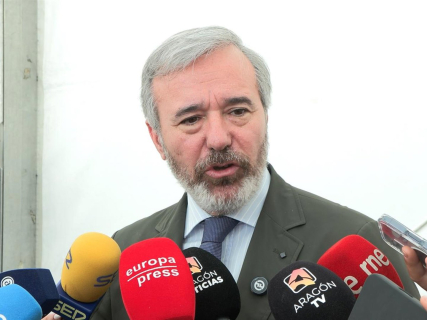

In Aragón, there is also a teachers' strike. Public education in this Community is immersed in two days of strike (Tuesday 19 and Wednesday 20) amid an escalation of the conflict opened by the Government of Aragón's decision to contract Baccalaureate units in private centers.
The protest, which has included mobilizations before the Department of Education in Zaragoza, occurs after weeks of growing political, union, and judicial tension surrounding a measure that the regional Executive defends as an expansion of families' freedom of choice and that teachers consider a direct blow to public education.
The conflict has not remained solely in the classrooms. Last week, the tension even moved to the Plenary Session of the Courts of Aragón, where several attendees in the stands staged a protest by throwing symbolic banknotes during the parliamentary debate on the measure, an image that showed the extent to which the clash has escalated politically.
Beyond the partisan confrontation, the strike has raised doubts among families, students, and teachers about the real scope of the conflict. These are the keys to understanding what is happening.
Featured story
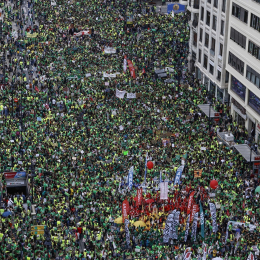
Teachers' strike: the stoppages extend this Monday through several communities
2 minutes
Who is calling the strike?
The call comes from a large part of the union front of Aragonese public education. Among the conveners are CGT Enseñanza Aragón, STEA-i, CCOO Enseñanza Aragón, UGT Servicios Públicos, and CSIF Aragón, who have closed ranks against the regional Executive's decision.
The union organizations maintain that the measure represents a political commitment to reinforce the subsidized network to the detriment of the public one and denounce that it is adopted in a context of demographic decline, which, in their opinion, makes it even less justifiable to divert resources towards new subsidized units.
What exactly has the Government of Aragón done?
The core of the conflict lies in the decision of Jorge Azcón's Government to contract places for 1st year of Baccalaureate in subsidized private centers, a step with a strong political charge because until now this stage was not generally included within the system of educational subsidies in Aragón.
The regional Executive has defended that the measure responds to its commitment to educational freedom of choice and the possibility of expanding options for families. The Department of Education has insisted that this is not an attack on public schools, but a reorganization of the system within the legal framework.
Why are teachers protesting?
The educational community maintains the exact opposite. Unions consider that contracting high school diverts public money to private centers while public schools face structural problems such as unit adjustments, loss of students due to demographic decline, and needs for reinforcement in staff and resources.
Furthermore, they interpret the measure as a change in the educational model promoted by the current regional government, with a greater commitment to subsidized private education versus the traditional weight of the public network.
Is there a legal battle?
Yes. The conflict has already reached the courts. The contracting of high school has been judicially appealed, which adds a legal dimension to a dispute that until a few weeks ago moved mainly in the political and union arena. This means that, in addition to pressure in the streets and in schools, the future of the measure may also depend on what judicial bodies determine about its legal fit.
What does the Government of Aragon say?
Azcón's Executive maintains its firm defense of the decision. Its main argument is that expanding educational contracts does not mean cutting rights in public education, but offering more alternatives to Aragonese families. This discourse clashes head-on with that of the mobilized educational community, which interprets the decision as an ideological and budgetary transfer towards subsidized private education.
What can happen now?
The end of the strike does not necessarily mean the end of the conflict. If there are no changes by the regional government, the scenario points to new mobilizations, political pressure, and the continuation of the judicial route. What began as an educational discussion about the high school model has now become one of the main open political fronts for the Government of Aragon.