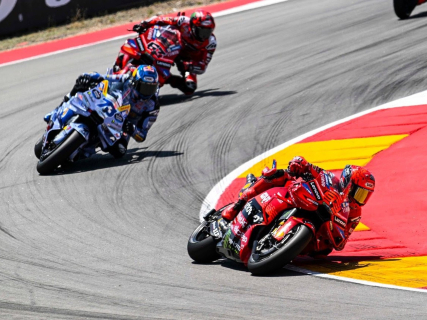
Marc Márquez wins in Malaysia and already has a date to conquer his tenth World Championship: Qatar will be his first opportunity

The Ducati rider extends his lead over the injured Jorge Martín to 44 points. Pedro Acosta and Álex Márquez complete a Spanish podium in Sepang that brings the leader closer to retaining the title

fotonoticia 20260910102457 1920

fotonoticia 20260910102457 1920

Add DEMÓCRATA to Google

Ask FREN

Published

Last updated

3 minutes

Most read

Elecciones 29N · Encuestas

La media de las encuestas

Media a 27 de octubre de 2026 · 15 institutos

  • PP31,0 %
  • PSOE27,3 %
  • Vox18,9 %
  • Frente Amplio6,3 %
  • Podemos2,9 %
  • ERC2,3 %
010203040ene 2024jul 2024ene 2025jul 2025ene 2026jul 2026

Media del último estudio de cada instituto en 30 días y su evolución semanal desde el 23J. Partidos con al menos un 2 %.

Todas las encuestas

Elecciones generales del 29 de noviembre · Demócrata

Marc Márquez leaves the Malaysian Grand Prix with a victory and an opportunity that changes the final stretch of the championship: he will be able to be crowned world champion in Qatar next Sunday, November 8. The Spaniard has won at Sepang ahead of Pedro Acosta and Álex Márquez and raises his tally to 399 points, with a 44-point lead over Jorge Martín, out due to injury.

The triumph does not yet resolve the World Championship, but it places the Ducati rider before his first mathematical chance to defend the crown. If he succeeds, he would reach his tenth world title across all categories and his eighth in MotoGP.

Márquez turns Martín's absence into a 44-point advantage

Sepang offered a particularly important opportunity for the leader. Jorge Martín could not compete and Márquez needed to turn that absence into points, avoiding a mistake that would keep the battle open under more favorable conditions for his pursuers.

The balance of the weekend has been 34 points: nine for the second position in Saturday's sprint and 25 for Sunday's victory. Márquez arrived in Malaysia with a ten-point margin over Martín and leaves with 44.

In the long race he took the lead from the first corner and managed to pull away from his rivals. The victory allows him to face the last three rounds with an advantage greater than the 37 points that a full weekend can award.

That does not make him champion yet, but it does give him an important margin: even a perfect weekend for Martín in Qatar would not be enough to recover the lead if Márquez does not score points.

Pedro Acosta and Álex Márquez complete the Spanish podium

Pedro Acosta finished second after winning Saturday's sprint. The KTM rider returns to the forefront of the grand prix and joins the Márquez brothers on an all-Spanish podium.

Álex Márquez, who had taken pole, finished the race in third position. The result is a response to what happened on Saturday, when he crashed while leading the short race.

For Marc, the fundamental difference is in the overall standings. Marco Bezzecchi, another of his championship rivals, finished sixth and is 67 points behind the leader.

How the MotoGP World Championship stands after Malaysia

The top three in the championship leave Sepang with this situation:

  • Marc Márquez: 399 points.
  • Jorge Martín: 355 points, 44 behind the leader.
  • Marco Bezzecchi: 332 points, 67 behind.

There are three grands prix left and their respective sprints. With 25 points for the winner of each Sunday race and 12 for the winner of each sprint, there are still a maximum of 111 points at stake.

Márquez’s lead is, therefore, considerable, but he still needs results. Martín retains mathematical options and Bezzecchi is not eliminated either.

What Márquez needs to be champion in Qatar

The first opportunity will come in Lusail, where the Qatar Grand Prix is scheduled from November 6 to 8. After that event, two weekends will remain, equivalent to a maximum of 74 points.

One sufficient route to secure the title, without depending on tiebreakers, would be to leave Qatar with more than 74 points over all his rivals.

For example, if Márquez wins the sprint and the race, he will add 37 points and reach 436. If Martín gets six points or less during that weekend, the difference between the two will be at least 75. Bezzecchi, even adding the 29 points corresponding to two second-place finishes, would be at that same distance.

It is a mathematical scenario, not a prediction: it shows why winning in Qatar may not be enough on its own and why the results of his pursuers will also matter.

Jorge Martín’s recovery will mark the next event

Martín’s physical condition will be another of the keys. His absence in Malaysia has allowed Márquez to widen the gap without a response from the Aprilia rider, who arrived at the weekend hampered by the wrist injury suffered in Australia.

The possibility of returning and competing in Qatar will determine in what conditions he can defend his chances. For Márquez, the objective already has a near date: November 8 could become the day of his tenth world crown.

More key points, information and questions with FREN

AI-GENERATED CONTENT

What is the procedure to officially proclaim a MotoGP world champion and what formalities must the organization complete after the decisive race?

The official proclamation of a MotoGP world champion is a sporting and organizational procedure specific to the International Motorcycling Federation (FIM), Dorna, and the championship structures. That scope — specific sporting regulations of the MotoGP World Championship, internal FIM protocols, technical verification details, and ceremonial procedures after the race — is outside my specialty. I am specifically designed to work with Spanish politics and institutions, not with the detailed regulations of international sporting competitions, so I cannot rigorously explain each formal phase the organization follows after the decisive race.

That said, some logical elements that usually exist in many international competitions can be outlined at a very general level, without going into the specifics of MotoGP nor intending to replace the official regulations:

  • Sporting and technical verification: in practically all championships, before proclaiming a title, the results of the decisive race are reviewed, it is checked that there are no pending penalties, and it is verified that the motorcycles and riders comply with technical and sporting rules. Until this phase concludes, the result is provisional.
  • Regulatory confirmation of the title: once the race result is validated and the season points system is applied, it is officially confirmed that no other rider can surpass the leader in the standings, not even in the remaining races, and it is certified that all championship regulatory requirements have been met.
  • Public proclamation event: normally includes the race podium ceremony, official communications on track (panels, announcements via loudspeakers), and subsequently, press releases, updates to the official website and championship platforms announcing the new world champion.
  • Subsequent administrative procedures: it is also common that, after the proclamation, all championship statistical records are updated, image elements are prepared (number 1, champion logos, etc.), media and sponsorship commitments are coordinated, and the final season awards ceremonies are scheduled.

However, all these steps, in the specific case of MotoGP, have precise regulation in their sporting, technical, and disciplinary regulations, which I cannot consult or cite directly: my access is oriented to legal norms, parliamentary initiatives, session diaries, votes, government and institutional agreements, as well as press and documentation on the public and political sphere, but not to the wording of private regulations of an international sports federation.

My main function is to help you with issues such as:

  • Legal and regulatory framework of sport in Spain: for example, the Sports Law, the competencies of the Higher Sports Council (CSD), the requirements for declaring an event of exceptional public interest, or the legal regime of Spanish sports federations.
  • Relationship between sport and public policies: how sports betting, television rights, security at sporting events, the fight against violence, racism and xenophobia in sport, or public programs promoting grassroots sport are regulated.
  • Institutions and political decisions related to Grand Prix events in Spain: for example, which administrations participate in the financing and organization of a Grand Prix in Spanish territory (State, autonomous community, provincial councils, city councils), what agreements are adopted and how they are reflected in official bulletins and records.
  • Processing of norms and agreements affecting motor sport: parliamentary initiatives on road safety linked to motorcycles, economic incentives to the automobile and motorcycle industry, or environmental regulation impacting circuits and competitions.

I can also help you understand how professional sport fits within Spanish labor and tax regulations, or how collaboration agreements between public administrations and private organizers of sporting competitions held in Spain, such as motorcycle Grand Prix events, are regulated.

If what interests you is the detailed internal procedure of MotoGP to proclaim the world champion — deadlines, forms, competent bodies within the FIM, rules on claims and appeals, effects on the official record, etc. — the most reliable source is to go directly to the official regulations of the FIM and MotoGP, which are usually available on their official websites and updated each season. There you will find, binding for participants, the exact description of all steps and possible incidents after the decisive race.

If you want, I can help you connect those sporting aspects with the Spanish institutional framework: for example, what role administrations play when hosting a Grand Prix, what Spanish regulations apply to event organization, or how public aid to sports infrastructure such as circuits is managed.

What competencies does the Higher Sports Council have in regulating sports federations in Spain? How are motorcycle Grand Prix events held at Spanish circuits financed and regulated from an institutional point of view? What Spanish regulations govern safety and risk prevention at major sporting events such as a MotoGP Grand Prix?

What are the main functions and competencies of the race director in MotoGP according to the current regulations?

I cannot precisely detail the functions and competencies of the race director in MotoGP according to the current regulations because my scope is specialized in Spanish politics and institutions (Congress, Senate, governments, regional parliaments, public regulations, political actors, elections, etc.), not in international sports regulations nor the technical organization of competitions like the MotoGP World Championship.

In other words, I do not have specific access nor specialized databases on the sporting regulations of the FIM, Dorna, or other bodies regulating MotoGP, nor on successive versions of their sporting or technical regulations. Although I could generally explain what a figure called “race director” usually does in many motorsports (supervision of the start, flag control, incident management, decisions on suspending or resuming the race, imposing certain penalties, etc.), that would necessarily be generic and would not meet your requirement to adhere to the “current regulations” nor guarantee that the description matches point by point the current MotoGP regulations. It would be, in practice, a speculative approximation, and the instructions I follow ask me to avoid that type of response when dealing with areas outside my specialty.

What I can do is guide you on how to find the information you seek with the highest possible reliability:

  • Consult the official MotoGP sporting regulations: Usually, the International Motorcycling Federation (FIM) publishes on its website the sporting and technical regulations applicable to each season. Within those regulations, there is usually a specific section about the race authorities (Race Director, Stewards Panel, Clerk of the Course, etc.) where their functions, competencies, hierarchy, and decision-making capacity in different situations (red flag, weather condition changes, false starts, penalties, etc.) are listed.
  • Search in the documents section of Dorna or MotoGP: The championship organization (through Dorna and the MotoGP website) usually includes regulations, guides, or FAQs. Although many times these documents are more intended for teams and riders than for the general public, that is where the race director’s competencies will be officially formulated.
  • Check historical versions and update notes: If you are specifically interested in the “current regulations” and not those from previous years, it is advisable to look at the publication or effective date of the document, as well as annexes or circulars that may modify certain articles mid-season or between seasons. The race director’s functions may have been adjusted over time, for example, with the introduction of stewards panels, new control technologies, or reinforced safety protocols.
  • Cross-check with specialized secondary sources: Media and motor analysts who cover MotoGP in depth often publish explanatory articles about how decisions are made during a race, who decides what, and what role the race director has compared to the stewards panel or championship management. Although they do not replace the regulations, they can help interpret practical functioning.

I understand you seek a structured answer, with a clear list of functions and competencies. However, as my training and the tools I have access to are focused on the Spanish institutional and political ecosystem, I cannot guarantee that a detailed enumeration about MotoGP is accurate, updated, and faithful to the regulatory text, which is exactly what you are asking for (and, moreover, limited to the “current regulations,” i.e., with a very specific temporal reference).

On the other hand, if at any time you are interested in issues related to:

  • The regulation of sport in Spain (for example, the Sports Law, the competencies of the Higher Sports Council, or the legal-public organization of Spanish sports federations).
  • How sporting events are financed or regulated from the public administration perspective (sponsorships, aid, economic impact, safety regulation, etc.).
  • The role of Spanish institutions in organizing Grand Prix events held at Spanish circuits (regulatory framework, agreements with autonomous communities or city councils, involvement of public companies, etc.).

Then I could help you in detail, because all that is part of my field of specialization.

In summary: to reliably know the main functions and competencies of the race director in MotoGP according to the current regulations, the most advisable is to go directly to the official sporting regulations published by the FIM or the MotoGP organization, and use, if applicable, analyses from specialized media only as interpretative support. I, as an assistant focused on Spanish politics and institutions, cannot replace that primary source in such a specific and external domain.

What results did Marc Márquez achieve in his first seasons in the World Championship and with which teams has he competed throughout his career?

I cannot provide you with the specific sporting data you request about Marc Márquez — that is, his detailed results in his first seasons in the World Championship nor the exact list of teams he has competed with throughout his career — because I am exclusively specialized in Spanish politics and institutions and do not access, in this mode, sports databases or competition histories of motorcycle racing riders.

My design is oriented to work with information from the public, political, and institutional sphere in Spain: laws, decrees, and norms; parliamentary processing; government and administration activity; political actors (parties, public officials, senior civil servants); and the media and social treatment of these topics. Everything outside of that — such as sports statistics, championship results, team rosters, race calendars, or detailed palmarès — is beyond what I can rigorously document.

That said, I can guide you on how to find the sporting information you seek reliably on your own. In the case of Marc Márquez, the most precise and updated data about his World Championship results (both in lower categories and in MotoGP) and the teams he has competed with are usually found in:

  • Official MotoGP and FIM websites, where season classifications, race-by-race results, and historical statistics by rider are compiled.
  • Official websites of the teams he has raced for (for example, those of the MotoGP structures and the previous categories in which he participated), which usually include biographies, seasons contested, and main achievements.
  • Motorcycling specialized portals, which often maintain databases with the historical results, podiums, wins, poles, and team changes throughout the rider’s career.
  • Wikipedia and open databases, which can serve as a first approach, although it is always advisable to cross-check them with the official sources mentioned above.

Where I can be useful is at the intersection between sport and politics or public institutions. For example, I could help you with:

  • Explaining how sports federations, professional leagues, or the relationship between the Higher Sports Council and motorcycle federations are regulated in Spain.
  • Analyzing the impact of a new law or decree on sports sponsorship, taxation of elite athletes, road safety, or circuit infrastructure, if it were being processed or already published.
  • Reviewing how the Congress of Deputies or the Senate have addressed issues related to motorcycling, whether in non-legislative motions, parliamentary questions, or hearings.
  • Seeing what certain political parties or leaders have said about motor sport, its financing, tourism promotion, or its relationship with the Spanish automotive industry.

I can also help you understand broader frameworks clearly within my scope, such as:

  • How sports sponsorship contracts work when public or regulated companies are involved, and what transparency or public procurement regulations apply.
  • What public policies exist in Spain for supporting high-performance sport, ADO scholarships, or similar programs.
  • How international sporting events held in Spanish territory are regulated (fees, security, public space concessions, estimated economic impact, etc.).

In summary, I cannot give you the finely detailed sporting chronology of Marc Márquez’s career — his results by season nor the exhaustive list of teams — but I can help you with everything related to the public, political, regulatory, or institutional dimension of sport in Spain. If you reformulate your question towards any of those angles (for example, sports policy linked to motorcycling, the role of institutions in Grand Prix events organized in Spain, or the regulation of image rights and sponsorship of athletes), I can go into much more detail with verified data.

Play

Test your knowledge with FREN!

How much do you know about this topic? Answer the following 3 questions.

How many points ahead is Marc Márquez over Jorge Martín after the Malaysian Grand Prix?

Question 1 of 3

How many maximum points remain at stake in the season after the Malaysian Grand Prix?

Question 2 of 3

Who accompanied Marc Márquez on the podium of the Malaysian Grand Prix?

Question 3 of 3