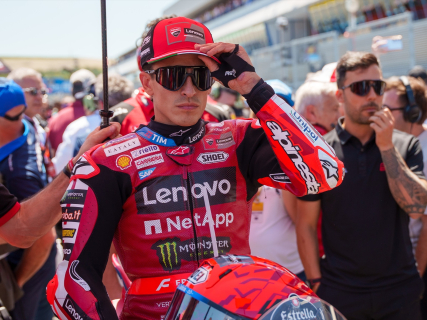
MotoGP runs in Qatar this Sunday: why safety forced the date to be changed

The MotoGP Qatar GP takes place this Sunday, November 8 at 17:00, Spanish peninsular time, after abandoning its scheduled date in April due to the geopolitical situation in the Middle East. The safety of riders, teams, and attendees explains a move that also modified the end of the championship

EuropaPress 7474124 piloto espanol motos marc marquez parrilla salida moto gp gran premio

EuropaPress 7474124 piloto espanol motos marc marquez parrilla salida moto gp gran premio

Add DEMÓCRATA to Google

Ask FREN

Published

Last updated

1 minute

Most read

Elecciones 29N · Encuestas

La media de las encuestas

Media a 7 de noviembre de 2026 · 11 institutos

  • PP31,0 %
  • PSOE26,2 %
  • Vox19,5 %
  • Frente Amplio6,6 %
  • ERC2,4 %
  • SALF2,2 %
  • Podemos2,1 %
01020304050ene 2024jul 2024ene 2025jul 2025ene 2026jul 2026

Media del último estudio de cada instituto en 30 días y su evolución semanal desde el 23J. Partidos con al menos un 2 %.

Todas las encuestas

Elecciones generales del 29 de noviembre · Demócrata

Catar returns to the calendar in November. The night-time test in Lusail arrives with sporting interest, but also with a question that accompanies its celebration: what has changed since the organization decided to postpone it.

MotoGP justified the move due to the situation in the region and said that the decision was made with the FIM, the promoter and the Qatari authorities. The stated priority was to protect those who take part and attend the event.

A decision that affected other races

Repositioning Qatar forced the calendar to be adjusted. Portugal moved to 22 November and Valencia to 29, according to the official announcement.

The change shows how a regional crisis can alter events organized months in advance. The problem is not limited to activity on the track: it also affects travel, staff and movement between countries.

What was reviewed before keeping the test

Reuters reported on 1 November on meetings with the teams and on guarantees examined by the organization, coming from authorities, embassies and experts.

The agency also collected concerns about evacuation and insurance, as well as Yamaha’s withdrawal due to the company’s travel restrictions. MotoGP defended keeping the test and continuing to monitor the situation.

Holding the grand prix does not mean asserting that any risk has disappeared. The decision expresses an organizational assessment, which can be revisited if circumstances change.

What time are Sunday’s races

GP de Qatar · Sunday 8 November · Spanish peninsular time
Category Race
Moto3 14:00
Moto2 15:15
MotoGP 17:00

One hour less in the Canary Islands. Official schedules subject to change.

Márquez arrives with a title opportunity

The official preview placed Marc Márquez with 44 points of advantage over Jorge Martín at the start of the weekend and presented Qatar as his first chance to resolve the championship.

That margin is the one at the time of arrival at the test, not necessarily the one in force after Saturday’s sprint. The specific combinations to be champion must be updated with that result before Sunday’s race. MotoGP plans to complete 22 laps in Lusail.

More key points, information and questions with FREN

AI-GENERATED CONTENT

What is the parliamentary status of the international regulation of major sporting events in conflict zones?

No specific parliamentary initiative establishing international regulation of major sporting events in conflict zones has been found in the consulted sources. There are resolutions regarding the participation of teams linked to Israel and legislative proposals related to occupied territories, but these do not amount to such regulation. As of November 7, 2026, it is useful to distinguish between resolutions already approved and expired state initiatives.

The most directly related parliamentary actions

The located measures expressly connecting sport and conflict are two resolutions from the Parliament of Catalonia, both adopted by its Sports Commission on April 7, 2026 and published in the bulletin of May 7:

  • Resolution 651/XV, on the participation of Israeli teams in the Tour de France. Its processing concluded with approval. It urges the Government of Catalonia to reject that participation in the 2026 Tour, to convey the rejection to the organization and the International Cycling Union, and to request the exclusion of the team linked to Israel. It also demands that affected municipalities condition their institutional, logistical, or economic support on certain guarantees regarding the participants. The text is in the Parliament bulletin.
  • Resolution 652/XV, on the exclusion of the State of Israel from sporting events. Also approved. It urges the Government of Catalonia to take steps to exclude individuals, teams, selections, or entities sponsored by the Israeli Government or companies linked to that State from sporting and cultural events organized, co-organized, or financed by the Generalitat while serious human rights violations noted in the text persist. It can be consulted in the same official bulletin.

These are parliamentary requests directed at the Government of Catalonia, not an international law. Moreover, they mainly refer to who participates in competitions held in Catalonia, not to a general regime to authorize or prohibit major events within conflict zones.

Related state proposals: expired

In the Congress, there are two initiatives on activities linked to occupied territories that provide context, although they do not constitute specific sports regulation:

  • Bill regarding the regulation of economic and commercial activities with settlements established in occupied military territories, 122/000120. It was published on July 5, 2024, after being admitted for processing. It proposed measures on economic relations with settlements in occupied territories; no specific regime for major sporting events is recorded in the consulted material. It expired on October 6, 2026, without becoming law. See the text of the bill.
  • Bill on compliance with international obligations of non-recognition and non-assistance to situations of illegal occupation of territories, 122/000199. It also expired on October 6, 2026. The consulted sources do not provide its articles, so no specific sports prohibitions can be attributed to it.

The date corresponds to the dissolution of the Congress and Senate by Royal Decree 806/2026. Therefore, these proposals are no longer pending debate or approval.

Conclusion on the parliamentary status

The balance is of approved regional resolutions and related expired state proposals, not of a specific international regulation identified in processing. This matter should also not be confused with proposals on the international representation of Spanish federations: their object is different. If the reference corresponds to a specific initiative from another parliament or an international organization, its title would allow specifying the status without mixing different procedures.

What are the powers and functions of the FIM president in decision-making about safety in MotoGP?

I do not have specific or sufficiently reliable information about the powers and functions of the FIM (Fédération Internationale de Motocyclisme) president in decision-making regarding safety in MotoGP, because my specialization is focused on Spanish politics and institutions, not on the details of international sports governance or its internal regulations.

Consequently, I cannot rigorously detail what specific powers this figure has in the FIM regulations (for example, which decisions they make directly, which they propose, which they validate, or which collegiate bodies intervene alongside them in matters of sporting, technical, and medical safety in the Grand Prix).

For a precise and legally accurate answer, I would recommend consulting directly:

  • The FIM Statutes and Regulations, where the functions of each body (General Assembly, Council, President, Commissions, Race Direction, etc.) and their role in safety are usually detailed.
  • The Sporting Regulations and Medical Regulations of MotoGP / World Speed Championships, which normally specify who decides on track conditions, red flags, medical protocols, weather criteria, etc.
  • Official communications or institutional documentation from FIM or Dorna (commercial promoter of MotoGP) explaining the governance of safety in the championship.

Where I can help you in detail is in matters related to:

  • Spanish political institutions: Government, General Courts, regional parliaments, organizations, and political actors.
  • Laws, decrees, and regulations approved in Spain (or debated in the Congress, Senate, and regional parliaments): content, processing, current status, amendments, etc.
  • Public policies and sectoral regulation in Spain: sport, health, transport, energy, digital, housing, consumer affairs, and other areas when connected with decisions of governments, parliaments, or regulators.
  • Political and parliamentary debate in Spain: who has said what on a topic, what initiatives have been presented, what has been voted on and with what result.

If you want, I can help you, for example, to:

  • Analyze how safety in sport is regulated from the perspective of Spanish legislation (sports law, powers of the Higher Sports Council, etc.).
  • Review what has been discussed or legislated in Spain about safety in sports competitions, responsibility of organizers, federations, or public administrations.
  • See what position parties, governments, or parliaments have taken on major sporting events, their safety, or their regulation.

If you reformulate your question towards any of these aspects connected with politics or public regulation (for example, "what powers does the CSD or a Spanish federation have regarding safety in competitions" or "what does Spanish regulation say about safety in motorcycle Grand Prix held in Spain"), I can provide a much more complete and well-founded answer.

What legal requirements must host countries meet to guarantee the safety of international sporting events according to Spanish and European regulations?

Host countries must establish prevention measures, police coordination, and security of facilities, as well as protect the rights of spectators and participants. However, there is no identical obligation for every country and event: Spanish regulations apply in Spain, European Union obligations affect its Member States, and European conventions bind their State parties.

1. European framework: distinguishing its instruments

The Saint-Denis Convention of 2016, ratified by Spain, belongs to the Council of Europe, not the European Union. It requires an integrated approach to security, protection against violence, and public care. Its mandatory application covers matches and tournaments of professional football clubs and national teams; States may extend it to other sports, especially when risks exist.

In Spain, this instrument replaces the 1985 Convention on spectator violence, whose denunciation was published in 2019. Both should not be presented as cumulative Spanish obligations without distinguishing this substitution.

2. Obligations of the host State

Articles 4 and 5 of the Saint-Denis Convention require guaranteeing:

  • National and local coordination: mechanisms integrating authorities, police, organizers, and other competent entities, with clearly assigned functions.
  • Risk assessment: identifying and analyzing threats, sharing updated information, and periodically reviewing strategies.
  • Safe venues: effective approval and certification procedures, infrastructure and crowd control standards, and supervision of compliance.
  • Operational communication: usage regulations allowing fluid communication with police, emergency services, and associated bodies.

The Convention also requires promoting an inclusive and friendly environment, considering minors, elderly people, and persons with disabilities, as well as adequate sanitary facilities. Protection is not limited to inside the stadium: the integrated approach also covers its surroundings and movements related to the event.

3. International police cooperation

The Council Decision of 2002, related to international dimension football, obliges each Member State to create or designate a national football police information point. This centralizes information exchange and facilitates cooperation between countries.

The host must maintain this communication before, during, and after the match or competition. Risk analyses and strategic, operational, and tactical information are exchanged; personal data may only be communicated according to applicable rules and preserving confidentiality. Article 11 of the Convention also establishes this cooperation for its State parties.

4. Specific requirements when held in Spain

The Spanish core is Law 19/2007, developed by Royal Decree 203/2010. Its scope includes official state competitions and those organized or authorized by Spanish federations. Within that scope, it is required to demand:

  • Documented planning: security, prevention, and control protocol; internal venue regulations; and an individual risk plan approved annually by the competent authority.
  • Capacity and tickets: not exceeding safe capacity and reducing it when conditions require. Computerized control is mandatory in professional state competitions.
  • Access and stay: prohibiting weapons, flares, and dangerous objects; applying access bans; and acting against violent, racist, or discriminatory behavior.
  • Enhanced measures: matches declared high risk require additional controls and separation of fans. Video surveillance and other specific requirements depend on legally foreseen cases.

In short, the host must ensure a verifiable prevention and response system, not simply deploy police officers. Obligations are shared between authorities and organizers and must be applied respecting dignity, fundamental rights, and data protection.

Play

Test your knowledge with FREN!

How much do you know about this topic? Answer the following 3 questions.

What was the main reason MotoGP initially postponed the Qatar Grand Prix?

Question 1 of 3

What were the consequences of the date change of the Qatar Grand Prix on the MotoGP calendar?

Question 2 of 3

Which team decided to withdraw from the Qatar test due to travel restrictions from the company?

Question 3 of 3