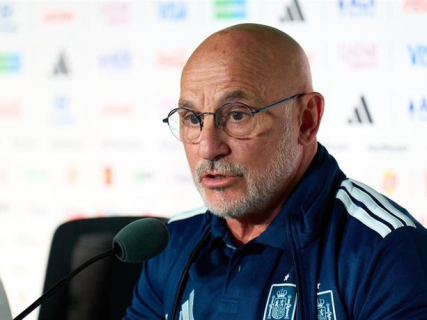
Spain's lineup against France: De la Fuente keeps Fabián and leaves Pedri on the bench

Luis de la Fuente does not introduce changes with respect to the team that eliminated Belgium in the quarterfinals. Fabián Ruiz is once again a starter in the midfield and Pedri will start the match from the bench in the World Cup semifinal against France

1 minute

WhatsApp Image 2026 07 14 at 19.16.30

WhatsApp Image 2026 07 14 at 19.16.30

Add DEMÓCRATA to Google

Ask FREN

Published

Last updated

1 minute

Most read

There is already the official eleven from Spain to face France in the World Cup semifinals. Luis de la Fuente has cleared all doubts and will repeat the same team that defeated Belgium in the quarterfinals, maintaining his confidence in Fabián Ruiz in the midfield and again leaving Pedri among the substitutes.

The coach is committed to continuing with a block that has performed very well during the tournament and trusts that the balance between Rodri and Fabián will once again be one of the keys to stopping the offensive potential of the French team.

Fabián once again prevails over Pedri

The main unknown in the lineup was in midfield. Finally, De la Fuente maintains his bet on Fabián Ruiz, who will form the Spanish team's midfield along with Rodri and Dani Olmo.

Pedri will wait for his opportunity from the bench and could become one of the main game-changers in the second half, as already happened in the previous match.

The same eleven that eliminated Belgium

The coach from La Rioja has not wanted to change a formula that worked in the quarterfinals and will repeat exactly the same lineup:

Position Player
Goalkeeper Unai Simón
Right-back Pedro Porro
Center-back Pau Cubarsí
Center-back Aymeric Laporte
Left-back Marc Cucurella
Defensive Midfielder Rodri
Midfielder Fabián Ruiz
Attacking Midfielder Dani Olmo
Right Winger Lamine Yamal
Left Winger Álex Baena
Forward Mikel Oyarzabal

Spain seeks another World Cup final

With this eleven, Spain will try to overcome France and qualify for another World Cup final. De la Fuente once again trusts the block that has brought the team to the semifinals and reserves players like Pedri or Mikel Merino to change the game if circumstances require it.

More key points, information and questions with FREN

AI-GENERATED CONTENT

What procedures must the national team follow to officially register its lineup before an international match according to FIFA regulations?

I do not have specific or up-to-date information on the technical-sporting procedure that a national team must follow to officially register its lineup with FIFA before an international match. My scope is focused on politics and institutional current affairs, not on the regulatory details of sports competitions. However, I can explain why I cannot go into that level of regulatory detail and what types of questions I can answer accurately.

Thematic scope of this assistant

This assistant is specifically designed to address topics of a political, institutional, regulatory, and social nature, with a special focus on Spain. This includes:

  • Parliamentary and executive activity in Spain (Cortes Generales, Government, autonomous communities when information is available): bills and legislative proposals, royal decree-laws, debates, votes, etc.
  • Public policies and regulation: regulations on economy, environment, social rights, taxation, energy, digitalization, regulated markets, etc.
  • Political and social current affairs: context of government decisions, party positions, social impact of certain laws or measures.
  • Political and organizational actors: parties, parliamentary groups, unions, employers' associations, social organizations, think tanks and their role in the political process.

Within this framework, I could, for example, analyze a Spanish sports regulation (such as a sports law, a royal decree on sports federations or financing of sports events) as long as it is approached from a legal, political, or institutional perspective, not a technical-sporting one.

Why I cannot answer your specific question

The issue you raise — the procedures a national team must follow to officially register its lineup according to FIFA regulations — belongs to the realm of:

  • Technical and competition regulations of FIFA and confederations (UEFA, CONMEBOL, etc.).
  • Internal protocols of national federations and tournament organizers.
  • Aspects of sports management and refereeing rather than public policy or Spanish domestic law.

That is, we are talking about specific sports rules (deadlines for submitting player lists, maximum number of call-ups, final moment to confirm the starting eleven, registration forms and electronic systems, disciplinary consequences of an error, etc.). That type of regulatory detail is outside the scope of information for which I am configured and, above all, I cannot guarantee that the information I would provide would be accurate, up-to-date, or consistent with the latest FIFA circulars.

What kind of approach I could provide about sports

If you are interested in sports from a political, regulatory, or institutional perspective, I can provide context and analysis, for example:

  • Explain how the representation of national teams in various sports disciplines is regulated in Spain from a legal point of view (competences of the Higher Sports Council, role of federations, etc.).
  • Comment on the content and impact of a Spanish law or legislative reform affecting football (club ownership, audiovisual rights, sanctioning regime, women's sport, integrity and betting, etc.).
  • Analyze political debates about the use of public resources for sports infrastructure, organization of major events, or Olympic and world bids.
  • Describe political-institutional controversies related to the Royal Spanish Football Federation, always from the perspective of governance, accountability, or intervention by Spanish or international authorities.

How to obtain the information you seek

To know precisely the procedures for registering lineups according to FIFA regulations, the safest is to go directly to the sports regulatory sources. In particular:

  • The Regulations of the specific competition (for example, a World Cup, a European Championship, or a qualifying phase), where the procedure and deadlines for registering provisional lists, final lists, and starting elevens are usually stated.
  • The Regulations on the Status and Transfer of Players and other general FIFA regulations, which sometimes include provisions on eligibility and registration.
  • The official FIFA circulars addressed to national federations, which refine practical issues such as electronic registration systems or injury replacement windows.
  • The national federation itself (in Spain's case, the RFEF), which usually publishes internal operational guides or informational notes for teams and press on how lineups and call-ups are formalized.

These sources are specifically oriented to the technical-sporting dimension your question requires and will offer you the exact detail of procedures, forms, and deadlines that I cannot rigorously develop here.

What are the main functions of a national team coach in Spanish football according to the RFEF statutes?

The Statutes of the Royal Spanish Football Federation (RFEF) do not contain an article that expressly and in detail lists the functions of the national team coach. Instead, they attribute to the RFEF itself the competence to select the players of the national teams and assign to the Board of Directors the power to appoint the coaches, from which their role derives. The specific functions of the coach are later developed in the RFEF General Regulations and in federation practice.

What the RFEF Statutes literally say

In the current Statutes, published in the Official State Gazette (BOE) by Resolution of August 3, 2022 (2022 Statutes), the key reference is related to the competences of the Board of Directors:

  • Appointment of the coach: the Board of Directors has, among its competences, the power to “appoint, at the proposal of the President, the National Coaches, as well as the technical team.” This is the statutory legal basis for the appointment and possible dismissal of the coach.
  • Selection of players: under the heading of “own activities” of the RFEF, it is established that it is the Federation's competence to select the players who will make up the national teams. This is an institutional competence, typically exercised through the appointed national coach.

In previous versions of the Statutes, such as those for the 2015-2016 season available on the federation's own website (2015-2016 Statutes and the institutional information section), the same logic is maintained: the coach does not appear as an organ with its own statute, but as a technical position appointed within the governance competences of the Board of Directors.

Operational functions derived (General Regulations)

The "day-to-day" functions of the coach are detailed in the RFEF General Regulations — for example, in versions such as the 2013-2014 Regulations (2013-14 Regulations) and the July 2023 edition (2023 Regulations) — and in internal circulars. From that regulation and federation practice, the main functions can be summarized as follows:

  • Call up players: decide, within the general competence of the RFEF to select players, which players are called up for each training camp and official or friendly match of the corresponding national team.
  • Lead training and matches: plan and lead training sessions, develop tactical and technical preparation, and make sporting decisions during official and friendly matches.
  • Plan the activity of the national teams: propose and coordinate, together with the RFEF sports area, the annual programming of activities, training camps, and friendlies of the team under their charge.
  • Intervention in organizational decisions: be consulted on aspects such as the venue for international matches of the national team, and even in the design of the technical staff of other teams, as established in internal regulations and training materials such as those compiled in external resources ([link], CAEF).
  • Coordinated work with the technical staff: lead and coordinate the other members of the technical staff (assistant coach, fitness coach, analysts, medical staff, etc.) who are also appointed by the Board of Directors at the President's proposal.

All this is inserted within the organizational and transparency framework of the RFEF, accessible on its institutional portal (institutional information) and in sections such as remunerations and allowances, which allow understanding the coach's position within the federation structure.

Legal position and limits of their functions

From a legal-institutional point of view, the national coach is a technical trusted position, dependent on the President and the Board of Directors, not an autonomous governing body. This implies several things:

  • They do not have their own normative or disciplinary power: they apply the Statutes, the General Regulations, and the rest of the RFEF rules, but do not create or interpret them in a binding way.
  • Their sporting decisions are framed within the federation's strategy: call-up lists, playing systems, or selection criteria must respect the general regulatory framework and the guidelines set by the Federation's sports management.
  • Internal responsibility: they answer to the governing bodies for results and the adequacy of their professional performance, with the practical consequence that their continuity or dismissal depends on the confidence of the President and the Board of Directors.

In summary, according to the RFEF Statutes, the national coach does not have a statutory catalog of functions; it is the RFEF that holds the competence to select players for the national teams, and the Board of Directors that appoints the coach as the main technical instrument to exercise that competence. The specific functions — calling up, training, leading matches, and planning the team's activity — are completed in the General Regulations and federation practice, always under the supervision of the Federation's governing bodies.

What has been Luis de la Fuente's professional career and previous teams before managing the senior national team?

Before reaching the senior national team bench, Luis de la Fuente developed a long career first as a professional footballer — mainly at Athletic Club and Sevilla FC — and later as a coach of modest clubs and youth categories, until consolidating within the structure of the Royal Spanish Football Federation (RFEF) leading the under-19, under-21, and Olympic teams. This path, closely linked to youth football and academies, explains why the RFEF considered him the natural successor to manage the senior team in 2022.

Stage as a professional footballer

Sources consulted indicate that Luis de la Fuente, born in 1961, trained at Haro Deportivo before joining Athletic Club's academy in the late 1970s. From there, he made the jump to the Bilbao first team, where he established himself as a left-back.

His playing career can be summarized as follows:

  • Haro Deportivo: initial training in his hometown.
  • Athletic Club (first spell): debuted in the First Division in the early 1980s and stayed about seven seasons. The information gathered highlights that he was part of the squad that won two Leagues and the double of League and Cup in 1984.
  • Sevilla FC: joined the Seville club in the late 1980s and played four seasons in the top division, with over 80 league matches.
  • Athletic Club (second spell): returned to Bilbao in the early 1990s for a shorter second spell.
  • Deportivo Alavés: ended his career at the Vitoria club, in Segunda B, in the mid-1990s.

In total, reference sources place his career at around 16 years as a professional, with about 254 First Division matches and several goals scored, almost always playing as a left-back. This competitive background at historic clubs like Athletic and Sevilla is a central part of his public profile, also recalled in the note from the Seville City Council, which highlights that he was a player for the Nervión club for almost five years and lived there nearly a decade as a player and later as a club coach (Seville City Council note).

First steps as a coach in clubs

After retiring, De la Fuente began his coaching career in the late 1990s in modest Basque football. The information gathered shows the following progression:

  • Club Portugalete (1997–2000): first experiences as a coach in regional categories.
  • Aurrera de Vitoria (2000–2001): coached in Segunda B, completing much of the season before being replaced.
  • Sevilla FC youth (2001–2005): returned to Sevilla, now as a youth coach. Various reports recall that he coincided with very prominent youth generations at Sevilla.
  • Athletic Club División de Honor youth (2005–2006): returned to Lezama to coach the top-level youth team.
  • Bilbao Athletic (2009–2011): took charge of the rojiblanco reserve team in Segunda B for two seasons.
  • Deportivo Alavés (2011): assumed the Alavés bench in Segunda B for a few months until his dismissal at the start of the season.

This career block shows a clear pattern: De la Fuente specialized in youth development and working with young players in demanding environments but away from the big spotlight, both in Sevilla and Athletic and Alavés. That experience is precisely what the RFEF later sought for its youth categories.

Career in the RFEF before the senior team

The jump to the federation structure came around 2013. According to the biographical summary gathered, the RFEF incorporated Luis de la Fuente that year to lead the youth national teams, starting a decade of continuous work with young Spanish talent.

  • Spain under-19 (2013–2017): took charge of the under-19s, with whom he completed a prolonged cycle consolidating his reputation as a development coach.
  • Spain under-21 (2017–2021): promoted to the under-21 category, which is the direct stepping stone to the senior team. With this group, he achieved European titles that consolidated his profile.
  • Spain under-23 / Olympic team (2021–2022): assumed the team competing in the Olympic cycle and maintained the line of results and projection of young players toward the senior team.

Various journalistic and biographical sources highlight that De la Fuente became the first Spanish coach to win the European Championship in three different categories (under-19, under-21, and senior) and also the Nations League, as recalled by the mayor of Almería at an institutional event (Almería City Council note). Before being appointed senior coach, he had already won European titles with the youth teams and led the Olympic team, reinforcing the idea of internal continuity in the RFEF model.

When Luis Enrique left the national bench in 2022, the Federation opted for that profile: a coach trained within the house, with a past as a player in elite clubs, a decade of work with the federation's youth system, and a notable record in the under-19, under-21, and Olympic categories. All that previous trajectory, both in the youth football of Athletic and Sevilla and in the youth national teams, culminated in his appointment as senior coach.

Reference links used

To reconstruct this career, among others, the following materials were consulted:

biography on Wikipedia (es) video interview profile on CNN en Español report on Infobae profile on Esquire article on RTVE piece on ABC note on Okdiario profile on Transfermarkt biography on Wikipedia (en) biography on Wikipedia (it) homonymous entry [link] biography on Wikipedia (ca)

What specific titles did Luis de la Fuente win with the under-19, under-21, and Olympic teams before taking over the senior team? How was the process within the RFEF that led to the replacement of Luis Enrique by Luis de la Fuente in 2022? What influence have Athletic Club and Sevilla FC had on Luis de la Fuente's understanding of the game as a coach?

Play

Test your knowledge with FREN!

How much do you know about this topic? Answer the following 3 questions.

Who makes up the starting midfield for Spain in the match against France?

Question 1 of 3

Which player was a substitute in Spain's official lineup against France?

Question 2 of 3

What characteristic does De la Fuente highlight about the Rodri-Fabián midfield partnership?

Question 3 of 3

Hola, soy Fren. ¿Cómo te ayudo?