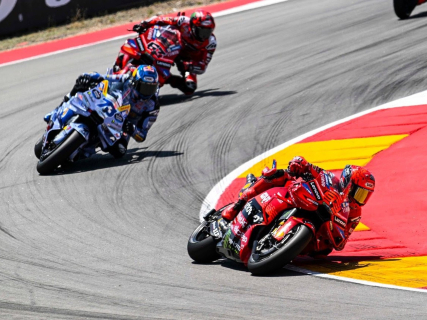

Marc Márquez and Massimo Rivola have starred in one of the dialectical showdowns of the MotoGP Malaysian Grand Prix, held this Sunday, November 1, at the Sepang circuit. The controversy began after Saturday’s sprint race, when the Spanish rider focused on the performance of Ai Ogura, rider for the Trackhouse team on an Aprilia bike, and suggested that his way of defending the position could be related to the fight for the world title.
The words of the Ducati rider did not sit well with Massimo Rivola, CEO of Aprilia Racing, who responded before the main race with a statement full of irony. The Italian executive questioned Márquez’s insinuations and took the opportunity to make a reference to the sporting relationship between the Spaniard and his brother Álex, also a Ducati rider, although within the independent Gresini structure.
The exchange has reopened the debate on team orders in MotoGP, a practice that allows manufacturers to try to favor one of their riders when a championship is at stake. However, neither Aprilia has confirmed that there were instructions for Ogura nor has the Japanese rider admitted to having received orders to benefit Bezzecchi.
What Marc Márquez said about Aprilia’s orders in Malaysia
The origin of the controversy lies in Saturday’s sprint race on October 31, in which Márquez maintained an intense battle with Ai Ogura over several laps.
The Japanese rider, who started from fourth position, made a great start and managed to overtake several rivals. In the early stages of the race he even made contact with Márquez while both were fighting for the front positions, forcing the Ducati rider to correct his line.
The battle was repeated later for second place. Ogura defended his position intensely against Márquez, while Marco Bezzecchi, rider for Aprilia’s factory team and one of the mathematical championship contenders, was running behind. After the race, the Spaniard explained that he expected especially aggressive defense from the Japanese rider because of the situation the World Championship was going through. "The paddock is small", Márquez stated, implying that the riders know the sporting interests that exist within each manufacturer.
According to what he explained, Ogura knew that, if he finished between Márquez and Bezzecchi, he could harm his teammate’s chances in the championship. For that reason, the Spaniard considered it especially important to overtake the Japanese rider and finish ahead of the Italian.
Márquez did not claim to have seen a direct order from Aprilia, but his statements were interpreted as an insinuation that the factory’s interests could be conditioning the on-track battle.
Finally, Pedro Acosta won the sprint race, Márquez finished second, Bezzecchi was third and Ogura ended up fourth, after having led for several laps.
Massimo Rivola’s response: "Factory games are done in the family"
Márquez’s statements reached Massimo Rivola this Sunday during an interview with DAZN, held before the main race. Aprilia’s top boss refused to directly enter into the Ducati rider’s interpretation, but responded with a phrase that quickly became one of the most talked-about moments of the weekend. "Factory games have to be done in each one’s own house... In the family", Rivola assured, according to Motorsport.com.
The reference to the family was interpreted as an allusion to Marc Márquez and his brother Álex, who compete on Ducati motorcycles and have coincided in several battles for the front positions during the championship.
The comment takes on special relevance because Álex Márquez, Gresini rider, uses a Ducati, although he is not part of the official team in which Marc competes. Both belong to different structures, but share a manufacturer and a family relationship that Rivola took advantage of to return the criticism.
The Italian official’s response came at a particularly delicate moment for Aprilia. Jorge Martín, their main title contender, had had to withdraw from the Malaysian Grand Prix due to an injury, while Bezzecchi continued trying to keep his mathematical chances alive.
Ai Ogura denies having received orders to favor Bezzecchi
One of the protagonists of the controversy, Ai Ogura, expressly denied that Aprilia had given him instructions to help Marco Bezzecchi during the sprint race.
The Japanese explained that his intention was to defend the position he had gained on track and that the contacts with Márquez occurred because both arrived in parallel at several corners. Ogura acknowledged that the Spanish rider had a superior pace, but maintained that that did not mean he should make the overtake easier for him. When he was directly asked if he had received orders from the manufacturer to favor Bezzecchi in the fight for the championship, he answered no.
His explanation introduces an important element: an intense battle between riders from different brands does not in itself prove the existence of team orders. To establish that there were any, it would be necessary to know the instructions transmitted by Aprilia or to have other elements that confirmed that coordination.
In addition, before the Malaysian Grand Prix, Aprilia's own management had explained that its riders still had freedom to compete as long as the mathematical possibilities of the championship remained open, although it acknowledged that it could assess specific strategies during the last races.
The Sunday race contradicts the suspicions about Aprilia
The controversy acquired a new meaning during the main race on Sunday, November 1, when Ai Ogura and Marco Bezzecchi met again on track.
On this occasion, the battle was directly between two Aprilia riders. Ogura attacked Bezzecchi during the final laps and the two even touched, to the point that the Japanese rider's bike lost part of an aerodynamic element. Far from giving up the position to help the Italian in the fight for the title, Ogura managed to overtake him and finished fourth, while Bezzecchi also lost another place to Enea Bastianini and finished sixth.
The result left an image difficult to reconcile with the existence of effective instructions to protect Bezzecchi during Sunday's race. It does not show that strategic conversations within Aprilia never existed, but it does show that Ogura raced against the Italian and took points from him in Malaysia.
The battle also harmed the manufacturer's aspirations to improve its standing in the manufacturers' championship, while Ducati managed to place two of its riders among the top three.
Márquez again jokes about Aprilia after winning in Sepang
The response of Marc Márquez came after imposing himself with authority in the Malaysian Grand Prix, a victory that allowed him to widen his lead in the World Championship standings.
During his meeting with the journalists, the Spanish rider was asked about what happened between Ogura and Bezzecchi, in a new reference to possible team orders.
"Damn! Today there hasn’t been, today there will be a telling-off", Márquez replied with laughter, according to AS. With that comment, the Ducati rider again resorted to irony to refer to the situation at Aprilia, after its two representatives had ended up confronting each other directly on the track. The episode adds a new chapter to the sporting rivalry between Ducati and Aprilia, two manufacturers that have competed for the championship during much of the season.
However, there is no record of an official sanction or investigation related to team orders in the Malaysian Grand Prix. The controversy has developed mainly through the statements of the protagonists.
Márquez wins in Malaysia and moves closer to the MotoGP title
Aside from the exchange with Rivola, Marc Márquez was the great sporting protagonist of Sunday after securing his seventh victory of the season.
The Ducati rider dominated the Sepang race and crossed the finish line with more than four seconds of advantage over Pedro Acosta, second place. The podium was completed by Álex Márquez, who had taken pole position on Saturday. The victory allows the elder of the Márquez brothers to reach 399 points in the championship, with an advantage of 44 over Jorge Martín and 67 compared to Marco Bezzecchi.
Martín, who suffered a fracture in his right wrist during the Australian sprint race, had tried to return to competition in Malaysia, but ultimately withdrew from the weekend after realizing he could not ride normally. His absence has meant a new blow to Aprilia's aspirations, which faces the final rounds of the championship with an increasingly larger deficit against the Ducati rider.
The next event is scheduled for 6 to 8 November in Qatar, where Márquez will have his first mathematical opportunity to secure the title if he manages to widen his advantage sufficiently over his pursuers.
What team orders are and why they generate controversy in MotoGP
The team orders are instructions or strategic agreements by which a manufacturer tries to benefit one of its riders, normally when it has options of winning the championship.
These strategies can consist of facilitating an overtake, avoiding a fight that puts a victory at risk, or prioritizing the rider best placed in the standings. In MotoGP, however, the situation is more complex than in other competitions such as Formula 1, since manufacturers also supply bikes to independent teams that have their own sporting interests.
This is the case of Ducati with Gresini, where Álex Márquez competes, and of Aprilia with Trackhouse, the structure of Ai Ogura. In addition, the absence of continuous radio communications between the teams and the riders makes it difficult to transmit instructions during the race. The possible strategies are usually discussed beforehand or communicated through the systems available on the motorcycles.
The Malaysia controversy has shown that the debate over team orders remains open when a title is at stake, but also that suspicions do not amount to proof. For now, the confirmed facts are that Márquez questioned Aprilia's strategy, Rivola responded with a reference to the Spanish rider's family, and Ogura denied having received instructions. On Sunday, in addition, the Japanese rider overtook Bezzecchi on track, while Márquez took advantage of his victory to get even closer to the championship.
The tension between Márquez and Rivola thus leaves a rivalry that moves from the circuits to public statements, with the MotoGP World Championship entering its decisive phase.