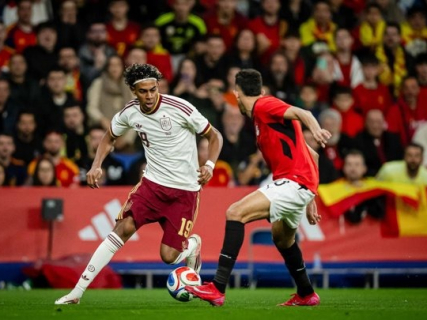
Why Lamine Yamal can win the Ballon d'Or and be the youngest in history to achieve it

The Barcelona footballer aspires to surpass the record of precocity that Ronaldo Nazário has held since 1997 after winning the World Cup with Spain.

Add DEMÓCRATA to Google

Ask FREN

Published

Last updated

3 minutes

Most read

Elecciones 29N · Encuestas

La media de las encuestas

Media a 26 de octubre de 2026 · 15 institutos

  • PP31,2 %
  • PSOE27,2 %
  • Vox18,8 %
  • Sumar6,3 %
  • Podemos3,0 %
  • ERC2,3 %
010203040ene 2024jul 2024ene 2025jul 2025ene 2026jul 2026

Media del último estudio de cada instituto en 30 días y su evolución semanal desde el 23J. Partidos con al menos un 2 %.

Todas las encuestas

Elecciones generales del 29 de noviembre · Demócrata

WhatsApp Image 2026 04 01 at 16.24.21

Lamine Yamal aspires this Monday, October 26, to become the youngest footballer in history to win the Ballon d'Or, a recognition that would crown his rise among the great figures of world football. The winger of FC Barcelona, who turned 19 last July, presents a candidacy supported by his individual figures, his prominence in the world champion Spanish national team, and the titles won during the 2025-2026 season.

The ceremony, which takes place in London, brings together the main candidates for the most prestigious individual award in football. Among Yamal's arguments are his 25 goals and 20 assists in 57 matches, in addition to his participation in the conquest of LaLiga, the Supercopa de España, and the 2026 World Cup, a combination of performance and collective successes that can be decisive in the voting.

A World Cup that strengthens his candidacy

The conquest of the 2026 World Cup constitutes one of the main sporting arguments of Lamine Yamal, who has managed to add to his trajectory the most important title in international football when he had just turned 19 years old.

The championship allows the Spanish footballer to present a candidacy that goes beyond his performances with Barcelona. Major international tournaments have special relevance in World Cup seasons, both for the dimension of the competition and for the exposure of players in decisive matches.

Yamal had already gained international prominence during the Euro 2024, when Spain won the title and the winger became one of the big names of the tournament. Two years later, his participation in a new victory for the national team reinforces a trajectory that combines precocity and sporting successes.

The numbers of Lamine Yamal with Barcelona

The performance of the footballer during the 2025-2026 season also supports his aspirations. His 25 goals and 20 assists in 57 matches reflect an offensive contribution that combines goal-scoring ability and participation in creating opportunities for his teammates.

His importance in Barcelona, however, is not limited to statistics. Yamal has become one of the main offensive resources of the team due to his ability to break through in one-on-one situations, attract defenders, and create space near the opponent's area.

The extreme has taken on responsibilities in a team accustomed to competing for national and European titles, a demand that takes on special relevance due to his age. His participation in the conquest of LaLiga and the Supercopa de España completes a sports balance in which the collective results accompany his individual performance.

The record of Ronaldo Nazário that he can surpass

If Lamine Yamal receives the Ballon d'Or, he will establish a new record for precocity in the men's category. Ronaldo Nazário has held the mark since 1997, when he won the award at 21 years old, after his time at Barcelona and his incorporation to Inter Milan.

The Brazilian forward was 21 years and three months old when he received that recognition, while Yamal is currently 19 years and three months old. The difference would allow the Spaniard to lower a mark that has been in effect for almost three decades by approximately two years.

The precedent of Ronaldo reflects the exceptional nature of winning the Ballon d'Or at such a young age. Other footballers who ended up dominating the award, such as Lionel Messi or Cristiano Ronaldo, needed more time to conquer their first trophy.

Messi achieved it for the first time in 2009, at 22 years old, while Cristiano Ronaldo debuted his trophy cabinet in 2008, when he was 23. A victory for Yamal would place him ahead of both in the historical ranking of youngest winners.

Mbappé, Kane, and Rodri among his competitors

Lamine Yamal's candidacy will have to compete with those of other footballers who also present important sports arguments. Among them are Kylian Mbappé, Harry Kane, and Rodri, whose merits combine individual statistics, titles, and prominence in their respective teams.

Mbappé stands out for his goal-scoring ability and his weight in Real Madrid, while Kane presents a candidacy supported by his offensive performance and the successes achieved with Bayern Munich. Rodri, for his part, represents a different profile, in which the control of the game, the balance of the midfield, and his contribution to collective results take on special importance.

The Ballon d'Or is not decided exclusively by the number of goals or the titles won. The official criteria include individual performances, the decisive character of the player, collective results, and fair play, so the different candidacies can receive different evaluations from the journalists responsible for voting.

When is the Ballon d'Or 2026 awarded

The Ballon d'Or 2026 ceremony takes place this Monday, October 26, in London, after the evaluation period has concluded, which runs from August 3, 2025, to July 19, 2026.

The voting is already closed, so performances after that date do not affect the selection. The result will determine if Lamine Yamal adds the main individual award in football to his achievements and becomes, at 19 years old, the youngest male winner in history.

More key points, information and questions with FREN

AI-GENERATED CONTENT

What is the selection and voting process for the Ballon d'Or and who participates in choosing the winner?

I do not have specific and verified information about the selection and voting process of the Ballon d'Or, nor about exactly who participates in choosing the winner. I specialize in Spanish politics and institutions and in the functioning of the parliamentary, governmental, and regulatory system, so I do not work with technical or updated details about competitions or sports awards like this one. To properly answer your question, it would be necessary to consult specialized sources in sports information (for example, the award's own organization or reference sports media), something beyond the scope for which I am designed.

To better understand the reason for this limitation, my field of work focuses on issues such as:

  • Laws, decrees, and parliamentary initiatives: identifying, explaining, and contextualizing regulations (bill projects and proposals, royal decree-laws, ministerial orders, etc.), their content, processing, and political and regulatory impact.
  • Functioning of the Cortes Generales and regional parliaments: how initiatives are processed, what phases they follow (consideration, amendments, committee, plenary, referral between chambers), what majorities are required, and the role of each body (Board, Spokespersons' Committee, commissions, Permanent Deputation, etc.).
  • Government and administrations' activity: agreements of the Council of Ministers, publications in the BOE and regional bulletins, plans and strategies of ministries and public bodies, as well as their interaction with the legal and parliamentary framework.
  • Political actors and their public stance: profiles of public officials and representatives, as well as their interventions in parliamentary sessions and, in many cases, their public positions on politics, regulation, economy, public services, rights, and freedoms, etc.
  • Political and regulatory current affairs: analysis of the political context, ongoing debates on topics such as housing, energy, taxation, health, education, justice, digitalization, environment, territorial policy, European Union, and many other areas with public and regulatory dimensions.

On the other hand, the Ballon d'Or is an award organized in the private sports sphere, linked to international professional football and managed by an entity and rules that are not part of the Spanish institutional or regulatory system. Although it has enormous media and social impact, its internal selection, nomination, and voting process is not regulated as a public procedure, nor is it processed in parliaments or recorded in official regulations that I can reliably report on.

If you want to know precisely how nominees are chosen, what criteria are applied, who can vote, how votes are weighted, and what phases they follow until the winner is proclaimed, my recommendation is to consult:

  • The official page or regulations of the Ballon d'Or itself, where the award's bases and voting criteria are usually explained.
  • Reference sports media (for example, newspapers specialized in football or sports sections of major newspapers), which usually publish detailed explanations of the procedure each year.
  • Interviews or statements from the organization responsible for the award, where changes in format, expansion or reduction of the voting body, and time limits of the evaluated period are often clarified.

Although I cannot go into the specific details of the Ballon d'Or, if you are ever interested in the political or regulatory dimension of sports — for example, what Spanish regulations affect sports federations, how sports public limited companies are regulated, the role of the Higher Sports Council, or what parliamentary debates have taken place on audiovisual rights, sports betting, or equality in sports — I could help you with much more detail and context.

In summary: for specific sports questions like the Ballon d'Or selection process, I am not the right tool, but for everything related to Spanish politics, institutions, laws, parliaments, government, sector regulation (including sports in its public dimension), and analysis of political and regulatory debate, I can offer you developed explanations, comparisons, and context.

Which Spanish public institutions regulate and supervise professional sports and what competencies does each have? How is the financing and legal form of professional football clubs regulated in Spain? What recent parliamentary debates have taken place in Spain about gender equality and professionalization in sports?

What competencies and powers does Lamine Yamal have within FC Barcelona and the Spanish national team according to his position and role in the team?

I do not have specialized information about the strictly sports or internal scope of football clubs like FC Barcelona nor about the technical-sporting functioning of the Spanish national team beyond its general public dimension. I am specifically designed to work with political and institutional information in Spain (parliaments, governments, regulations, public actors, sector policies, etc.), not to detail sports roles and powers of specific players within their teams.

That said, I can explain in general terms — without entering into specific data about Lamine Yamal — how the concept of “competencies and powers” is usually understood applied to a football player from an organizational or institutional logic, differentiating between the formal level (contract, regulations) and the functional level (tactical role and leadership within the group). That can help you reinterpret your question with a more structured approach, even if you then consult a specialized sports source to complete the specific details about this player.

1. Formal competencies of a player within a club

In a club like FC Barcelona, the “formal” competencies of any player basically depend on:

  • Professional contract: defines labor rights and obligations (remuneration, duration of the link, basic disciplinary regime, duty to train, to follow technical instructions, to represent the club in certain events, etc.). It normally does not establish “powers” over other players, but duties towards the club.
  • Internal club regulations: regulate issues such as punctuality, code of conduct, attendance at training, internal sanctions, use of corporate image, or participation in promotional events. A player must comply with them but usually does not have decision-making faculties derived from them, unless holding a special position (for example, captain).
  • Nonexistent statutory role: unlike positions such as president, director, or member of the technical staff, a player is not a club body with “competencies” in the legal sense (does not decide signings, budgets, or general sports policies, except informal influence).

Therefore, even in the case of an emerging star, their formal decision-making capacity within the club structure is very limited: it is confined to accepting or rejecting contractual proposals, negotiating certain conditions, and fulfilling or breaching their labor obligations, with the corresponding consequences.

2. Functional powers within the team

Another very different thing is the functional or tactical role a player performs:

  • Position on the field (for example, right winger, attacking midfielder, inside forward, etc.): in that position, they assume specific tasks (creating chances, beating opponents on the wing, assisting, pressing high, etc.). These “powers” are defined by the technical staff and adjusted according to the game plan.
  • Sporting leadership: some players, due to their talent or personality, assume a certain status as an offensive reference or creative figure. This is not a legal competence but a de facto power: the team tends to look for them, plays are designed to enhance them, or they are given tactical freedom.
  • Responsibilities in specific situations: free kicks, penalties, corner kicks, etc. These are purely technical decisions: the coach designates who executes them based on their profile.

Applied to any very talented offensive player, the pattern is: few formal competencies (does not make structural decisions) but a very high functional weight in the game if the technical staff so decides.

3. Spanish national team: similar framework, different nature

In the Spanish national team, the scheme is similar, with nuances:

  • Call-up: it is not a player’s competence but the coach’s and federation’s. The player can only accept or decline personally.
  • Sporting role: once called up, the player integrates into a specific tactical scheme. Again, functions on the field are assigned according to the coach’s plan (be disruptive on the wing, provide depth, assist, etc.).
  • Image and representation: players act as representatives of the national team and, by extension, the country in the sports field. They assume conduct and communication obligations set by the federation but without institutional decision-making powers.

In legal-organizational terms, the national team does not turn a player into a public authority or a management body: they remain an athlete who follows technical instructions under a federative regulatory framework.

4. What I can and cannot provide

In summary, I cannot provide you with a precise and updated list of “competencies and powers” of Lamine Yamal within FC Barcelona and the national team, because that would require handling specific and real-time sports information about lineups, internal hierarchies, tactical instructions, and technical decisions, which are outside my area of expertise.

What I can do, within my field, is help you:

  • Understand the legal and organizational structure of sports entities when they relate to the public sector.
  • Analyze the interaction between clubs, federations, and public institutions (subsidies, sports regulations, public contracts, etc.).
  • Contextualize the role of professional sports in public policies (taxation, employment, image rights, European regulations, etc.).

For specific details about Lamine Yamal’s tactical and sporting role, I would recommend consulting specialized sources in football information or tactical analysis that are focused on that type of content.

What have been the recent electoral results in the Royal Spanish Football Federation and how do they affect the management of awards and recognitions?

The most relevant recent electoral result in the Royal Spanish Football Federation (RFEF) was the election of Rafael Louzán as president on December 16, 2024, for the 2024-2028 term, with 90 votes against Salvador Gomar's 43. His arrival meant a renewal of leadership but does not allow concluding that the rules for awarding prizes and recognitions have automatically changed. It is important to distinguish between the replacement of those who manage them and an accredited modification of their criteria.

Electoral result and new leadership

Louzán's victory opened a new stage after Pedro Rocha's presidency. The result is recorded in Público's report, while FIFA identifies Louzán as president of the Spanish federation. The consulted sources do not provide any subsequent electoral result replacing that election.

At the end of December 2024, the new Board of Directors for the 2024-2028 cycle was constituted. Published information about its organization describes the incorporation of representatives from professional football and players, as well as renewals in administrative, refereeing, technical, and communication areas. These changes affect interlocutors and the execution of institutional decisions, although they do not themselves equate to a reform of the awards. Agreements can be consulted in the Board of Directors and minutes section.

Consequences for awards and recognitions

The main effect is organizational, not an automatic reassignment of competencies. Management remains subject to federation rules and the agreements of the competent body for each recognition. The presidency and the Board can set new institutional priorities, but this leadership capacity must be distinguished from the power to change requirements, select awardees, or review previous decisions.

  • Responsibles and supervision. The new leadership changes who promotes, coordinates, or supervises proposals. There is a concrete reference: the summary of agreements from November 17, 2025 includes matters related to evaluation committees and the José Ángel de la Casa sports journalism award. This shows that recognitions remain part of the Board's ordinary activity.
  • Galas and representation. The change can influence the schedule, format, guests, protocol, and communication of events. These are different aspects from awarding criteria: changing a ceremony does not prove that the procedure to choose awardees has changed.
  • Continuity. The election does not imply, by itself, canceling existing awards or withdrawing granted distinctions. The consulted sources do not record a general reform of awards or a global review of recognitions as a consequence of the electoral result.

Transparency and real scope of the change

Information about political and personal links of members of the new structure raises a debate about institutional independence. However, that controversy does not prove an irregular awarding of any specific prize. To assess each case, what matters is knowing the applicable bases, the composition of the evaluation committee, possible conflicts of interest, and the awarding agreement.

In short, Louzán obtained the presidency and reorganized the federation's leadership; the accredited impact on recognitions lies in their responsibles and institutional supervision. This change should not be confused with a demonstrated modification of the required merits, winners, or economic rights associated with an award.

Play

Test your knowledge with FREN!

How much do you know about this topic? Answer the following 3 questions.

What record can Lamine Yamal break if he wins the Ballon d'Or in 2026?

Question 1 of 3

When and where is the 2026 Ballon d'Or ceremony held?

Question 2 of 3

What titles has Lamine Yamal won during the 2025-2026 season?

Question 3 of 3