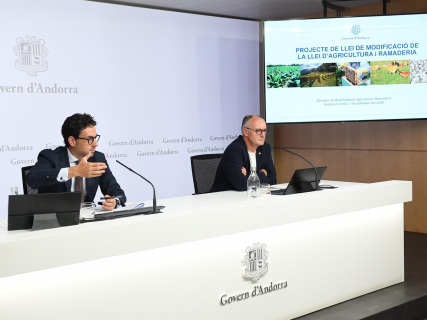

The Executive of Andorra has launched a reform of the agriculture and livestock regulations that, among other changes, establishes "the vehicle" to promote new agricultural productions of general interest, including the cultivation of cannabis for medicinal use.
This has been detailed by the Minister of Environment, Agriculture and Livestock, Guillem Casal, and the director of the Agriculture department, Josep Casals, in a press conference held this Tuesday, as reported by the Government itself in a statement.
The legal modification provides for the creation of a representative entity of the primary sector, conceived as a reference body for the holders of agricultural operations before the public Administration.
This new entity will be able to act as an interlocutor for the sector, promote initiatives considered of general interest, and launch projects linked to innovation, competitiveness, and modernization of the operations.
To achieve official recognition, the entity must gather, at a minimum, 65% of the active agricultural operations in the Principality.
A "flow element" for new productions
Casal has emphasized that these bodies are "a flow element" to facilitate the development of new agricultural productions that are considered of general interest for the primary sector, such as cannabis.
The operating system will be articulated through the call for a public competition by the Government to award the licenses, with an evaluation based on several criteria. Among them, being linked to a collective representation body will grant additional points.
Specific law on medicinal cannabis and other reforms
In parallel to the creation of this entity, the Executive has worked on the law that will regulate the cultivation of cannabis for medicinal purposes, a text that is intended to be submitted for parliamentary procedure in the next session period.
Casal has announced that the regulatory project will be presented shortly and that it foresees a single license for a single operator, with an exclusively indoor cultivation, which in no case will replace tobacco and that will be "highly regulated".
In addition, the reform of the agriculture law incorporates a new formula for cooperation between operations through the regulation of agricultural or livestock groups of common exploitation (GAREC).
This figure will allow between two and five farms to share, totally or partially, means of production, infrastructures, or resources, in order to increase efficiency, reduce costs, and strengthen the economic viability of agricultural and livestock activities.
The legal modification also introduces the figure of zoological nuclei of income animals, aimed at facilities where animals intended for family self-consumption are kept. Likewise, it is anticipated that legally constituted groups in the primary sector will have preferential access to certain licenses or authorizations related to the development of economic activities linked to agriculture and livestock farming.