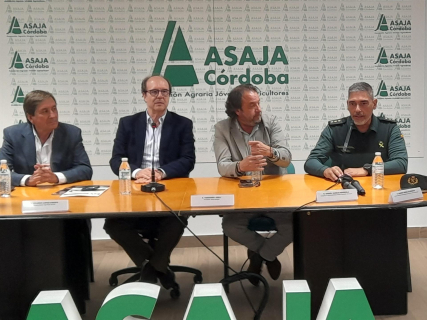

Asaja Córdoba has celebrated this Monday its XVII Hunting-Forest Day, an event focused on management protocols against the dieback of oaks and on the main demands, challenges, and goals of the Andalusian hunting sector in the short and medium term.
The meeting has brought together institutional representatives and specialists from the forestry and hunting fields to address issues that directly affect the management of estates and the future of hunting activity in the province, according to the organization in a statement.
At the opening of the day, the president of Asaja Córdoba, Fernando Adell, highlighted the economic and social weight of this field for Córdoba. "Behind there are owners, managers, workers, and families who maintain their connection to the territory. There is employment, economic activity, and a knowledge of the countryside that we must value and transmit to new generations," he indicated.
Adell has defended "responsible, orderly hunting that is compatible with conservation, integrated into the management of our estates and mountains" and has insisted on the need for those who take on these tasks to have "support, legal security, and a close Administration, capable of listening and providing practical answers."
Alongside the president of Asaja Córdoba, the inauguration was attended by the vice president of Caja Rural del Sur, Ricardo López-Crespo; the territorial delegate in Córdoba of the Ministry of Sustainability and the Environment of the Junta de Andalucía, Daniel García-Ibarrola, and the colonel chief of the Civil Guard Command of Córdoba, Ramón María Clemente Castrejón.
The dieback of oaks and forest management
The technical block focused on the dieback of oaks, with a presentation by Francisco José Ruiz Gómez, professor of the Department of Forestry Engineering at the University of Córdoba (UCO). Under the title "Integrated management protocols against the dieback of oaks: the case of Vesta in the cork oak forest," his presentation addressed this problem from the perspective of integrated management and its practical application in forest management.
In relation to this issue, Adell conveyed the concerns of those working to conserve holm oaks, cork oaks, and dehesas, and emphasized the importance of linking scientific knowledge with the daily management of the operations: "We need research to reach the estates and help guide the decisions of their managers."
Challenges and priorities of the hunting sector in Andalusia
The day continued with a round table dedicated to the demands, challenges, and objectives of the hunting sector in Andalusia in the short and medium term, moderated by the coordinator of the Hunting-Forest Department of Asaja Córdoba, Tomás Jurado.
In this debate, the director of the Andalusian Institute of Hunting, Juan Ortegón Calvente; José Manuel Labrador, from the Andalusian Hunting Federation, and the lieutenant chief of Seprona in Córdoba, Eleuterio Otero Martín, participated. The table allowed for the confrontation of different visions about the current situation and the future of hunting activity, as well as the priority needs of the sector.
Among the goals of this forum, the president of Asaja Córdoba pointed out the need to advance "in more effective management, in simpler procedures, in collaboration between the sector and institutions, and in the recognition of those who care for and work our mountains."