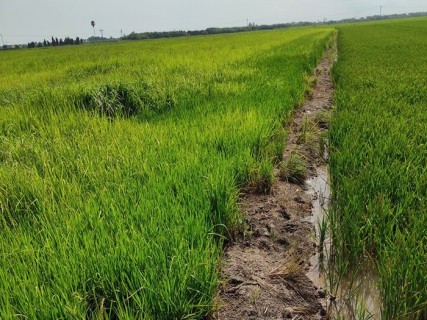

The Valencian Association of Farmers (Ava-Asaja) warns that a growing number of rice producers in the l'Albufera natural park are considering not planting next season to avoid continuing to accumulate losses, "an unprecedented fact that puts the conservation of this area of high environmental value at risk".
According to Ava-Asaja's calculations, rice growers in the Comunitat Valenciana have suffered losses exceeding 16 million euros in the 2026 season. The sector denounces the restrictions derived from working within a protected area, "without receiving any compensation in return", such as the obligation to grow rice exclusively, the rules on water management, the bans on certain infrastructures and the limitations on the use of helicopters and drones.
In a statement, the agricultural organization emphasizes that production costs have suffered a "historic surge". Just in this season, expenses have risen by around 7 percent, mainly due to the increase in the price of nitrogen fertilizers (urea or "guano"), fuels — especially agricultural diesel in a highly mechanized crop—, seeds —amid a full shift toward varieties more resistant to the pyricularia fungus— and labor.
Yield losses have also been very high, with damage of up to 35% in certain plots. In the early stages of the crop, wild fauna species such as water birds, wild boars and flamingos caused damage to the plants, forcing reseeding or the affected areas to be written off as lost.
Later on, the "lack of solutions" authorized by the European Union and the Government of Spain to "prevent and combat" pests and diseases left "numerous rice fields were decimated by the 'cucat' and pyricularia".
Added to this scenario is the collapse of prices at origin to 0.31 euro/kg, 40% less than a year ago and well below the 0.70 euro/kg paid four seasons ago. These prices are clearly below production costs and the aid from the Common Agricultural Policy (CAP) "does not cover that difference at all".
According to Ava-Asaja, the collapse in prices is due above all to the massive entry of imported rice from third countries that floods the community market. These products arrive in the EU "with no kind of food guarantee", with residues harmful to health and using phytosanitary substances prohibited in Europe (Tricyclazol, Thiamethoxam, Carbendazim, Chlorpyrifos, Imidacloprid, Acephate, Profenofos, Triazophos and Hexaconazole).
In the face of this situation, the large-sector meeting on rice held this Thursday agreed to ask the Generalitat Valenciana to urgently put in place an extraordinary line of direct aid that covers the losses suffered and helps finance the expenses of the next planting. This demand is raised regardless of whether the Consell conveys to the Ministry of Agriculture the need to activate funds from the CAP crisis reserve to support Valencian rice, in line with what is being studied in other producing areas such as Andalucia and Extremadura.
Likewise, it is requested to activate the safeguard clause against imports of rice from third countries to halt the price crisis, and to promote campaigns to promote Valencian and European rice through clearer labeling that differentiates it from other origins and allows greater added value to be obtained.
The sector also demands access to more effective phytosanitary active substances for the control of pests, diseases and weeds in rice. Finally, the sectoral urges the president of AVA-ASAJA to request an urgent meeting with the president of the Generalitat and the consellers of Agriculture and Environment with the aim of addressing this situation, agreeing on measures that mitigate this unprecedented crisis as much as possible and preventing it from happening again in the next campaigns.