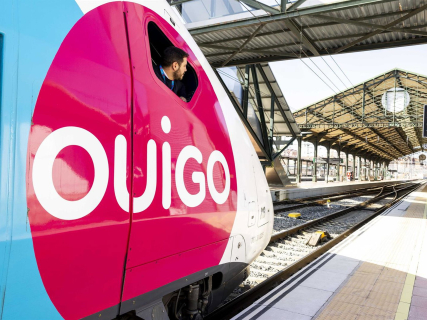
A breakdown in an Ouigo interrupts high-speed traffic between Madrid and Levante

A fault in the catenary leaves a train traveling from Murcia to Valladolid without electrical supply. The company organizes the transfer of the passengers on another train and provides buses to complete the journey

fotonoticia 20260730104722 1920

fotonoticia 20260730104722 1920

Add DEMÓCRATA to Google

Ask FREN

Published

Last updated

2 minutes

Most read

Elecciones 29N · Encuestas

La media de las encuestas

Media a 27 de octubre de 2026 · 15 institutos

  • PP31,0 %
  • PSOE27,3 %
  • Vox18,9 %
  • Sumar6,3 %
  • Podemos2,9 %
  • ERC2,3 %
010203040ene 2024jul 2024ene 2025jul 2025ene 2026jul 2026

Media del último estudio de cada instituto en 30 días y su evolución semanal desde el 23J. Partidos con al menos un 2 %.

Todas las encuestas

Elecciones generales del 29 de noviembre · Demócrata

Rail traffic high-speed between Madrid and Levante suffered this Thursday a new interruption after a Ouigo train became immobilized inside a tunnel at the height of Aranjuez (Madrid) as a consequence of a snag with the catenary. The incident, recorded barely a day after the railway accident in Urda (Toledo), has forced the traffic on track I between Valdemoro and Villarrubia de Santiago to be suspended, with repercussions for the connections with the Comunidad Valenciana and the Region of Murcia.

The affected train, identified as the Ouigo service 6775, had departed from Murcia del Carmen bound for Valladolid-Campo Grande when the breakdown in the electrical supply system occurred. The convoy remained stopped inside the tunnel and without the possibility of continuing the journey under its own means, which forced coordination with Adif of an operation to transfer the travelers.

According to the information provided by the operator, no injuries have been reported as a consequence of the incident, although the immobilization of the train has forced the passengers' transfer to be reorganized and other services planned for this Thursday to be modified.

Ouigo organizes the transfer of travelers and buses to Valladolid

To evacuate the passengers from the immobilized train, Ouigo has organized an operation that contemplates the arrival of another convoy on the adjacent track, from which the transfer of the travelers will be carried out to later take them to the Madrid station of Chamartín-Clara Campoamor.

The company has also planned an alternative road service for those whose destination was Segovia Guiomar or Valladolid, so that they can complete the journey by means of buses provided by the operator.

The incident has also affected later rail scheduling, since Ouigo has had to cancel the return service between Madrid-Chamartín and Valladolid given the impossibility of maintaining the planned circulation.

Refunds, ticket changes and 200% compensations

Affected travelers by the service changes may request the full refund of the ticket or a date change, in accordance with the extraordinary measures announced by Ouigo after the incident.

The operator has also communicated a additional compensation equivalent to 200% of the amount of the journey for affected users, a measure that accompanies the travel alternatives organized to address the consequences of the breakdown.

The interruption of the Madrid-Levante corridor comes at a particularly delicate moment for the Spanish rail network, after on Wednesday a collision between an AVE from Renfe and a train from Iryo was recorded in Urda (Toledo), which has caused dozens of fatalities. Although both events respond to different circumstances and there is no proven causal relationship between them, the new incident again alters the functioning of high speed while the investigations into the previous day's accident continue.

More key points, information and questions with FREN

AI-GENERATED CONTENT

What procedures and processes are usually followed to restore traffic after a failure on the Spanish high-speed rail network?

To restore traffic after a failure on the Spanish high-speed rail, a sequence of protection, diagnosis, repair, verification, and operational authorization is followed. Adif or Adif Alta Velocidad manage the infrastructure and traffic; the railway company attends to the train and its passengers. The reopening can be partial and does not mean that schedules immediately return to normal.

1. Detect the incident and protect traffic

The failure can be detected by monitoring systems, the driver, control centers, or maintenance personnel. First, the location, affected installations, and risks are determined. The regulation center coordinates initial measures: stopping trains, preventing movements toward the affected area, limiting speeds, or using alternative routes.

If there is electrical risk, fire, obstacles, or people on the tracks, the environment is protected and necessary resources are mobilized. The Protection and Security Centers coordinate alarms and emergencies, as explained by Adif in its information on railway safety.

2. Activate coordination and attend to passengers

The response is structured through the Contingency Plan, coordinated with self-protection and emergency plans when applicable. Its purpose is to recover normality in the face of technical failures or other disturbances, as stated in the Adif AV agreement published in June 2025.

Adif exchanges information with operators and technical teams. Renfe or another railway company informs its passengers, organizes assistance, and evaluates transfers or alternative transport. Evacuation is not automatic: it requires risk assessment and coordination of track protection and, when appropriate, electrical installations. These actions are described in the Senate documentation.

3. Diagnose and resolve the failure

Specialists are mobilized according to the problem: track, catenary — the wiring that supplies electricity —, signaling, telecommunications, or rolling stock. If a broken-down train blocks the passage, it may be necessary to assist or remove it. Repair can be carried out with traffic suspended or combined with limited circulation on another track, always under safe conditions.

Not all incidents require the same actions. An electrical supply failure demands different checks than a fault in systems that detect trains or authorize movements.

4. Verify that it is safe to circulate

Removing the obstacle or replacing a part is not enough. The affected installations must be inspected, the track cleared, and its operation verified. Depending on the damage, on-site inspections, functional tests, or test runs may be performed. Adif publishes information about its access and operation procedures.

If the usual systems are still unavailable, circulation can only proceed under the corresponding alternative safety conditions. Reopening does not mean allowing normal speed: restrictions and longer intervals between trains may remain.

5. Authorize reopening and normalize service

Once technical conditions are confirmed, the competent center operationally authorizes resumption and communicates instructions to traffic personnel and operators. Recovery may start on a single track or specific routes. Then, held trains, departures, and available resources are reorganized.

Therefore, delays may persist after the failure is repaired. As an example, Transport described a phased recovery, with passengers relocated and trains reinforced, in its May 2025 report. Finally, the infrastructure is supervised, restrictions are lifted when appropriate, and causes and corrective measures are documented.

What are Adif's legal competencies in managing railway incidents on the high-speed network?

Adif is responsible for managing infrastructure and traffic safely, responding to incidents, and restoring traffic. In high speed, a distinction must be made between Adif and Adif-Alta Velocidad, legally different entities: competencies correspond to the administrator of the affected infrastructure, although both can delegate activities by agreement. They do not replace operators, emergency services, or the supervisory authority.

1. Prevention and infrastructure safety

The Railway Sector Law 38/2015 establishes that administrators and railway companies are responsible for the safety of the part of the system that affects them. They must have safety management systems that include risk assessment, control, and monitoring, also when contracting supplies or services.

For the administrator, this includes maintenance, inspection, and operation of tracks and installations, as well as control, traffic, and safety systems. The statutes of Adif and Adif-Alta Velocidad expressly assign control and inspection of infrastructure and traffic, as well as the drafting of instructions specifying operating conditions.

2. Measures during an incident

The law requires the administrator to take "all necessary measures to restore normality as soon as possible" when an accident, technical failure, or other incident significantly disrupts traffic. This is not only a power: it is a duty to act.

  • Protect traffic: apply speed restrictions, stop traffic, or close sections according to risk, traffic rules, and safety procedures.
  • Suspend services without prior notice: when, due to exceptional causes, the infrastructure becomes temporarily unusable and urgent repairs are necessary. In this legal case, affected operators have no right to claim compensation from the administrator; this rule does not by itself eliminate passengers' rights.
  • Require collaboration: railway companies must provide resources deemed appropriate and offer the required cooperation.
  • Coordinate cross-border effects: share information and cooperate with other administrators when their networks or traffic may be affected.
3. Contingencies, emergencies, and victims

The administrator must develop a contingency plan establishing measures to recover normality and identifying bodies to inform in case of major incidents or serious disturbances. Its railway intervention must respect the competencies of Civil Protection and autonomous communities: directing traffic does not mean assuming command of all rescue services.

Additionally, both administrators and operators must have victim and family assistance plans. Therefore, it would be incorrect to attribute all attention to those affected exclusively to the company selling the ticket.

4. Investigation and limits of its competencies

The statutes assign the administrator accident investigation procedures and annual reports on accidents and incidents. These internal actions serve to identify causes and correct risks, but do not replace independent technical or judicial investigation. The administrator must report events and cooperate with investigators.

The investigative framework must be read as updated: Law 2/2024 created an independent authority and Royal Decree 141/2026 approved its statute and repealed part of the previous organizational regulation of the CIAF.

Finally, the AESF supervises safety; operators retain their obligations regarding trains, personnel, and service. Managing the incident does not automatically make Adif responsible for its cause: that responsibility requires analyzing facts and specific breaches.

What requirements must a railway operator like Ouigo meet to offer high-speed services in Spain?

An operator like Ouigo needs a railway license, single safety certificate, authorized trains and personnel, and allocated capacity to operate. Additionally, it must pay to use the infrastructure and comply with passenger obligations. There is no single permit that replaces all these requirements: having a license does not guarantee obtaining a route or requested schedules.

1. Railway company license

The Railway Sector Law 38/2015 requires a license expressly covering passenger transport. In Spain, it is granted by the State Railway Safety Agency (AESF); licenses granted by other European Union States also have effect.

To obtain it in Spain, the company must prove:

  • The required corporate form: a public limited company established indefinitely, with registered shares, or a public company.
  • That its main activity is railway transport.
  • Financial capacity to meet present and future obligations.
  • Professional competence of its managers and civil liability coverage.
  • No legal prohibitions related to insolvency, disqualifications, or certain convictions and serious offenses.
2. Single safety certificate

Before operating, it must have a certificate covering the type of service and its operating area. It accredits a proprietary safety management system: procedures to control risks, manage traffic, and ensure personnel readiness and train maintenance.

According to Royal Decree 929/2020, if operating exclusively in Spain, it can request it from the AESF; when covering multiple States, it corresponds to the European Union Railway Agency. Its maximum validity is five years and must be updated upon substantial changes. New operations must be communicated to the AESF at least two months in advance.

3. Compatible trains and qualified personnel

Rolling stock must be authorized and compatible with the planned lines, including signaling and control systems. The operator must guarantee maintenance and comply with interoperability requirements, i.e., technical conditions allowing safe operation on the network.

Personnel with safety functions must have the required qualifications, training, and psychophysical aptitude. Maximum driving times and controls on alcohol and substances affecting faculties must also be respected.

4. Capacity and access to facilities

The company needs to obtain train paths from Adif or Adif Alta Velocidad: circulation slots assigned to a route and schedule. It must comply with the Network Statement and formalize conditions for using tracks, stations, and necessary facilities.

Availability is conditioned by existing capacity, works, and technical restrictions. Framework agreements allow multi-year reservations; their importance for Ouigo appears in this CNMC resolution.

5. Charges, passengers, and supervision

It must pay infrastructure and facility charges and prices for services used. The Law 26/2022 reformed its regulation: administrators determine them through regulations published in the BOE, under CNMC supervision.

It must also comply with passenger information, accessibility, assistance, compensation, and claims obligations. If competing with public services, it may be subject to an economic equilibrium test: the CNMC analyzes whether it significantly harms the public contract, as it did with Ouigo between Córdoba and Seville.

In short, the AESF supervises safety; the CNMC controls non-discriminatory access, charges, and economic conflicts. These requirements must be maintained throughout the operation.

Play

Test your knowledge with FREN!

How much do you know about this topic? Answer the following 3 questions.

Where was the Ouigo train immobilized that caused the interruption on the Madrid-Levante line?

Question 1 of 3

What extraordinary measure has Ouigo offered to passengers affected by the breakdown?

Question 2 of 3

What other railway service was affected by the breakdown, suffering a delay of more than an hour?

Question 3 of 3