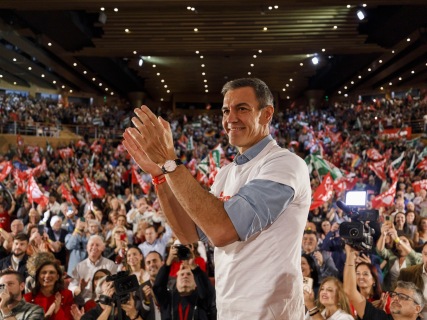
The music and dancing are over: the tragedy of Urda breaks the PSOE campaign and puts the focus on public management

The tragedy shifts Sánchez’s pre-campaign from emotional mobilization toward scrutiny of public administration. Adamuz, the doubts about Transportes and the Ceuta precedent place the Government before a question that is harder to answer with electoral messages: how it guarantees that the State works

EuropaPress 7865996 imagen secretario general psoe presidente gobierno pedro sanchez acto

EuropaPress 7865996 imagen secretario general psoe presidente gobierno pedro sanchez acto

Add DEMÓCRATA to Google

Ask FREN

Published

Last updated

6 minutes

Most read

Elecciones 29N · Encuestas

La media de las encuestas

Media a 27 de octubre de 2026 · 15 institutos

  • PP31,0 %
  • PSOE27,3 %
  • Vox18,9 %
  • Sumar6,3 %
  • Podemos2,9 %
  • ERC2,3 %
010203040ene 2024jul 2024ene 2025jul 2025ene 2026jul 2026

Media del último estudio de cada instituto en 30 días y su evolución semanal desde el 23J. Partidos con al menos un 2 %.

Todas las encuestas

Elecciones generales del 29 de noviembre · Demócrata

Music may stop for a few days, perhaps forever. Lthe campaign that was supposed to accompany it, however, does not necessarily return when the silence ends. The Urda train accident has interrupted the PSOE pre-campaign and has altered the terrain on which Pedro Sánchez intended to contest the elections of November 29. After the mourning, the events may be recovered. It will be much harder to recover their meaning intact.

The contrast with the images from barely two weeks ago is evident. In Fuenlabrada, Sánchez turned the thanks to Begoña Gómez and a public declaration of love into one of the central moments of his intervention. The couple’s entrance was accompanied by the music of Rusowsky. The scene combined personal vindication, closeness, and militant enthusiasm.

Urda introduces a different demand. The Government must attend to the victims, explain what happened, and demonstrate that it has the capacity to correct whatever has failed. The electoral problem for the socialists is that those institutional obligations move to occupy the center of the public conversation.

There are still no data that allow measuring how much vote the tragedy can move. There are signs of a change in strategy: laSexta reports on Socialist leaders who consider the campaign broken, while El Independiente describes conversations in the Government and in Ferraz about the need to reorient it. These are internal assessments published by those media outlets, not a forecast of the electoral result.

From emotional bond to competence test

The Socialist pre-campaign had offered scenes in which Sánchez sought a relationship with the electorate less dominated by institutional confrontation. Music, cultural references, and the display of a personal dimension of the candidate helped build that register.

LOS40 reported, for example, his musical recommendations during the return from a trip to Valladolid and the presence of contemporary artists in his public communication. The political reading of those elements is recognizable: humanize the leader, mobilize supporters, and reach audiences that do not follow parliamentary debate. That resource is neither exceptional nor exclusive to the PSOE. But its effectiveness depends on the context.

After a catastrophe, the question that organizes attention changes. The citizen can continue valuing the closeness of a president and, at the same time, demand explanations about safety, maintenance, coordination, or operational decisions.

In political science terms, the risk for the Government is a change in the criterion by which it is evaluated. The dispute ceases to focus on who best represents certain values and shifts toward who demonstrates the ability to manage essential services. Ideology does not disappear, but governmental competence gains weight.

Adamuz turns Urda into a question about the system

An accident forces the clarification of a concrete chain of events. Two major railway tragedies in the same year add a political dimension: the public may ask whether there is a broader problem of prevention, oversight, or institutional learning.

That does not allow one to affirm that Adamuz and Urda have the same causes. The temporal proximity does not demonstrate a technical relationship nor authorize replacing the investigations with a general explanation of deterioration.

But public perception does not function exclusively with separate case files. Repetition can weaken the calm offered by general safety guarantees. For the Executive, explaining each accident will be necessary; demonstrating what was learned from the previous one may prove equally important.

Various media outlets report the impact among socialist leaders of Sánchez's words about how untenable it is to suffer two high-speed accidents in a year. Also the doubt about Puente's continuity among the members of the Government consulted.

The issue that is opening up is institutional: what procedures existed, how they were applied, what controls were supposed to prevent a collision, and what measures will be adopted when the failures are determined. A convincing explanation will have to make it possible to distinguish each responsibility without leaving areas outside the examination.

Puente concentrates the pressure, but does not exhaust the problem

Óscar Puente has ruled out resigning and has placed his priority on clarifying what happened. Moncloa maintains its support: according to laSexta, government sources maintain that his management is not in question with the information available.

That is the known position. The doubts published in other media do not amount to a decision by Sánchez to replace him.

From the political point of view, however, the dilemma exists. Keeping the minister requires that his presence help coordinate the response and give credibility to the explanations. Replacing him could express assumption of responsibility, but it would also open questions about why that decision is made and what changes with it.

Neither of the two options by itself resolves the crisis of trust. A dismissal without diagnosis may seem like an insufficient response. A backing without accountability can be interpreted as political protection.

In addition, the pressure does not come only from the opposition. UGT has questioned pointing to workers at the control center before clarifying all the circumstances and calls for also examining the organization, the resources and the working conditions.

For the PSOE, that front is especially sensitive: it forces it to respond to actors with whom it shares part of its social space and makes it difficult to reduce all criticism to a partisan offensive.

Ceuta: another crisis, the same demand for coordination

Ceuta does not explain the Urda accident. They are different matters, with different powers, causes and consequences. Their connection in this analysis is political: both subject the Government to an examination of anticipation, coordination and informational clarity.

VerificaRTVE documented the contradictions between Defense and Interior over the CNI warnings before the mass entry of migrants on July 30. It also reconstructed the changes in position regarding the creation of a single command.

The state response, for its part, has not been limited to statements. The Council of Ministers approved on October 13 more than 45 million euros of financial support for Ceuta to face extraordinary expenses and sustain essential services.

Both elements matter. The first confirms problems in the coherence of the public explanations; the second shows measures adopted to respond to the crisis. A rigorous assessment must incorporate both.

The electoral risk appears if different episodes end up feeding the same impression: that institutions react late, contradict themselves or do not sufficiently explain their decisions. That perception is not proven by a survey in this analysis. It is a political vulnerability that the Government will have to avoid with verifiable actions.

After mourning, another campaign

The PSOE suspended its agenda after the accident. The pause responds to mourning and to the priority of the emergency, but it does not freeze the public evaluation of the Executive.

When the events resume, the main challenge will be one of content. Reducing the music or adopting a more sober tone may be necessary, but it does not replace the answers that are expected from a Government.

A campaign adapted to this context will have to rely on verifiable information: attention to families, transparency about what is known and what remains pending, protection of the independence of the investigations and explanation of the corrective measures. Promising security without specifying how it is guaranteed can be less persuasive after a tragedy.

There is also a demand for the opposition. Fiscalizing the management does not require taking as proven responsibilities that are still being investigated. Its credibility will depend on the precision of the questions and the consistency of the proposed solutions.

The result is not written, but the script has changed

The shock is not automatically translated into an electoral punishment. The subsequent response, the conclusions of the investigations and the ability to convey control and empathy can influence the citizen evaluation. There is still a month left until the polls.

What seems more difficult is to return without changes to a pre-campaign centered on the enthusiasm of one’s own. Defending public services also requires explaining their functioning, their failures and the necessary decisions to correct them.

Music and love had a place in the socialist narrative. After Urda, Sánchez faces a demand that goes beyond that register: to demonstrate, from the Presidency, the capacity to govern a crisis and account for it. Mourning can have an end marked on the calendar. The examination of public management, no.

More key points, information and questions with FREN

AI-GENERATED CONTENT

At what parliamentary stage is the investigation into the Urda railway accident, and what are the next planned steps?

As of October 29, 2026, no specific parliamentary committee has been established to investigate the Urda railway accident, nor has an approved schedule of hearings or conclusions been found. Therefore, it is not appropriate to place it in an already open parliamentary investigation phase: what exists are judicial and technical actions. The next parliamentary steps are, for now, possible courses of action, not officially scheduled milestones.

What is the parliamentary situation?

The sources consulted do not show an agreement from the Congress, the Senate, or the Cortes of Castilla-La Mancha creating a specific committee on Urda. Nor has a formal proposal with a debate date, an approved work plan, or a list of people summoned to testify been located. The distinction is important: requesting explanations or an investigation does not equate to having launched a parliamentary committee.

There is a precedent that may cause confusion: the Senate Investigation Committee on the state of the railway network in Spain, whose documented work during the XV Legislature addressed Adamuz, Gelida, and the general situation of the network. Demócrata reported on its hearings, and the Senate records actions in its parliamentary documentation. These precedents do not prove that Urda has been incorporated into its work nor that new sessions have been convened on this accident.

Moreover, that agenda should not be automatically transferred to the situation after the dissolution of the Cortes. A committee from the previous legislature does not, by itself, constitute an active channel to investigate a subsequent accident. Therefore, there is no upcoming hearing on Urda that can be considered confirmed.

What investigations are underway?
  • The judicial investigation. The Civil and Instruction Section No. 2 of the Orgaz Court of First Instance has begun proceedings to clarify the accident, according to Castilla-La Mancha Media. This action is not a parliamentary investigation.
  • The technical investigation. The Railway Accident Investigation Commission is working to reconstruct the circumstances of the collision. The institutional statement from Moncloa on October 28 confirms the actions of this body and the judicial authorities.

Among the issues to be clarified are the origin of the security system failure, the instructions transmitted from the control center, and the information available about the position of the trains. The reconstruction published by Demócrata describes these points as matters under investigation, not as definitive conclusions.

What would be the next steps?

If a specific parliamentary investigation is launched, the expected sequence would be as follows, without confirmed dates:

  • Present a formal proposal that defines its scope: the Urda accident or a broader examination of railway safety.
  • Debate and approve its creation in the corresponding chamber. A public request does not replace this agreement.
  • Constitute the committee and approve the work plan, including requested documents and hearings.
  • Hold investigation sessions with responsible parties and experts whose presence is agreed upon; there is not yet an approved list for Urda.
  • Draft and vote on conclusions and recommendations derived from the work.

In short, the next milestone to watch is a concrete parliamentary initiative and its processing agreement, not a date for conclusions. Until that step occurs, presenting hearings, deadlines, or summoned officials as already adopted decisions would confuse an expectation with an official schedule.

What are the powers and functions of the Minister of Transport in Spain according to current legislation?

The Minister of Transport and Sustainable Mobility directs the state policy on transport, infrastructure, and mobility within the competencies of their department. Their powers combine the general functions of any minister with the specific matters assigned to the Ministry; it is important to distinguish their political leadership responsibility from the management entrusted to subordinate bodies.

1. General functions as a member of the Government

Article 4 of the Law 50/1997, of November 27, on the Government, establishes that ministers have competence and responsibility within their scope of action. Specifically, the Minister of Transport is responsible for:

  • Developing the Government's action in their department, according to the agreements of the Council of Ministers and the guidelines of the Prime Minister.
  • Exercising regulatory authority in matters pertaining to the Ministry, within legal limits and the powers reserved for the Council of Ministers.
  • Exercising other powers granted by laws, government organization and functioning rules, and other provisions.
  • Endorsing, when appropriate, the acts of the king related to their competencies.

Therefore, their capacity to promote a regulation should not be confused with the power to approve it: draft laws and royal decree-laws, for example, correspond to the Council of Ministers, according to Article 5 of that law.

2. Material areas of their department

The main organizational reference is Royal Decree 253/2024, of March 12, which develops the Ministry's structure. Its Article 1 assigns the department the proposal and execution of government policy in the following areas:

  • Transport infrastructures: land, air, and maritime infrastructures under state competence, along with planning and programming of corresponding investments.
  • Transport services: their control, organization, and administrative regulation within the areas attributed to the State.
  • Sustainable mobility: its promotion in social, economic, and environmental dimensions, including active mobility. The expressly stated goal is to guarantee safe and sustainable mobility based on social justice criteria.
  • Postal services: their normative regulation.
  • State geographic and scientific services: promotion and direction of those related to astronomy, geodesy, geophysics, and cartography.

These powers must be exercised in coordination and without prejudice to the competencies of other ministries. The state delimitation also prevents interpreting that the minister directs all transport managed by autonomous communities or local entities.

3. Administrative direction and execution

The minister directly oversees the Secretariat of State for Transport and Sustainable Mobility and the Undersecretariat. The former acts under their direction and articulates policies through the general secretariats of Land Transport, Air and Maritime Transport, and Sustainable Mobility.

Among the tasks assigned to that Secretariat of State are strategic planning of infrastructures and services, investment programming, monitoring of the railway network, general organization of state transport, and promotion of intermodality, that is, the combination of different means of transport. These are functions of subordinate bodies, not actions the minister must personally carry out.

4. International relations and organizational framework

The Subdirectorate General of International Relations, which coordinates the department's relations and representation in international institutions, especially the European Union, in collaboration with Foreign Affairs, also reports directly to the minister.

The framework includes Royal Decree 829/2023, of November 20, on ministerial departments, and Royal Decree 690/2025, of July 29, which modified certain aspects of the Transport structure. In summary, the minister sets the department's orientation and is accountable for it, while its bodies carry out the functions legally assigned to them.

What results did the PSOE obtain in the last general elections and how many seats does it currently hold in Congress?

In the last general elections, held on July 23, 2023, the PSOE obtained 121 seats and came in second place, behind the PP. The final result was 7,821,718 votes and 31.68%, including the PSC and associated candidacies counted in the socialist total. The reference socialist representation in Congress remains 121 deputies, according to the sources consulted.

The result of the last general elections

The definitive data allow distinguishing three aspects of the result: the number of people who voted for the socialist candidacies, their percentage of valid votes, and the seats obtained. These are related measures but not equivalent: a national percentage does not directly translate into the same percentage of seats.

  • Votes: 7,821,718 ballots for the socialist group as a whole, including the PSC and associated candidacies.
  • Percentage: 31.68% of valid votes, approximately 31.7% when rounded to one decimal place.
  • Seats: 121 deputies in Congress.
  • Position: second parliamentary force, compared to the PP's 137 seats.

The series of definitive results published by Demócrata includes these figures and clarifies that it includes the PSC. For the official reference of the elections, the publication of results in the BOE can be consulted.

How many seats does it currently hold?

The figure that recent sources continue to attribute to the PSOE is 121 seats. Therefore, the numerical answer matches the deputies obtained in the July 2023 elections. PSC representatives should not be added separately: they are already included in that socialist total.

As a recent reference, a Demócrata report from October 28, 2026 explicitly uses the current 121 deputies as a comparison point with electoral expectations expressed by Félix Bolaños. It is important to separate that figure from forecasts about future elections: an expectation or a poll does not change the seats obtained at the polls.

How does it compare with its previous result?

In the elections of November 10, 2019, the PSOE had obtained 120 seats, 6,792,199 votes, and 28.00%. In July 2023, it thus obtained one more deputy, 1,029,519 additional votes, and 3.68 percentage points more, according to the same comparison of definitive results.

The comparison with April 2019 offers another nuance: then it had reached 123 deputies. Thus, the 2023 result was better than that of November 2019 but two seats below that achieved in April of that year, despite gathering more votes. This difference helps understand why it is advisable to look separately at votes, percentage, and representation.

In short, to answer your question there are two central data points: the PSOE obtained 121 deputies in the last general elections and that remains the currently cited socialist representation figure. The definitive percentage was 31.68%; the 31.7% commonly appearing in reports is its rounded expression, not a different electoral result.

Play

Test your knowledge with FREN!

How much do you know about this topic? Answer the following 3 questions.

What event has interrupted the PSOE's pre-campaign and altered its electoral strategy?

Question 1 of 3

What aspect has come to occupy the center of public conversation after the Urda tragedy according to the news?

Question 2 of 3

What measure did the Council of Ministers take to support Ceuta after the migration crisis?

Question 3 of 3