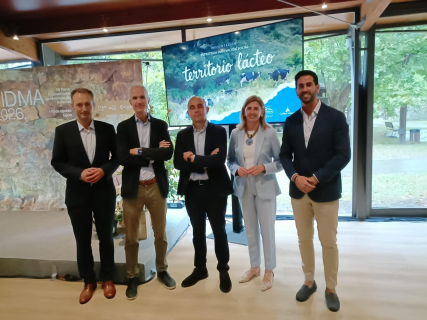

The director of impact investment and open innovation at Capsa Food (Grupo Central Lechera Asturiana), Rubén Hidalgo, announced this Thursday the social innovation strategy "Territorio Lácteo," developed through Capsa Impact, with which the company plans to mobilize around ten million euros by 2030.
Hidalgo, in statements to Europa Press prior to the event held at the Museo Pueblo de Asturias, within the 69th International Fair of Exhibitions of Asturias (Fidma), which takes place at the Gijón fairgrounds "Luis Adaro," emphasized that this is an additional effort specifically aimed at addressing the issue of generational change in the dairy sector of Asturias.
He indicated that the solution to the so-called generational clock is based on three axes: act, know, want, and can. In this framework, he detailed that the aim is to facilitate that people can settle in a rural environment, with accessible housing, proximity services, and, from the financial aspect, services and insurance, the capacity to meet the demands of a livestock operation.
In the realm of wanting, he stressed that their goal is to launch cultural projects that once again convey to youth the idea that working in the field is "wonderful," and the same applies to the dairy sector, where it is possible to "earn a good living and have a good quality of life working in the field."
Regarding knowing, he announced that they will promote a structured training proposal in three phases. The first year will include a four-month specialization period for livestock technicians, followed by a stage of official specialization.
On this last point, he specified that, in collaboration with the Public Employment Service, they will try to design a "solvent" professional career that allows both people with previous family ties and those coming from other fields who wish to work in livestock to join the sector. Their initial goal is to reach about ten people in the first year.
This training is integrated into the Paraíso Natural Academy, a new line created to respond to the shortage of qualified profiles, facilitate generational change, and open new job and rooting opportunities in rural areas.
From Central Lechera Asturiana, it has been pointed out, through a press release, that the territorialized social diagnosis highlights a clear "paradox of rooting."
Specifically, it is indicated that the surveyed people rate the territory with a 6.2 out of 7 as a place to live, but the rating drops to 5.0 when it comes to their opportunities to work. Thus, it is concluded that quality of life, by itself, is not enough to retain population.
Employment is the main priority for 64 percent of those consulted. However, the prevailing narrative is not that there is no work, but that there are positions that remain unfilled because the access conditions, the required qualifications, or the very life project are not sufficiently attractive.
Housing appears as another structural bottleneck: 43% identify it as a problem and 56% as a priority. In the central area of Asturias, this perception rises to 57%, especially associated with tourist pressure.
Aging, mentioned by 48%, confirms that generational change constitutes one of the great challenges of the dairy territory. Ensuring it involves improving the profitability of farms, modernizing the sector, and building a narrative capable of presenting livestock farming as an attractive professional option for new generations.
The presented strategy also includes the establishment of alliances with municipalities, administrations, funding entities, knowledge centers, and the associative fabric of the territory.
The diagnosis also warns that, although community life receives a score of 5.8 out of 7, 76% perceive little or no collaboration among the different actors in the territory. Strengthening that coordination is therefore considered an essential condition for solutions to scale and be sustained over time.