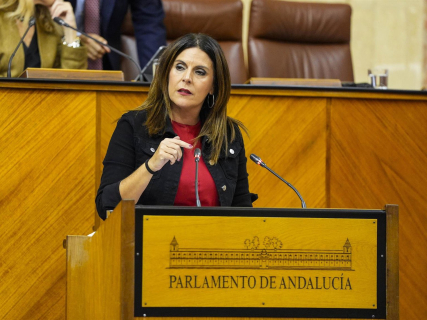

The Plenary of the Andalusian Parliament has rejected this Thursday, thanks to the absolute majority held by PP-A and Vox in the current legislature, the proposal to create an investigative commission put forward by the three left-wing opposition groups --PSOE-A, Adelante Andalucía, and Por Andalucía-- regarding "the management of the early cancer detection system of the Andalusian Health System and its possible political responsibilities," following the crisis that erupted a little over a year ago in the breast cancer screening program.
On behalf of the Socialist Group, the deputy spokesperson, Ángeles Férriz, intervened, criticizing the regional government for "having passed more than a year" since the public became aware of "this scandal thanks to the complaint of the women" from the Amama association and, despite this, "they have not been able to provide a coherent, rational, or humane explanation" about what happened.
Férriz emphasized that this situation translates into "shattered lives," and that the actions of the Andalusian government "have broken lives." She stressed that "those women and their families deserve to know what happened, what went wrong, how it was managed, what is being done to assist those affected, and to prevent it from happening again."
The socialist leader warned the PP-A seats that "you may be able to reject this investigative commission, but the truth will eventually come out," and wanted to send a message to those affected by the failure in the screenings: "you are not alone, we will not be silent, we will not abandon you, and we will not stop" in the face of what she described as "criminal management" and "brutal negligence" attributed to the regional government.
The deputy of Adelante Andalucía, Javier Montes, also defended the establishment of this commission, recalling that more than a year has passed since this "scandal" was uncovered, in which "the Government of the Junta did not inform at least 2,317 women that they had a suspected breast cancer diagnosis."
Montes asked "who could be against investigating the failures in the breast cancer screening of Andalusia, knowing the origin of the errors to prevent" them from happening again, or "informing women about what happened and why they lost a breast or even their life," emphasizing that "women have many doubts about this process, about what happened afterward, and about what may be happening today."
The deputy has questioned the Andalusian Government: "If we don't even know why that error occurred, how can you guarantee that it won't happen again today?", and has urged its officials to "look the affected women in the face" to explain why they reject the creation of the commission.
"Heartbreaking stories of women" and criticism of the lack of explanations
The parliamentarian from Por Andalucía, Esperanza Gómez, has focused on the fact that this crisis has left "heartbreaking stories of women" who, "despite having had the mammogram" within the screening program, "were diagnosed with cancer shortly after" and "became ill", and even some "have lost their lives due to a failure that no one has yet explained." She emphasized that all this has happened "with a system that had been functioning like clockwork since 1995," "a machine that had always been perfectly oiled and that, however, suddenly jammed."
"What we still don't know is where and whose responsibility it is," Gómez added, who defended that "the first thing the Government of the Junta should have done" in this situation was to "apologize, because it is clear that the chain had failed and had broken where it hurt the most" and, immediately afterwards, "study, analyze where the problem is."
The deputy has demanded "to know where the controls that were supposed to ensure the follow-up of patients who became ill later, and some of whom died, failed," and has warned that "we still do not know how many women were actually affected and how many have died to date." In her opinion, the Junta has not provided "all the necessary explanations," nor "has it responded to all the women who suffered this problem," nor has "any political responsibility been assumed."
PP-A accuses the left of making a "mean" opposition
In response to the opposition's request, PP-A and Vox, partners of the Andalusian Government that emerged after the regional elections on May 17, voted against. The PP-A deputy Beatriz Jurado has admitted that what happened with the breast cancer screening was one of the "most important issues that occurred in the previous legislature" and that "it should not have happened," labeling it as a "serious failure in the communication of inconclusive screenings." She recalled that the president of the Junta, Juanma Moreno, "apologized" and that the then Minister of Health, Rocío Hernández, left her position assuming "responsibility" for what happened.
Jurado has maintained that the "narrative" of the leftist groups "is false, and the truth is far above what they want to construct," and has defended that "the Government of Andalusia responded with responsibility, rigor, transparency, and sensitivity." At the same time, he has accused the left of having made "a vile, sneaky policy, taking advantage of and using the pain and suffering of women."
The representative of PP-A has emphasized that, in the year that has passed since the ruling on the screenings became known, measures have been applied with the "only objective" of "caring for and protecting women, giving confidence to the Andalusians, and safeguarding our healthcare system so that failures or errors of this type never happen again." He concluded by defending that the Andalusian Parliament "is here to work for the interests of the Andalusians, not for those of the left front in Andalusia."
Vox explains why it now rejects the investigation commission
The Vox deputy Rafael Segovia has also admitted that there were "errors in the breast cancer screening" and has supported that the affected "have every right in the world to know the truth," highlighting that "Vox's position has been validated" by its previous actions.
Segovia has recalled that, "when the events" subject to the debate occurred, Vox "was not part of the" Andalusian government and supported at the time the request to create an investigation commission promoted by the leftist groups, understanding that it was "essential to know the errors, the responsibilities, and, above all, to correct everything that had gone wrong to avoid possible future errors."
However, he has pointed out that the situation has changed since Vox joined the Andalusian Executive after the elections of May 17 and assumed "institutional responsibility." From that new position, Rafael Segovia has defended that his party "can contribute to achieving" the objective of "clarifying the facts."
He explained that "before we demanded explanations from the opposition with parliamentary initiatives like the one that the leftist groups present today," while "now as part of the Government we have to promote the necessary actions in a direct, more discreet way, and verify that the announced measures are being fulfilled." The deputy concluded that "in the opposition, one denounces," but when governing "what needs to be done is to solve," and he assured that this is what they are "going to do" from Vox, relying on the government pact signed with the PP-A.