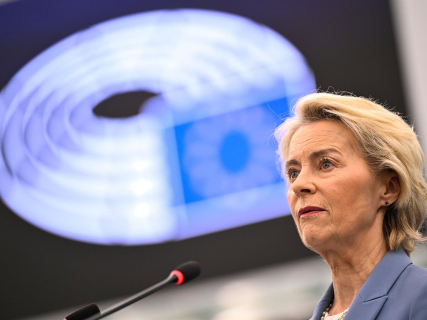

The President of the European Commission, Ursula von der Leyen, denounced this Wednesday the political use of migration by "state and non-state actors" who seek to "deliberately" tension the external border of the European Union in episodes like the one experienced this summer in Ceuta, with the intention of generating internal division and destabilizing the community bloc.
In a debate held in the plenary session of the European Parliament in Strasbourg (France), Von der Leyen announced that, before the end of the year, she will present a detailed proposal for the "European emergency response framework" that she outlined in September before the Eurochamber itself. This instrument aims to empower member states to temporarily suspend the right to asylum in exceptional situations marked by massive arrivals of migrants.
"This summer we witnessed the tragic scenes in Ceuta. Likewise, we have seen how Russia and Belarus have turned migration into a weapon," recalled the President of the community Executive, emphasizing the need to "prepare" the Union to face "new challenges," such as hybrid attacks that use migratory flows as a pressure tool.
In this line, the German conservative leader warned that "state and non-state actors are deliberately provoking mass movements of people in order to overwhelm the authorities, sow fear, and divide us."
"They will not succeed. We will not allow anyone to take advantage of our values to pressure our Union," affirmed Von der Leyen, before reiterating her commitment to present "before the end of the year" an initiative that provides the governments of the Twenty-Seven with the "necessary tools to respond quickly to extraordinary threats" against the external border of the European Union.
During her speech before the MEPs, in which she examined the conclusions of the last European Council held last week in Brussels, the President of the Commission defended that community migration policies are yielding positive results, especially after the implementation of the Migration and Asylum Pact and the application of the new return rules.
According to the data presented, irregular arrivals have decreased by 56% in the last two years across the European Union —a 34% just this year—. At the same time, asylum applications have fallen by 19% and expulsions of migrants without the right to remain in European territory have doubled in the last five years, so 30% of the issued return orders are effectively executed.
Still, Von der Leyen has warned that the experience of this summer, with the arrival of nearly 80,000 migrants from Morocco to Ceuta, "once again showed how quickly new threats can emerge" at the common border. Therefore, she has called to "continue building on the progress" and to persevere in strengthening border controls, speeding up returns, and designing new instruments to contain irregular flows.