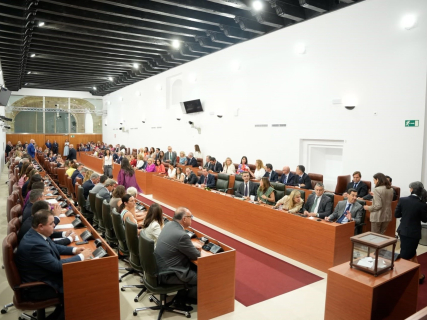

This Saturday, June 13, marks eleven years since the socialist Susana Díaz took office as president of the Junta de Andalucía in the tenth legislature, a position for which she was invested after a complex process with four votes in the Plenary of the Andalusian Parliament, after not achieving sufficient support in the first three to continue as head of the regional Executive after the elections of March 22, 2015.
In those elections, the PSOE-A led by Susana Díaz —who had already been invested president in September 2013 after the resignation of José Antonio Griñán— was the most voted party with 1,411,755 votes and obtained 47 deputies, a figure that was eight below the 55 needed for an absolute majority in the Andalusian Chamber.
The re-election of Susana Díaz as president in the tenth legislature was made viable thanks to the pact that the PSOE-A finally closed with Ciudadanos (CS). As a result of that agreement, the orange formation finally voted in favor of the candidacy of the general secretary of the PSOE-A in the fourth investiture vote held in Parliament between May and June 2015.
This commemoration coincides this year with the process underway for a new investiture of the person who will assume the Presidency of the Junta after the regional elections of last May 17, in which the PP-A won with 1,744,728 votes and 53 seats, falling two short of the absolute majority that would guarantee the continuity of its candidate and current acting president, Juanma Moreno.
PP-A and Vox have already held initial contacts to begin negotiations with a view to closing a pact for the "governability" of Andalusia, given that both formations add up to 68 deputies in this legislature, 13 above the threshold of 55 seats that marks the absolute majority.
Juanma Moreno himself participated in the first meeting that the PP-A held last Tuesday, June 9, with representatives of Vox in the Andalusian Parliament, a meeting that both the 'popular' ranks and the party led in Andalusia by Manuel Gavira described as "cordial," and which will be the first of a series of contacts aimed at advancing that agreement.
Steps for the investiture debate
The Andalusian Parliament held this Thursday, June 11, the constitutive session of the XIII legislature, in which the PP-A deputy Jesús Aguirre was re-elected president of the Chamber with the support of the Popular Group.
After this step, the Parliament's Regulations, consulted by Europa Press, state in article 138.1 that "the president" of the regional Chamber, "after consulting the spokespersons designated by the political parties or groups with parliamentary representation, will propose a candidate for the Presidency of the Junta de Andalucía" within a maximum period of "fifteen" working "days" "from the constitution of the Parliament or from the resignation of the president".
In this way, Jesús Aguirre must designate a candidate for investiture within 15 working days following last June 11.
The President of the Parliament announced this Friday, in an interview on Canal Sur Radio, that he plans to hold that round of contacts with the group spokespersons during the week of June 22, once the parliamentary groups are formally constituted next week, which in this legislature will be five: PP-A, PSOE-A, Vox, Adelante Andalucía, and Por Andalucía.
Afterwards, the Statute of Autonomy specifies in its article 118, regarding the election of the president of the Junta de Andalucía, that the candidate proposed for investiture "will present their program to the Parliament" and, "to be elected", must obtain an absolute majority "in the first vote".
"If it is not obtained, a new vote will be held forty-eight hours (48) after the previous one, and confidence will be deemed granted if a simple majority is obtained in the second or subsequent votes," adds the statutory text.
The same rule specifies that, if that majority is not reached, new proposals for candidates for the Presidency of the Junta will be processed "as provided", and that, if "two months have passed since the first vote, no candidate has obtained a simple majority, the Parliament will be automatically dissolved and the acting president of the Junta will call new elections".
To date, this scenario has not occurred in the history of Andalusian autonomy, as it has never been necessary to repeat elections due to the impossibility of investing a president of the Junta, regardless of whether their party had obtained an absolute majority in the polls.
The 2015 precedent
However, there is indeed the precedent of 2015, when four votes were required for the candidate for President of the Junta proposed by the then president of the Parliament, Juan Pablo Durán (PSOE-A), to achieve the necessary majority, thanks to the support of the Socialist and Citizens groups, more than 80 days after the regional election of March 22.
Susana Díaz was finally invested president of the Junta in the fourth vote held before the Plenary. In the previous three —all of them in May 2015— she only had the support of the PSOE-A, while the four opposition forces —PP-A, Podemos, Citizens, and IU— positioned themselves against it.
In the legislature immediately preceding the current one —the twelfth of the autonomy—, the times for investiture were much shorter, as the PP-A had an absolute majority of 58 seats. Thus, the investiture debate of Juanma Moreno took place between July 20 and 21, 2022, barely a week after the constitution of the Parliament of the XII legislature, held on the 14th.