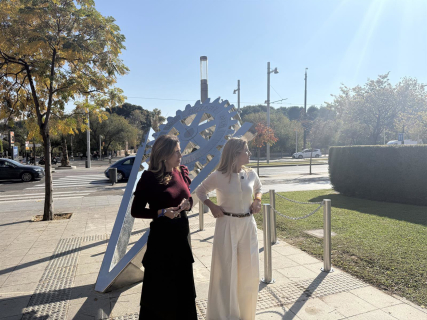

The head of the PP list to the Congress for Zaragoza, Rocío Dívar, and the mayor of the city, Natalia Chueca, have focused this Friday, November 6, their message on public safety, the occupation of homes, acts of vandalism, and the need to reinforce the resources of the police forces. Both PP officials have called for changes in state policy to improve protection for the population and have defended the measures promoted from the Zaragoza City Hall.
The two leaders appeared before the press in Emperador Carlos V square to analyze the security situation in cities and in municipalities. Dívar pointed out that Spaniards "are concerned" about security in railway infrastructure and on trains, but also about what happens on the streets, and she has stated that citizens "live with more insecurity than just a few years ago."
The PP candidate referred to acts of vandalism, cases of squatting, and the fear of many women regarding the release of sex offenders. She also noted that "young people cannot enjoy their leisure freely" and described situations in which owners, upon returning from vacation or after a hospital stay, discover that their home has been squatted.
"From the Partido Popular we have been saying it for a long time. We want to return safety to the streets and we want Spaniards to feel safe in their cities and in their towns," Dívar said, laying out a package of measures from her party to tackle these problems.
SQUATTING AND MULTIPLE REOFFENDING
Among the proposals, she highlighted the so-called anti-squatting law, with which the PP aims for occupants to leave the buildings within a maximum of 48 hours from the filing of the complaint. She also mentioned the Law on multiple reoffending, which, as she explained, seeks to curb acts of vandalism and prevent those who commit crimes repeatedly from being released without serving a sentence.
"We need a law of eviction so that within 48 hours the homes are vacated, as is being done and as the Partido Popular proposes," Chueca said, adding that it is also essential "a Law on multiple reoffending that allows those people who are being repeat offenders not to go in through one door and out through the other, but to really serve a sentence."
Dívar has also called for more human and material resources for the Armed Forces and Security Corps of the State and has reiterated the PP’s support for the National Police and the Civil Guard. In this line, he has asked that both corps be recognized as a profession of risk, a demand that he has recalled his party has already defended in the Senate.
The popular candidate has extended this demand to small municipalities and has criticized the closing of Civil Guard barracks, expressly citing those in Quinto and La Muela. She has stressed that "citizens, the people of Zaragoza who live in small municipalities have the same right as those of us who live in large cities to feel protected and to have security."
CHUECA DEFENDS ACTIONS IN ZARAGOZA
The mayor has presented Zaragoza as an example of the policies, in her view, that the PP local governments are applying to strengthen security. Chueca has emphasized that the City Council has incorporated "more than 400 agents since the Partido Popular has been in government" with the aim of completing the Local Police roster.
To this increase in personnel, she has added the deployment of a network of video surveillance cameras and the incorporation of new technical equipment for the agents, including single-person cameras. However, she has called for this effort to extend also to the National Police and the Civil Guard, understanding that the central Government must support the work carried out from the city councils.
"Zaragoza is a very clear example, but just as Zaragoza are many the cities that are governed by the Partido Popular and that, under the PP’s mandate, what we are doing is to prioritize the security of our neighbors," she said.
Chueca has also highlighted the entry into force of the Civic Ordinance as one of the most recent measures to regulate coexistence in the Aragonese capital. She has explained that, in its first weeks of application, "more than 300 sanctions" have already been imposed.
The councilor has insisted that this ordinance allows clear rules to be set for the use of public space and has asked that the different administrations reinforce compliance with the law. "We need the State too to ensure the safety of its citizens," she said, contrasting the model defended by the PP with what she described as "free will and that each one gets by as they can, at their own pace."
SECURITY IN PUBLIC SERVICES
When talking about security, Chueca has expanded the focus to the protection of public services and the proper functioning of infrastructure. In this context, it has linked concern about public safety with the state of rail transport and the maintenance of the tracks, insisting that users must have guarantees when they travel.
"We are seeing how money, instead of being used for maintenance, has been diverted for other purposes, which is called corruption," it has stated, referring to investigations that affect Adif. The mayor has asked that institutions coordinate efforts to ensure the protection of citizens and the preservation of public services.
For his part, Dívar has closed his remarks by calling for responsibilities and explanations regarding the use of funds allocated for infrastructure. "We want to know where that money is and why the security of all Spaniards and the security of travelers has been neglected," he said.
Both PP officials have agreed on the need to strengthen coordination between administrations and to increase the resources devoted to security, both in large cities and in smaller municipalities.