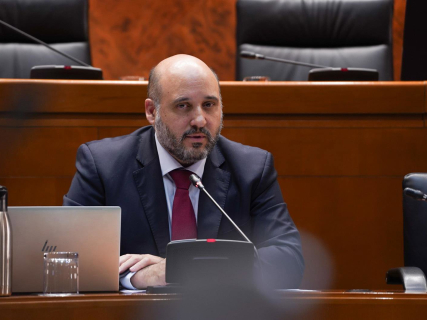

The president of the Court of Accounts of Aragón, Jesús Royo, stated this Monday before the regional Parliament that "it is not easy" to take charge of the management of electoral expenses. He did so during the presentation before the sectoral committee of the report on the audit of the electoral accounts corresponding to the regional elections held on February 8.
Royo explained that the purpose of the work of the auditing body has been "to analyze the management of resources and their compliance with the legal framework." He insisted that "at all times the Court of Accounts makes a technical diagnosis, it does not design how political parties should spend money."
In his appearance, he detailed that "there have been three concepts that have been very well reflected by all parties, and that is that it has been possible to distinguish between the declared expenditure, the granted, and the accepted subsidy," which, in his opinion, implies that "the same rules apply to the same facts."
Globally, the head of the auditing body indicated that 99.59% of the expenditure declared has been considered valid. Likewise, he wanted to acknowledge "the work of all parliamentary groups and electoral administrators," as "it is not easy to manage this type of expenditure" and "the result reflected in the report shows that the work has been done satisfactorily."
In the chapter of recommendations, Jesús Royo stated that "we must adjust to the new social reality, but it must be done now, we cannot wait until two months before the elections," emphasizing that "the greater the objectivity, the more transparency there will be and less discretionary scope." He also stressed that "it is important to take into account the registration of needs when they arise and not when they are paid."
From the PP, the deputy Lorena Tabanera emphasized that "all parliamentary groups have submitted the accounts on time," highlighting that her party "does not have a single euro of unapproved expenditure, has no debts with suppliers, and all of them were informed to the Court."
Furthermore, she highlighted that "the organic law provides for the possibility of having public and private resources, and what is important is not where the money comes from, but that it is lawful and legal."
On behalf of the PSOE, Óscar Galeano has considered that the document "conveys a generally very positive overview regarding the image of transparency that we can give in moments of electoral contention." Nevertheless, he has pointed out that "it should be considered whether it is necessary to address some kind of update in the regulations taking into account the digital reality of the moment."
On behalf of Vox, Juan Vidal has defined the report on the accounting of electoral expenses as "rigorous and detailed," and has specified that "in general, most of the expenditure has been allocated to the preparation of envelopes and ballots and various advertising actions." "All parties have respected the spending limits," he has pointed out.
The CHA deputy Verónica Villagrasa has maintained that "the trust of the citizens requires that there is certainty that all parties compete on equal terms," highlighting, moreover, that "this report conveys a very positive message regarding all parliamentary groups."
The spokesperson for Teruel Existe, Tomás Guitarte, has expressed his recognition to the staff of the Court of Accounts and has pointed out that "at no time have there been actions contrary to legality." "We are going to comply with all procedures and we accept what the report says and the sanction for not having paid on time one of the invoices we had," he has added.
Nominative subsidies from the Provincial Council of Zaragoza and Huesca
On the other hand, the Working Group on relations with the Court of Accounts met this Monday to finalize the report on the resolution proposals registered by the parliamentary groups regarding the audit reports on compliance with the legality of the nominative subsidies granted by the Provincial Council of Zaragoza and Huesca in the fiscal year 2022.
Regarding the report from the Provincial Council of Zaragoza, twenty-two resolution proposals have been incorporated, of which eight come from the popular group, one from the PSOE, five from Vox, seven from Chunta Aragonesista, and one from Aragón-Teruel Existe. In relation to the report from the Provincial Council of Huesca, the groups have raised nineteen resolution proposals: seven from the PP, one from the PSOE, two from Vox, six from CHA, and three from A-TE.