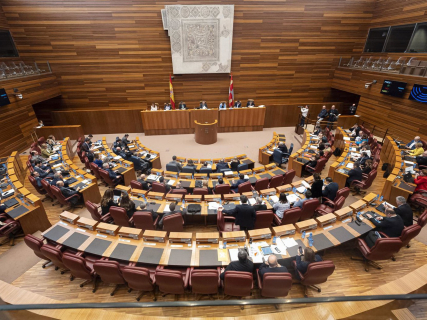

The constitution this Tuesday, April 14, of the Cortes of Castilla y León, with which the XII Legislature begins, has also activated the effective application of the rules that regulate the regime to which the procurators who have recognized exclusive dedication to their parliamentary work must submit.
These rules are included in the Agreement of the Bureau of the Cortes approved on October 2, 2025, during the XI Legislature, where it was established in its eighth point that they would come into force on the day of the constitutive session of the new Cortes elected in the first regional elections, a circumstance that materialized this Tuesday.
To elaborate this framework, the Bureau of the Cortes took as reference the incompatibility regime foreseen in the Organic Law of the General Electoral Regime for the members of the General Cortes –deputies and senators–, starting from the idea that the experience accumulated in the Congress and the Senate will facilitate its interpretation and application and will reinforce the legal certainty of the affected procurators.
The six members of the Bureau of the Cortes –Francisco Vázquez, Carlos Menéndez, Nuria Rubio, Daniel de la Rosa, Rocío Lucas and Susana Suárez–, as well as the spokespersons of the parliamentary groups –Leticia García, Carlos Martínez, Carlos Pollán and the one designated by the Mixed Group–, will be subject to the exclusive dedication regime, unless they expressly renounce said regime by means of a written statement addressed to the Bureau of the Chamber.
In addition, the procurators designated by the spokespersons of each parliamentary group will be able to opt for exclusive dedication, in the number determined by the Bureau at the beginning of each legislature. The spokespersons will retain at all times the power to review and modify those designations.
The agreement establishes that exclusive dedication is incompatible with the performance of any public function remunerated by salary, wage, or fee and with any other position in the service or with an allocation in the budgets of constitutional or statutory bodies, of public administrations, their agencies and public entities, as well as of companies with majority direct or indirect public participation, or with any activity on behalf of them, directly or indirectly.
Likewise, it will be incompatible with the perception of any other remuneration charged to the budgets of constitutional or autonomous bodies or of public administrations, their autonomous bodies, public entities and companies with direct or indirect majority public participation.
Another incompatibility included is the receipt of passive rights pensions or of any public and mandatory Social Security scheme, as well as the exercise of management, defense, direction, or advisory activities before state, autonomous, or local public sector bodies or companies, in matters that these entities must resolve, that directly affect the provision of a public service or that seek the obtaining of public subsidies or public guarantees.
The legislator excluded from this prohibition private acts that, in exercise of a recognized right, are carried out by the interested parties themselves, and also subsidies or guarantees whose granting derives from the automatic application of what is provided for in a general law or regulation.
Exclusive dedication will also be incompatible with the condition of contractor or guarantor of works, services, supplies and, in general, of contracts paid with funds from state, autonomous, or local public sector bodies or companies, as well as with the performance of positions that entail functions of management, representation, advice, or provision of services in companies or firms dedicated to said activities.
As a sixth incompatibility, the exercise of positions or offices that carry associated functions of management, representation, advice or provision of services in companies or societies that are lessees or administrators of monopolies is contemplated, and as a seventh, the provision of advisory services or of any other nature, with individual or shared ownership, in favor of organisms or companies of the state, autonomous, or local public sector.
Nor will exclusive dedication be compatible with the holding of a stake greater than 10 percent, acquired totally or partially after the date of election as procurator, except in the case of inheritances, in companies or societies that maintain contracts for works, services, supplies or any other type of contracts financed with funds from state, autonomous, or local public sector bodies or companies.
The ninth and last incompatibility affects the exercise of functions of chairman of the board of directors, director, administrator, general director, manager or equivalent positions, as well as the provision of services in credit or insurance entities, or in companies or entities whose purpose is fundamentally financial and that publicly resort to savings and credit.