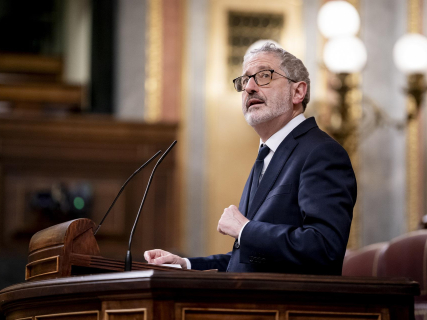

Sumar wants to set the pace for the upcoming Budgets in fiscal terms. The day after starting negotiations with the PSOE, it presented a new levy to raise 4.200 million euros from the large fortunes of the country. The objective is to finance a universal benefit of 200 euros per month for families.
Carlos Martín Urriza, economic and fiscal spokesperson for the group, meets with DEMÓCRATA to explain his proposal and, in passing, advance what they are asking from the Ministry of Economy to face a price crisis that, far from easing, is worsening. The previous one ended with inflation of corporate profits and this one, he criticizes, is going down the same path.
That is why he asks Vice President Carlos Cuerpo to “buckle down” and favor a wage pact in collective bargaining. That and capping prices, especially in housing: “In the PSOE they believe they lost last time because of debt, but it was housing. And we are at risk of losing again because of housing.”
Q: The new levy you are promoting would be a new public non-tax wealth benefit, the format that the energy and banking levies had.
A: Unlike a tax, this figure allows for a targeted use. In this case, to finance a universal benefit for child-rearing that combats the high rates of child poverty in Spain, above 10% when the European average is slightly above 8%. And countries with per capita income levels far below Spain, like Poland or Portugal, are at 3% and 2%, respectively. Our level of development does not align with these high rates of child poverty.
We have over 10% child poverty when Poland or Portugal, with lower income levels, are at 3%
Q: The focus of the levy is on the super-rich, it is aimed at fortunes over 50 million euros.
A: In reality, we tax what they have above 50 million. The large fortunes of the country are not contributing as they should. Despite the improvement we made in the Tax on Large Fortunes, when we set a floor to avoid regional competition, the Wealth Tax has deductions and exemptions that benefit large fortunes and make the tax less progressive in its highest brackets.
Among them, that the sum of what you pay in IRPF plus what you pay in Wealth cannot exceed 60% of your taxable base, being able to reduce you up to 80% of the fee in Wealth. Others are the deductions for shares in a family business. They may make sense for a small drugstore, but the largest company by market capitalization in the country is a family business (referring to Inditex). It makes no sense that they can benefit from that exemption.
Large fortunes are not contributing what they should
Q: How much do you think it is possible to collect?
A: About 4.2 billion euros from 1,500 taxpayers, which is actually a floor. We have worked with the household panel of the Institute of Fiscal Studies, which is from 2023, and large fortunes increased in 2024, according to the general aggregated statistics just published by the Tax Agency. We think that in 2025 and 2026 as well.
The concentration of wealth affects public debate, democracy. Globally, it is more easily seen with all these large tech CEOs who influence public debate and hack democracy. Here it is not so transparent.
Q: Have you included a clause so that if a large fortune changes residence, they continue to pay the tax?
A: We have set that escape clause at five years. But, notice, in other countries that we think are more liberal or neoliberal, like the United States, they are more forceful: if you want to maintain nationality, you have to continue taxing in the country.
The European Union needs fiscal muscle to finance the challenges in green and digital transition
Q: Are you going to bring this tax to the budget negotiation with the PSOE?
A: Yes, just like the new tax on large inheritances and donations that we presented a few months ago to establish a floor in the Inheritance and Donations Tax and tax inheritances above one million euros.
All of this is part not only of our strategy as a party but of an international movement. In the statement of reasons, we cite Gabriel Zucman and the Zucman rate, because it moves in that direction.
We are at a critical moment in Europe. We need to finance European public goods related to the green transition, the digital transition, housing, defense... And that has to be financed with debt, with eurobonds, but obviously needs fiscal backing. It is the next Hamiltonian leap that the European Union needs. In its day we had a leap with the single market, then with the euro. Now we need to generate a European treasury with fiscal muscle. This type of taxes can be part of it, just like the tax on energy companies, which we have not managed to maintain at the national level but which countries like France, Germany, or Spain are demanding.
ENERGY AND INFLATION CRISIS
Q: What are you going to propose to contain energy prices? This month many of the measures to face the economic consequences of the war expire.
A: We are again at the beginning of a serious inflationary crisis generated by the war caused by the far-right Trump. We have a problem with skyrocketing and abusive margins of the refineries, which are taking advantage to pass on to final prices a growth that they do not have in costs. That needs to be tackled. We want maximum prices on hydrocarbons, as we already have on butane. We want to recover the Iberian exception.
The refineries are taking advantage to skyrocket their margins. We want maximum prices and to recover the Iberian exception
We cannot escape the rise in energy prices. What needs to be done is to manage that rise and distribute it among entrepreneurs, workers, the state, rentiers, banks… There should be no abusive margins in the energy sector or in supermarkets, but rentiers should not take advantage either.
Q: What do you propose regarding housing?
A: We ask for the extension of rental contracts and to cap them at 2%. We also want to cap increases in mortgage contracts, especially because the references used, the Euribor and the IRPH, are not good. The IRPH is even worse, but the Euribor is an indicator manufactured by the banks themselves.
Before the 2008 crisis, there was an interbank market, but it ceased to exist and now it is determined through opinions of a panel of experts who are in the banks themselves. That is why it is above 3%, when intervention rates are well below.
We cannot escape the rise in energy prices. What needs to be done is to distribute it and ensure there are no abusive margins
We also want savings this time to be remunerated. Banks are going to make a lot of money just by leaving their liquidity in the central bank. We want those references to be shared with savers.
Q: And how do you achieve bringing that profitability to the clients?
A: By also setting a floor. Establishing that a part of the intervention rate of the deposit facility has to go to the sight accounts. That is what we have to do now.
In this crisis, what happened in the previous one cannot happen, where the loss of purchasing power falls only on the shoulders of working families. Our problem in the previous Ukraine crisis was not wage inflation, but profits. The second-round effect came from profits.
According to the Business Margins Observatory, entrepreneurs are at historic highs in profits and expanding margins. They are increasingly making more profits on sales. That is where the Minister of Economy, Carlos Cuerpo, has to work to find a solution.
We want to cap the rise of mortgages and force banks to remunerate savings
We have proposed one: to bring the information from the Business Margins Observatory to the negotiation tables of collective agreements. And then, in the most important collective agreements, respecting the autonomy of collective bargaining, talk with social agents. The minister, who is also the vice president, has many instruments to, through incentives, facilitate a fair distribution of the burdens that Trump has imposed on us.
Q: President Pedro Sánchez asked last week in Congress for sensitivity from the employers to raise salaries.
A: The Government is here to govern, and we are going to demand the vice president to roll up his sleeves and get down to the reality of each sector, of each activity, and to distribute that loss of well-being that Trump has imposed on us due to that reckless war. This coalition government has seen worse and has moved the country forward.
The problem of the Ukraine crisis was profit inflation. It cannot happen again
Q: Do you think there may be fear of a next major crisis and that companies will resort to layoffs again as in 2008?
A: Look, organizing an appropriate practice of cost distribution between capital and labor, which unions and entrepreneurs know how to do if you give them the instruments, is what allows you to manage a more serious crisis.
Businessmen are at historic highs in profits. That is where Vice President Cuerpo has to work, to go down to the negotiation tables
Adjust profits, dividends, salaries, to navigate a difficult situation and preserve more employment. And, when there is a recovery, quickly recover the lost purchasing power and salary. It should be a shared management, but the Government has to accompany it and believe in that.
Believing that the markets will solve it ultimately leads to an unfair distribution of burdens and to people being angry. There is a political responsibility that needs to be managed.
HOUSING CRISIS AND POLITICAL BLOCKAGE
Q: You have talked about many proposals regarding housing. I understand that many of your proposals are also in the decree-law that has not yet been released.
A: The problem is that we have a Parliament that closes to the right and defends property owners against tenants. Last week we proposed something very logical: that companies and funds that do not live in the houses cannot buy them in tense areas. Well, it did not go ahead and the PSOE abstained. We could not convince the Government partners that the housing issue is a serious issue.
In the PSOE they believe they lost last time because of the debt, but it was the housing. And we are at risk of losing again because of housing
In the PSOE they think they lost last time because of the debt, but they lost because of housing. The debt was a consequence of having poorly managed real estate. And we are at risk of the Government losing again because of housing.
We could have used 61 billion in soft loans from the Recovery Plan but they preferred not to increase debt because they think it is the danger. But, in reality, the danger is housing. What makes citizens think that you know how to manage the economy is that you solve their problems. And one of the fundamental problems for many people is that they cannot have a personal project because they cannot access housing at a reasonable price. And the PSOE does not quite see it.
The PSOE prefers not to increase debt because they think it is a danger, but the danger is housing
REGIONAL FINANCING
Q: Another major debate that will open in Congress is that of regional financing, an issue that has had a lot of internal debate in Sumar. Has that discussion concluded yet?
R: Yes, I believe that the position is very well established. We all agree that it is very good for the Government to take the initiative to renew a system that has been outdated since 2014. And it does so by putting 21 billion more on the table, although part of it, about 3 billion, comes from the autonomous communities.
The communities have received a huge amount and have not improved services due to the privatization processes
Our fundamental criterion is that the level of public service must be equivalent throughout the country. We advocate for a complete leveling based on the adjusted population of each territory, which leads to the quality of the public service provided being equivalent, regardless of the territory. In this, I believe our space coincides, and now we have to sit down to negotiate the elements to reach that common goal.
We also want to condition those 21 billion, within the financing system or outside of it. Unlike the General Administration of the State, the communities have received that increase in revenue in their budgets, a huge amount. And we are not seeing that waiting lists are decreasing in healthcare, for example, or that education is improving.
If we are going to put more money into the financing system, we want a reflection on the efficiency of the privatization processes
What is the reason behind all this? The privatization processes. The cost of a public service, such as that of a hospital, is only in the doctors, nurses, orderlies, and the material and machinery that is needed.
If you do it through a private hospital, you also have to compensate for the private capital, which is not satisfied with a margin of 2% or 3%. They ask for 10% or 15%. This is making public services more expensive and is draining a large part of the money that taxpayers contribute. We want this issue, even if it is not within the financing system, to be part of the reflection. If we are going to put more resources, a reflection should be made in terms of the effectiveness and efficiency of that spending.