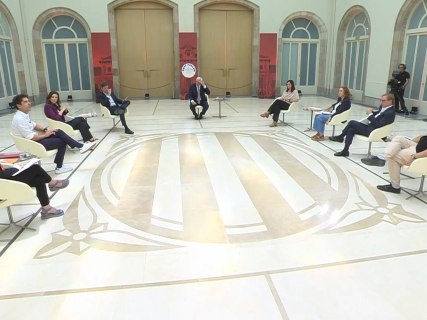

The crisis of the educational system, the reform of the autonomous financing model, access to housing, and immigration, among other issues, have been the focus this Thursday of the debate among the spokespersons of the groups in the Parlament on La2Cat and Ràdio 4, in a space covered by Europa Press.
The spokespersons who intervened were PSC-Units, Elena Díaz; the representative of Junts, Salvador Vergés; that of ERC, Ester Capella; that of PPC, Lorena Roldán; that of Vox, Joan Garriga; that of the Comuns, David Cid; that of the CUP, Dani Cornellà, and the leader of Aliança Catalana, Sílvia Orriols.
Debate on the educational pact
In terms of education, the central axis has been the educational pact that the Govern and several parties have put on the table to try to address the current crisis: PSC, Junts, ERC, and the Comuns agree that it is essential and point out as priorities to reduce bureaucracy, strengthen Catalan, lower ratios, advance in inclusive education, climatize classrooms, and improve the working conditions of teachers.
Roldán has deemed a pact unfeasible with those who, in her opinion, have directed educational policies in recent years without admitting that linguistic immersion has failed; and Garriga has announced that they will not participate in the meetings: "We will not waste time."
The CUP will attend the meetings to "propose that the Govern listens to whom it needs to listen," that is, to the unions and the entire educational community; while Orriols has assured that her party does not establish sanitary cords, but has demanded that educational policies move away from the current "political correctness" and has rejected the inclusive education decree.
Even sharing the convenience of the pact, Vergés has reproached ERC and the Comuns for having supported the Executive despite the teaching conflict. Capella has responded that now the Govern has no excuses not to resolve it, since it has budgets.
Cid has also pointed to Junts and ERC, who have been at the head of the Govern in recent years, and Díaz has defended that the Executive has increased resources allocated to education by 25%: "Education must be the number 1 priority for the Govern and for the rest of the political forces."
Autonomous financing model
Regarding the new financing model, Capella has offered collaboration to Junts to gain their support, understanding that they are willing to explore improvements, and has asked them if they will accept to give up 4.700 million despite the defense that those of Carles Puigdemont make of the economic agreement.
"Who must approve it is a majority in the Spanish parliament that does not agree with the agreement nor with anything that comes from Catalunya," Capella has warned Vergés, who has called for weaving a common front with the PSC to pressure in favor of the agreement.
According to Vergés, those 4.700 million correspond to the proportional part that Catalunya should receive due to the increase in revenues from the central Government: "This is not an improvement in financing. We ask to leave the common regime and have what the Basques already have."
For the socialist spokesperson, it is urgent to agree on a new model and has accused the PP of being "incapable" of presenting a proposal when it governed and of limiting itself to criticizing every initiative that is proposed; Cid has demanded that the new financing serve to reinforce housing, public services, and Rodalies, and not to expand the Barcelona Airport.
Roldán has defended that the system should be agreed upon jointly among all communities and not through a "bilateral negotiation" between the President of the Government, Pedro Sánchez, and the leader of ERC, Oriol Junqueras, and has questioned the spending on foreign delegations and high-ranking officials.
In a similar line, Garriga has maintained that the money should remain in the hands of workers and families and not with the Government or the Generalitat, while Orriols has labeled the idea of a singular financing as a fallacy, has warned that the model "dilutes all singularity of the Catalan nation" and has claimed the agreement.
Proposals on housing
The divergences between left and right have intensified when addressing housing: PSC, ERC, the Comuns, and the CUP have bet on regulating the market, while Junts, PP, Vox, and AC have attacked interventionist policies.
Capella has defended that limiting rents helps contain prices and must be accompanied by rehabilitation: "It must be taken out of the speculative logic"; Cid has emphasized stopping speculative purchases and, along with Cornellà, has demanded restricting tourist-use housing.
Vergés has rejected "lessons" from the left on housing and has criticized interventionism, proposing as the main way to increase construction: "Cranes are missing in Catalunya"; Díaz has responded that the escalation of prices has been halted and that 6 out of every 10 public housing units being built in Spain are in Catalunya.
Roldán has advocated for boosting construction and deregulation: "Every time you bring out a law to regulate housing, you take apartments off the market," she has shot at the leftist parties; Garriga has proposed zero taxation for the purchase of the first home and priority for Spaniards in access to social housing, and Orriols has maintained that immigration has worsened the housing problem.
Immigration and ideological clash
In the final block, dedicated to immigration, the differences between blocks have also been evident. The socialist Elena Díaz has defended working for the integration of immigrant people, while the republican Ester Capella has claimed to guarantee rights regardless of origin "nor the identity card that both the PP and Vox always wield."
From Junts, Vergés has admitted that immigration concerns citizens and has asked to face it without denying reality or claiming that "nothing happens here and that we want to welcome," but neither with the message of expelling any immigrant. The leader of AC, Sílvia Orriols, has demanded the deportation of irregular immigrants and has accused the Government of not controlling the borders.
The popular Lorena Roldán has rejected transferring immigration competencies to the Generalitat and has defended a firm migration policy coordinated with the EU to protect sovereignty and territorial unity, while the Vox spokesperson, Joan Garriga, has assured that "uncontrolled and illegal immigration" generates insecurity.
The 'cupaire' Cornellà has maintained that Catalunya must assume the immigration competency, just like in other areas, and for the spokesperson of the Comuns, David Cid, the problem is to suggest that an immigrant person could already be a potential criminal, which is why he has labeled Garriga as "racist" and has accused the PP of wanting to perpetuate the conflict in Ceuta.