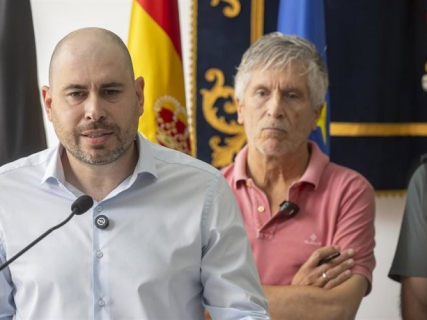
A court opens proceedings against the Government delegate in Ceuta for his alleged inaction in the face of warnings from the CNI

Manos Limpias holds that Miguel Ángel Pérez Triano did not act despite the alerts about the massive entry of migrants and attributes to him a possible crime of negligent prevarication.

2 minutes

WhatsApp Image 2026 09 01 at 20.10.02

WhatsApp Image 2026 09 01 at 20.10.02

Add DEMÓCRATA to Google

Ask FREN

Published

Last updated

2 minutes

Most read

The Investigating Court number 6 of Ceuta has opened proceedings against the Government delegate in the autonomous city, Miguel Ángel Pérez Triano, for an alleged crime of omissive prevarication, after the complaint filed by the association Manos Limpias.

The organization claims that the delegate did not take the necessary measures despite having been informed by intelligence services of a possible mass entry from Morocco. The complaint was filed on August 26 before the Dean Court of Ceuta and subsequently expanded to include other episodes related to the crisis.

The judicial procedure, therefore, stems from the accusations made by Manos Limpias and must determine whether there was any irregular action on the part of the Government delegate and whether this may have criminal relevance.

The complaint is supported by Robles' statements

Manos Limpias bases part of its complaint on the appearance of the Minister of Defense, Margarita Robles, before the Defense Commission of Congress on August 25.

According to what the union states in its document, Robles affirmed that the services of the National Intelligence Center (CNI) had warned the Government delegate of the situation that could occur in Ceuta.

The minister explained that the CNI had conveyed on July 29, one day before the mass entry, information about the movements of people preparing to irregularly access Spanish territory from Morocco.

Manos Limpias believes that this information obligated the Government delegate to take measures to prevent the mass entry and argues that his alleged lack of action may have contributed to the subsequent consequences.

The central issue of the proceedings will be to determine what information Pérez Triano actually received, when he received it, and what decisions were made based on it.

The complaint was expanded by other episodes

The union later expanded its complaint considering that there were other facts that needed to be investigated.

Among them is the assault suffered by four soldiers in Ceuta, after a Regulars patrol was attacked with stones in the Benzú area.

Manos Limpias argues that there would also have been a lack of action on the part of the Government Delegation in this case and demands that the possible responsibilities arising from these events be investigated.

The organization qualifies in its writing the actions it attributes to the delegate as "irresponsibility," "inaction," and "serious imprudence".

More key points, information and questions with FREN

AI-GENERATED CONTENT

What are the legal competencies and powers of a Government delegate in the autonomous cities according to Spanish legislation?

The Government delegate in the autonomous cities of Ceuta and Melilla is the highest representative of the National Government in each of them and the executive body that heads the General State Administration (AGE) in the territory. Their competencies are regulated, on a basic level, by Law 40/2015, on the Legal Regime of the Public Sector, by the regulations on the peripheral organization of the AGE (such as Royal Decree 1330/1997, on the structure of the Government Delegations), by Organic Law 2/1986, on Security Forces and Corps, and by the Statutes of Autonomy of Ceuta and Melilla.

1. General functions as Government representative

According to Law 40/2015, the Government delegate is a management body of the state peripheral administration and exercises a set of competencies that the text itself systematizes into five major blocks:

  • Direction and coordination: directs and coordinates the AGE within the territorial scope of the city, ensuring that the actions of state services and bodies comply with the Government's objectives and guidelines. Exercises superior direction over the functional areas and the services integrated into the Government Delegation.
  • Information on Government action: acts as the main channel of reciprocal information between the Government and the citizens of the autonomous city, disseminating state policies and conveying to the Executive the territorial needs and problems that require state response.
  • Coordination and collaboration with other Administrations: promotes cooperation with the autonomous city and with the local Administration (when it exists), participating in coordination bodies and facilitating joint action on matters of common interest.
  • Legality control: ensures that the actions of public Administrations in the city respect the competence order and the State's legal system, promoting, where appropriate, the challenge of provisions or acts before the contentious-administrative jurisdiction when appropriate.
  • Development of state public policies: promotes and supervises the territorial execution of Government public policies, especially those with a direct dimension in the territory (infrastructure, state social services, immigration, etc.).

Royal Decree 1330/1997 further specifies their position as the apex of the Government Delegations, with a support cabinet and functional areas (for example, promotion, industry and energy, agriculture, health), and attributes specific competencies over the integrated services, including the management of administrative authorizations, civil protection, immigration, and asylum, which in practice are channeled through the Delegation.

2. Relationship with Ceuta and Melilla as autonomous cities

The Statutes of Autonomy of Ceuta (Organic Law 1/1995) and Melilla (Organic Law 2/1995) configure both as autonomous cities with their own competencies and, at the same time, expressly recognize the presence of the Government delegate as a state representative.

In particular, they foresee that, by joint initiative of the city president and the Government delegate, mixed bodies may be created responsible for drafting and controlling the execution of joint plans and programs of works and services, “without prejudice to the competencies that correspond, in their respective scopes, to each of the two Administrations.” This underlines a specific function of the delegate in Ceuta and Melilla: to articulate structured cooperation between the AGE and the autonomous city, especially in areas of strong state involvement (borders, immigration, security, strategic infrastructure, etc.).

Law 40/2015 also includes specific references to the Government delegates in the cities of Ceuta and Melilla and to the “relations with the cities of Ceuta and Melilla” in its additional provisions, reinforcing the idea that, in these unique territories, the delegate is a key piece of the State's presence and inter-administrative coordination.

3. Public order, security, and civil protection

According to Organic Law 2/1986, the direction of the State Security Forces and Corps corresponds to the Government and, within it, to the Ministry of the Interior. At the territorial level, this direction is exercised through the peripheral structure, where the Government delegate plays a central role:

  • Coordination of the National Police and Civil Guard in the territory of the autonomous city, in accordance with the instructions of the Ministry of the Interior, and participation in citizen security planning mechanisms.
  • Presidency or relevant participation in the Local Security Boards, regulated by regulation, where the actions of the state bodies are coordinated with the local police (when it exists) and with the authorities of the autonomous city.
  • Action in emergency and civil protection situations, directing or coordinating, according to state and city plans, the response of state resources in cases of disaster, serious risk, or public calamity.

4. Summary

In short, the Government delegate in Ceuta and Melilla:

  • Politically represents the National Government.
  • Directs and coordinates the entire General State Administration in the territory.
  • Ensures collaboration with the autonomous city and other Administrations.
  • Monitors respect for the constitutional order of competencies and state legality.
  • Articulates the territorial execution of public policies, with a special role in security, borders, immigration, and civil protection.

All this makes the Government delegate a key body for the effective presence of the State and for managing the institutional and geopolitical singularities of Ceuta and Melilla.

Could you detail exactly what Law 40/2015 says about the competencies of Government delegates, article by article? What mixed cooperation bodies exist in practice between the Government Delegation and the autonomous cities of Ceuta and Melilla? How does the Government delegate coordinate with the State security forces and corps in migration crisis situations at the border?

What has been the professional and political career of Miguel Ángel Pérez Triano before taking office as Government delegate in Ceuta?

Miguel Ángel Pérez Triano arrives at the Government Delegation in Ceuta with a profile clearly marked by his career in the educational field and by his organic role in the Socialist Party in the autonomous city. Before being appointed representative of the central Executive, his career was mainly developed as a teacher and as a leader of the Ceuta PSOE, from where he actively participated in debates on migration, coexistence, and social policies.

On the professional level, available sources indicate that Pérez Triano is a teacher by profession. He holds several specialties in the field of teaching: Primary Education, Early Childhood Education, and Physical Education, all studied at the University of Granada. This initial training is complemented with higher studies in the field of educational sciences, as he is graduated in Pedagogy from the National University of Distance Education (UNED). This educational path clearly places him in the profile of a teacher and pedagogue, with a solid foundation both in school practice and in reflection on educational processes.

His experience as a teacher — exercised before his leap to institutional responsibilities — has been highlighted by the Ceuta PSOE itself when defending his appointment as Government delegate. The party emphasizes his direct knowledge of Ceuta's social reality from the educational system, where issues of cultural diversity, integration of students from very different origins, and structural deficiencies typical of a peripheral territory converge. Although public sources do not specify precisely in which schools or for how many years he worked, the constant emphasis on his condition as a teacher and pedagogue allows concluding that this has been his main previous professional occupation.

On the political level, the most relevant feature of his career before arriving at the Government Delegation is his role as secretary general of the Ceuta PSOE. Both in press reports from 2025 and in the announcement of his appointment in 2026, he is identified as the top leader of the socialist organization in the city. From that position, he has been one of the most visible voices of Ceuta socialism, especially on issues related to migration management, interreligious coexistence, and relations with the national leadership of the Popular Party.

In 2025, for example, he appears in the media as secretary general of the Ceuta PSOE criticizing the stance of the local and national PP regarding the reform of the Immigration Law to allow the relocation of unaccompanied migrant minors from territories in emergency situations, such as Ceuta and the Canary Islands. In that context, Pérez Triano aligns with the Government Delegation and local socialists to defend the legal modification and to reproach the Ceuta PP for distancing itself from a solution that the city had been demanding due to the saturation of its reception resources.

Also before his appointment, he intervenes in the public debate defending the Muslim population of Ceuta and Melilla, following statements by conservative leaders that generated controversy. As socialist secretary general, he demands an explicit condemnation from the Ceuta PP of those speeches, arguing that they endanger coexistence and attack the dignity of an essential part of the citizenry. This line of intervention shows a political profile focused on defending the religious and cultural pluralism characteristic of Ceuta.

The fact of combining his role as secretary general of the PSOE with a previous career as a teacher and pedagogue draws a figure who arrives at institutional politics from a professional field linked to public service, and not from administration or the business world. There is no record, in the sources consulted, that he had previously held elected positions in the Ceuta Assembly or other institutions, nor that he had held responsibilities in previous governments; his leap to the institutional forefront occurs with the appointment as Government delegate, agreed by the Council of Ministers in February 2026.

In summary, before assuming the Government Delegation in Ceuta, Miguel Ángel Pérez Triano combines two major career axes: on one hand, a professional career as a teacher and pedagogue, with specialized training in several educational stages and a degree in Pedagogy; on the other, an organic political projection as secretary general of the Ceuta PSOE, from which he becomes a regular interlocutor on migration, children's rights, and coexistence issues in the autonomous city. His institutional appointment can be read, in light of these backgrounds, as the culmination of that double educational and political local trajectory.

What are the legal requirements for a court to open proceedings for an alleged crime of omission prevarication in Spain?

For an investigating court to open proceedings for an alleged crime of omission prevarication in Spain, it is not required to prove the crime, but rather the existence of facts with a minimally reasonable appearance of constituting that offense. The threshold is rational indications of crime, not certainty, and their absence allows the immediate dismissal of the complaint or accusation.

1. What is omission prevarication

The crime of prevarication in article 404 of the Penal Code punishes the authority or public official who, in the exercise of their office, issues an arbitrary resolution knowing it to be unjust. The figure of omission prevarication is not usually named in the provision itself, but is jurisprudentially constructed as the unjust decision adopted by inactivity: not resolving, not processing, not issuing a due act, when there is a clear legal duty to act and that inactivity produces a result materially equivalent to an arbitrary resolution.

For there to be even a basis to open proceedings, the complaint or accusation must describe:

  • A qualified active subject (authority or official in the exercise of their office).
  • A concrete legal duty to act (to resolve, initiate a file, issue a resolution within a deadline, etc.).
  • A relevant inactivity (silence, paralysis, failure to initiate basic procedures) that is not mere ordinary bureaucratic delay.
  • A clear and serious injustice of that inactivity, not a simple irregularity or interpretative doubt.
  • A minimum support of intent (that the official knew the duty to act and, despite that, deliberately abstained).

2. Threshold of indications to initiate proceedings

The Criminal Procedure Law allows the investigating judge to immediately dismiss the complaint or accusation when the facts “do not constitute a crime” or are manifestly implausible. Only when from what is presented there are rational indications of crime or, at least, a reasonable appearance of typification, is it appropriate to initiate preliminary proceedings.

In practical terms, the court usually checks upon admission:

  • That the document identifies concrete facts, approximate dates, and specific actions or omissions, not mere generic assessments.
  • That some minimal objective basis is provided (documents, resolutions, unattended requirements, communications, etc.).
  • That, even provisionally, those facts could fit the criminal type of omission prevarication.
  • That the body is competent by reason of territory and person (privileges, if any).

3. Limits: minimal activity, no “general causes” and judicial sphere

Jurisprudence insists that criminal investigation must be limited to a minimal reasonable investigative activity: the judge may open proceedings to verify basic data (request a file, take statements, request reports…), but is not obliged to transform any administrative disagreement into an open criminal case.

From this derive three important limits:

  • Prohibition of “general causes”: the complaint cannot seek that the judge audit globally the functioning of an Administration, department, or court without delimiting concrete facts; for generic documents, initial dismissal is appropriate.
  • Difference between illegality and prevarication: mere violation of a rule, delay, or debatable legal criterion is not enough. To open proceedings, a patent and gross injustice is required, at least plausibly exposed.
  • Inviolability of judicial resolutions not manifestly unjust: when what is denounced is the “omission” or criterion of a judge in a procedure, the ordinary channel is procedural appeals, not the criminal complaint, except in extreme cases of evident arbitrary decision.

4. Particularities if the accused is privileged or authority

If the person indicated enjoys privilege (for example, deputies, senators, members of some regional governments, high officials of certain institutions), the ordinary investigating court lacks jurisdiction to open substantive proceedings. In those cases, after a minimal formal check, it usually:

  • Refers the complaint or accusation to the competent judicial body (Supreme Court or corresponding High Court of Justice).
  • Or rejects it indicating lack of jurisdiction, leaving the complainant free to address the privileged body.

In any case, even regarding privileged persons or high authorities, the premise remains the same: only if the account offers a founded appearance that a specific inactivity, when obliged to act, could constitute an arbitrary resolution by omission, does it make sense for the competent body to open criminal proceedings.

Play

Test your knowledge with FREN!

How much do you know about this topic? Answer the following 3 questions.

What crime is the Government delegate in Ceuta, Miguel Ángel Pérez Triano, being investigated for?

Question 1 of 3

Which organization filed the complaint that led to the opening of proceedings?

Question 2 of 3

What key information, according to the complaint, did the Government delegate receive before the massive entry from Morocco?

Question 3 of 3

Hola, soy Fren. ¿Cómo te ayudo?