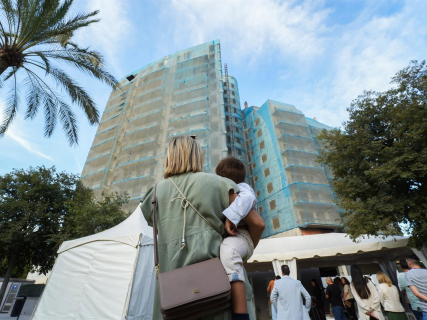

The fourth section of the Provincial Court of Valencia has decided not to reopen the criminal proceedings for the fire that occurred on February 22, 2024, in a building in the Campanar neighborhood, in Valencia, a disaster in which ten people died. The magistrates conclude that no new facts or subsequent evidence have emerged that would justify resuming the investigation.
This is set out in the ruling, which Europa Press has obtained, in which the court dismisses in its entirety the appeal filed by the legal representatives of several relatives of deceased victims and the Community of Owners of the affected building.
The Provincial Court confirms the order of May 8, 2026—issued by the Instruction Section of the Valencia Trial Court, court number 9—that already rejected reopening the case, as well as the resolution of June 16 that declared the application for reconsideration inadmissible. With this ruling, the only option left for the families is to go to the Constitutional Court (TC).
The relatives of several of the deceased persons appealed to the Provincial Court the initial case file, arguing that there was a novel element of relevance: an expert report which, they claimed, introduced technical aspects that had not been examined during the investigation phase.
They argued that the report incorporated new indications, such as the possible invalidity or expiry of the fire reaction certificates used to support the suitability of the façade cladding, or the difference between the thickness of the material analyzed by the Scientific Police (4.5 mm) and the one shown in the documentation provided by ALUCOIL (4 mm).
After analyzing this report, the court has chosen not to reopen the proceedings. In its view, "it does not constitute a enabling requirement for reopening merely a disagreement with the legal or evidentiary assessment already carried out by the investigating body, nor the submission of new opinions, analyses, or interpretations about facts that were exhaustively investigated and subjected to adversarial proceedings during the investigation".
The Provincial Court maintains that the requirement of novelty to justify reopening "cannot be identified with the mere inclusion of a new expert report when it concerns facts, documents, and circumstances fully known during the investigation and already assessed by the judicial bodies".
Along the same lines, consider that the report submitted "does not introduce facts discovered after the filing, nor documentary evidence hitherto unknown, nor results obtained through research techniques that could not have been employed during the investigation". "What it does—adds— is a reinterpretation of the applicable regulations, of the documentation on file in the case, and of the reports previously incorporated into the proceedings, offering conclusions different from those reached during the judicial investigation".
Therefore, the Court emphasizes that the opinion cannot be characterized as a new element in a procedural sense, but rather as an alternative technical assessment of materials already on file in the proceedings, "insufficient by itself to negate the finality derived from the provisional case dismissal ordered", it stresses.
REGULATIONS APPLICABLE TO THE PROJECT
The court also does not uphold the families' argument that the investigation would have overlooked the analysis of the impact of Royal Decree 312/2005, by understanding that this rule had to be applied to the building and that its correct consideration would alter the conclusions reached in the case.
At this point, the ruling specifies that the issue regarding the regulations applicable to the construction project of the property was one of the matters expressly addressed during the investigation, "with statements from municipal technical staff and an analysis of the urban planning and technical legality of the granted licenses".
It likewise states that the debate about whether the NBE-CPI/96, the Technical Building Code, or Royal Decree 312/2005 was applicable does not constitute a new fact, but rather a strictly legal controversy that could have been discussed during the investigation and in the various appeals filed against the case file orders.
"The appearance of a new interpretation of the regulations does not equate to the appearance of a new evidentiary element and, therefore, it lacks the force to justify by itself the reopening of proceedings that had already been archived," the Court says.
The court offers the same dismissive response to arguments related to the alleged expiry of certificates, divergences in the thickness detected in certain samples, or doubts raised about the traceability of the material used on the façade.
And concludes: "The instruction was particularly extensive; an abundant research activity was carried out; and the various claims formulated by the accusations were subject to an express examination both by the instructing body and by the fourth section of the Audiencia".