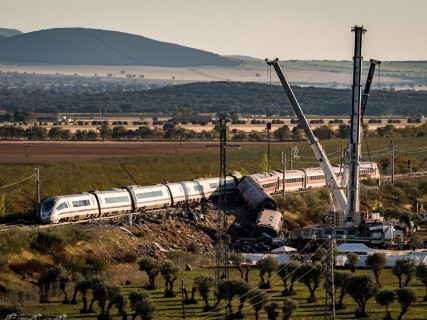

The European Public Prosecutor's Office and the Central Operational Unit (UCO) of the Guardia Civil are keeping open an investigation into alleged crimes of fraud and embezzlement of public funds related to the maintenance of the Madrid-Seville high-speed line, the railway corridor in which the accidents of Adamuz (Córdoba) and Urda (Toledo) have been recorded, which have left a combined toll of 115 fatalities in barely nine months. The investigations, initiated after the first accident, focus on determining how certain Adif contracts were awarded, which companies were beneficiaries and whether the European funds allocated to the railway works were used correctly.
According to La Vanguardia and sources from the European Public Prosecutor's Office have confirmed to Europa Press, the investigation is in an advanced stage and those responsible for the procedure expect important developments to occur during the coming weeks. UCO agents have spent months compiling documentation on contracts, public tenders and awards linked to the maintenance of the infrastructure, while European prosecutors examine whether there are sufficient indications to identify possible those responsible for the investigated irregularities.
The investigation takes on special relevance after the railway accident in Urda, which occurred on Wednesday, October 28 and left 69 dead, barely nine months after the Adamuz accident of last January 18, in which another 46 people died. However, the proceedings concerning the alleged fraud in the contracts are independent of the judicial investigations opened to clarify the causes of both accidents, and for the moment there is no conclusion that allows a relationship to be established between the possible economic irregularities and the railway tragedies.
The European Public Prosecutor's Office has been investigating the AVE Madrid-Seville maintenance contracts since March
The European Public Prosecutor's Office officially confirmed on March 20, 2026 the opening of an investigation into a possible fraud related to Community funds used for the maintenance of the Madrid-Seville high-speed line. In its statement, the body specified that the suspicions initially centered on the actions carried out in the vicinity of kilometer point 318.7, located near Adamuz, where the railway accident of January took place.
The investigations were launched ex officio, without the need for a prior complaint, after the European Public Prosecutor's Office learned that certain interventions in the infrastructure may have received financing from the European Union. Since then, two European prosecutors work together with agents from the UCO of the Guardia Civil to reconstruct the contracting process and verify the destination of public money. The same police group is also participating in the proceedings related to the Adamuz accident, which facilitates coordination between investigations that, although different, affect the same railway infrastructure.
According to the sources cited by La Vanguardia, the investigators have requested from Adif, as the body responsible for the contracts, documentation on the bidding procedures, the awarded companies and the conditions under which the work was carried out. The aim is to determine whether the European funds were used in the actions for which they had been granted or whether irregularities constituting crimes of fraud or embezzlement of public funds may have occurred.
The European Public Prosecutor's Office has the authority to investigate crimes that harm the financial interests of the European Union, so its action is focused on the operations that affect the Community budget. In this procedure, the magistrate of the Audiencia Nacional José Luis Calama acts as guarantee judge, in charge of authorizing the judicial measures that require it, while the European prosecutors direct the investigative proceedings.
UCO prepares new steps in the investigation and analyzes possible responsible parties
The latest information points to the fact that the European Public Prosecutor's Office is finalizing a first phase of analysis of contracts and awards, after several months examining documentation related to the works and maintenance of the Madrid-Sevilla line. The investigators intend to determine which people took part in the administrative procedures, which companies received the contracts and whether there are indications of irregularities in the use of public funds.
According to the sources of the investigation consulted by La Vanguardia, the procedure has become a matter of "maximum priority" for European prosecutors, especially after the second railway accident recorded in the corridor. The Prosecutor's Office also has the collaboration of the Intervención General de la Administración del Estado (IGAE) to analyze economic and administrative aspects of the awards.
Among the next actions could be the identification of people whose participation in the contracts must be investigated more deeply. However, the European Public Prosecutor's Office has still not publicly announced new charges nor specified which awards could present irregularities. The existence of these proceedings also does not imply that the awarded companies or the administrative officials have committed crimes, since it will be necessary to determine whether there is evidence of fraudulent conduct.
The investigation is being carried out through a procedure different from that of ordinary criminal cases led by a Spanish investigating judge. In the sphere of the European Public Prosecutor's Office, delegated prosecutors take on the direction of the investigations and request from the guarantee judge the authorization of those actions that require judicial intervention, such as certain searches or measures restricting rights.
Adif contracts for more than 136 million to renew the Madrid-Seville high-speed line
One of the relevant precedents of the investigation is the renovation program of the Madrid-Seville line promoted by Adif during recent years. In September 2021, the Board of Directors of Adif Alta Velocidad authorized the awarding of three contracts for a combined amount of 136,422,294.81 euros, VAT included, intended to modernize various security, signaling and operation systems of the railway infrastructure.
The highest-value action, valued at approximately 94 million euros, contemplated the renovation of signaling installations, train protection systems, object-fall detectors and telecommunications. Among its main objectives was the implementation of the European Rail Traffic Management System (ERTMS), a technology intended to improve the monitoring of traffic and the interoperability of high-speed networks.
The other contracts included the renewal of the track circuits and the replacement of 63 railway switches, essential elements for detecting occupancy of the sections and allowing trains to change from one track to another. According to what Adif explained when announcing the awards, the purpose of these interventions was to increase the capacity of the line and improve its availability, reliability, and regularity.
The actions were part of a broader program to modernize the first high-speed line inaugurated in Spain, which entered service in 1992. The authorities had envisaged the possibility of using European financing in different renewal projects, including structural improvement work, infrastructure conditioning, and modernization of railway facilities.
The existence of these contracts and their financing does not prove that fraud has occurred. Nor has it been publicly confirmed that the three contracts awarded in 2021 constitute, in their entirety, the subject of the European Public Prosecutor's Office's investigations. These are relevant background to understand the investments made in the corridor, while investigators continue defining the specific awards under suspicion.
The awards cover the terms of Ábalos, Raquel Sánchez and Óscar Puente
The documentary review could reach contracts awarded during the terms of José Luis Ábalos, Raquel Sánchez and Óscar Puente at the head of the Ministry of Transport, due to the time period covered by the maintenance and renewal works on the Madrid-Seville line.
Ábalos headed the department until July 2021, when he was replaced by Raquel Sánchez, who remained in office until November 2023. Since then, the Ministry of Transport and Sustainable Mobility has been headed by Óscar Puente. The investigators are examining the awards and the administrative processes carried out during that period to determine what decisions were taken and how the resources allocated to the infrastructure were managed.
The fact that the contracts correspond to different ministerial stages does not mean that the three political officials have the status of investigated persons in this proceeding. For the moment, the known proceedings are focused on the review of public procurement and on the possible irregular use of European funds, without criminal responsibilities against the department heads having been announced for these facts.
The investigation is also taking place in a context in which Adif has appeared in other judicial cases related to public awards, such as the proceedings linked to the so-called Koldo case. In this last proceeding, heard in the Audiencia Nacional, former officials of the railway administrator have been investigated, including its former president Isabel Pardo de Vera.
However, the European investigation into the maintenance of the Madrid-Seville AVE constitutes a different proceeding, so the suspicions or responsibilities from one case cannot be automatically transferred to another. It will be the result of the proceedings that will make it possible to determine whether specific irregularities existed in the railway contracts examined.
Two accidents in nine months: the investigations of Adamuz and Urda remain open
The inquiries into the maintenance of the infrastructure have acquired a new dimension after the Madrid-Seville high-speed line has recorded two serious railway accidents in barely nine months. The first occurred on January 18, 2026 in Adamuz, Córdoba, and caused the death of 46 people, in addition to numerous injured. The second took place last Wednesday, October 28, in Urda, Toledo, where the collision between two high-speed trains of Renfe and Iryo has left a provisional toll of 69 fatalities.
Both incidents are being investigated in independent judicial proceedings. The Adamuz accident is under the instruction of a court in Montoro (Córdoba), while the proceedings related to the Urda tragedy correspond to a court in Orgaz (Toledo). These investigations must clarify the technical and operational circumstances that caused each incident and determine whether there are criminal responsibilities arising from what happened.
The investigation by the European Public Prosecutor’s Office has a different purpose: to verify whether there was fraudulent use of the Community funds allocated to the maintenance of the railway infrastructure. Although the works under investigation affect the same corridor in which the accidents occurred, it has not been demonstrated that the possible irregularities in the awards caused safety failures or that there is a causal relationship with the collisions.
This distinction is fundamental for interpreting the scope of the proceedings. An eventual economic irregularity in a contract does not necessarily imply that the technical work was carried out defectively, just as a railway accident does not in itself constitute proof of embezzlement. Both issues require different investigations and evidence, although the information obtained in one case may be relevant to other judicial proceedings.
Transportes defends the justification of the European funds and promises to cooperate
The Ministry of Transport already responded to the opening of the European investigations last March, when it assured that the justification of the Community funds granted for the railway works was being carried out normally as the work progressed.
According to sources from the department told then to RTVE, the documentation corresponding to the European aid had been submitted in accordance with the established procedures and both the Ministry and Adif would maintain a cooperative attitude with the prosecutors in charge of the proceedings.
Óscar Puente himself has pointed out that the investigation by the European Public Prosecutor’s Office is not a novelty derived from the Urda accident, but rather a procedure opened months ago, after the Adamuz disaster. The minister has insisted that the intervention of the European Public Prosecutor’s Office is related to the existence of Community funding in the railway works and the need to verify its correct use.
The department’s position contrasts with the suspicions being examined by the investigators, although neither of the two circumstances allows the outcome of the proceedings to be anticipated. The Prosecutor’s Office will have to check the documentation provided, verify the destination of the funds, and determine whether there are sufficient indications to move toward a possible criminal action against specific persons.
What can happen now with the investigation into the AVE funds
The European Public Prosecutor's Office and the UCO are now facing a new phase of the investigation, after several months analyzing the awards and the actions carried out on the infrastructure. The sources consulted by La Vanguardia point to the possibility that relevant progress may be made in the coming weeks, although no dates have been specified and no new judicial measures have been formally announced.
Among the pending issues are the identification of the companies and administrative officials related to the awards examined, the verification of the work actually carried out, and the confirmation that the European money was allocated to the intended purposes. If the prosecutors find indications of possible crimes, they could expand the proceedings and request from the guarantee judge the actions they consider necessary.
All this happens while the technical and judicial investigations into the Adamuz and Urda accidents continue, which have reopened the debate on the state of preservation of the railway network, investments in maintenance, and the safety of Spanish high-speed rail.
The European investigation thus adds a new dimension to the examination of the infrastructure: not only to determine whether the railway systems were functioning correctly, but also to verify whether the public resources allocated to their maintenance and modernization were awarded and used in accordance with the law. For the moment, the suspicions of fraud and embezzlement remain pending proof and there is no judicial conclusion linking them to the two accidents.