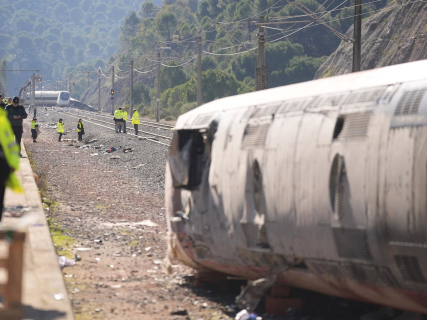

The magistrate of the Court of First Instance and Instruction of Montoro (Córdoba), Plaza número 2, who is directing the investigation of the railway accident in Adamuz, in which 46 people died and more than 120 were injured on the afternoon of Sunday, January 18, has issued a resolution in which she formally requests Adif to submit new contracting files for works and supplies linked to the track renewal that do not yet appear in the case.
According to said resolution, to which Europa Press has had access, the judge specifically requests the construction project for the integral improvement of the infrastructure of the Madrid-Seville high-speed line in the Guadalmez-Córdoba section, as well as the supply, transport, and pre-assembly file for track equipment for that same high-speed line.
Likewise, she requests the documentation related to the supply, transport, and ballast for the renewal of switches on the Madrid-Seville high-speed line (LAV); the project for the renewal of switches (phase 2) on that line, and the execution projects and their possible modifications regarding the renewal of elements of the overhead contact line of the Madrid-Seville LAV between kilometer points 315 and 470.
Conversely, the investigating judge has already confirmed the incorporation into the proceedings of two other contracts that affected the accident section but had not appeared in the list until now. One of them referred to technical assistance for the control and supervision of the drafting of construction projects and the execution of works for the renewal of installations, signaling, and energy, while the other alluded to consulting and technical assistance services for the control and supervision of works included in the energy projects of the Madrid-Seville high-speed line.
CIAF Access to Autopsies
The same resolution, dated July 12, includes the judge's authorization for the Railway Accidents Investigation Commission (CIAF) to access the autopsy reports, considering that "the invoked purpose is of public interest" and that such access may be "useful for formulating recommendations in the establishment of passive safety measures."
In any case, the authorization is subject to strict conditions: the examination of the reports must be carried out in judicial headquarters, on the date and time set by the judicial office, and without "in any case allowing the withdrawal of documentation, issuance of copies, or total or partial reproduction thereof". It is also established that "the capture of images, photographs, recordings, or the use of any documentary or digital reproduction method of the reports is prohibited".
The document further specifies that the persons designated by the CIAF for the examination must identify themselves and will be "subject to the duty of reserve and confidentiality of the information known on the occasion of the access". The information may only be used "for the technical purposes expressed in the request, preserving the privacy of the deceased persons and their families, as well as the duty of protection of personal data".
In relation to the request for access to the interior of cars 6, 7, and 8 of the Iryo train, the judge allows the investigators to enter for the purpose of carrying out a photographic report, a diligence that will be carried out under the supervision and control of the Organic Unit of Judicial Police (UOPJ) of Córdoba, "adopting the necessary measures to avoid any alteration of the wagons and of any vestiges or elements of interest for the investigation, extending the appropriate minutes which will be immediately sent to this judicial body".
On another note, regarding the request to recover the Deuta data recorder from the Alvia train involved in the accident, the magistrate has previously requested "the opinion of the judicial experts before authorizing its extraction", with the aim that "they determine if it affects pending evidence".
Interpretive Analysis and New Diligences
The court has urged the Civil Guard to identify the manufacturer of the Alvia train involved, as well as the technicians from Renfe, Iryo, and the construction company with the capacity to carry out an interpretive analysis of the crashed trains. The judge has required that these specialists be different from those who already participated in the initial reports prepared in March.
The provision also includes official letters from the UOPJ regarding the supervision of Adif's work related to the intervention in the pantograph dynamics detection system and its auxiliary elements, storage of material at the Hornachuelos base, and maintenance and adaptation work on the telecommunications facilities located in the vicinity of the Loma del Partidor tunnel.
Request for unsealing and review of Iryo
Regarding Iryo's request for "the unsealing and prior review for the transfer of carriages number 1 to 5 to the La Sagra (Toledo) maintenance base," the judge has ordered that the judicial experts be notified to indicate "whether the prior supervision and technical verification work necessary to carry out the displacement would involve alteration of effects, evidence, or traces that are relevant to the present investigation."
Finally, with the aim of precisely clarifying the mechanics of the accident, the magistrate ordered a judicial ocular inspection to be carried out last Monday at the exact point where the accident occurred. The investigating judge, the Public Prosecutor's Office, agents of the UOPJ of Córdoba, and the judicial experts participated in this proceeding, analyzing the track layout, the state of the infrastructure, and the concurrent circumstances on site.