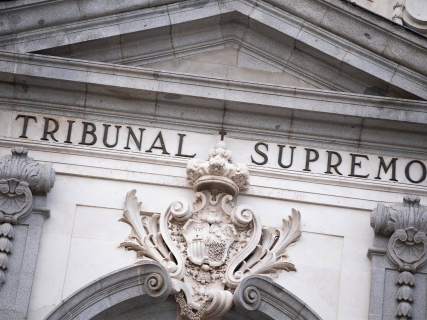

The Supreme Court has annulled the conviction for a crime against moral integrity imposed on a man for several comments published on the social network X after the fall into the well of Julen, the two-year-old boy who died in Totalán (Málaga) in January 2019. The Criminal Chamber concludes that these are expressions lacking empathy, but not constitutive of a criminal offense.
In a ruling reported by Europa Press, the high court accepts the appeal for cassation from the accused and overturns the ruling issued by a Criminal Court in Madrid, subsequently upheld by the Provincial Court, which had imposed 18 months in prison and the payment of 6,000 euros in compensation to the parents of the minor.
The judges, relying on the doctrine of the Constitutional Court and the European Court of Human Rights, frame those messages within the freedom of expression and conclude that they do not fit the criminal type of crime against moral integrity, despite the "lack of sensitivity" that they represented for the child's parents.
"Undoubtedly, the expressions uttered suffer from a lack of sensitivity towards the pain of parents for the loss of the minor and who, anguished, observe the disparaged efforts to save the life of their child who accidentally fell into the well," the judges point out, while showing "solidarity with the family for the suffering that the situation exposed in the proven fact refers to."
According to the resolution, the accused argued that his publications were epigrams of a satirical or critical nature, not aimed at insulting the parents or the minor, but at questioning the media coverage of the event and the continuous news dissemination system from the scene, which in his opinion did not provide relevant information.
The Supreme Court emphasizes that "what is relevant for the author" was to ridicule the media attention and "the coverage of the fact, he did not intend to attack the minor and his family, whom he did not know nor did he come to represent the injury caused to those people."
"They were tangential to the publication of his epigrams. If there is no recipient of the published affront, there is no attack on the moral integrity of the passive subject and the conduct is framed within the freedom of expression," reasons the court.
The Chamber recalls that "the typicality of the crime against moral integrity requires an action aimed at inflicting a serious detriment to moral integrity," so that, to avoid "an excess in its application," the degrading conduct must be serious, normally repeated, and occur in a context of relationship between the author and the victim in which the action is directed directly at harming a personal right of the latter.
Reference to the case of the 'tour of the Pack'
"Because moral integrity is part of a person's dignity and it is necessary that the action attacks the passive subject, in the same way that in article 510 of the Penal Code the action is directed against vulnerable groups and its content must be of such gravity that it compromises the norms of social coexistence," adds the ruling.
In this line, the magistrates bring up a resolution from the Constitutional Court that in 2025 granted protection to a convicted person for organizing a so-called 'Tour of the Pack', of supposed sarcastic nature, which proposed an itinerary through the streets and places linked to the rape of a woman in Pamplona in 2016.
The TC emphasized then, the Supreme Court now recalls, that despite the "seriousness" of the facts and the "little empathy" shown towards the victim, the case had not been analyzed from the objective perspective of its relationship with freedom of expression and creation.
Likewise, the ruling of the TS mentions that the ECHR has established several criteria to assess this type of cases: the context in which the expressions are issued, the personal capacities of the author, the nature and tone of the language used, the possible reiteration of the offensive content, the means used for its dissemination, and the specific conditions of that dissemination.
However, the Supreme Court points out that "the unlawfulness that undoubtedly surrounds the proven fact can be subject to compensation through civil liability as referred to in the law on the protection of honor and personal image," leaving open the possibility of claiming through that route without resorting to the criminal sphere.