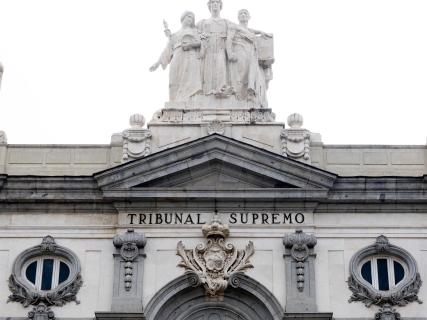

The Supreme Court has rejected the appeal on points of law lodged against the sentence of two years in prison imposed on former international volleyball player Cosme Prenafeta for sexually abusing two 18-year-old players he coached, whom he kissed “without her consent” during the post-meal in a Christmas lunch held at his home in December 2020.
The High Court, which orders the appellant to pay costs, finds that the appeal lacks cassational interest and specifies that it was lodged through an inappropriate procedural channel against an appeal judgment, given that the ruling handed down by the Provincial Court of Almería had already become final.
The decision, which Europa Press has obtained, emphasizes that the appeal sought to reopen the discussion about facts that had already been declared proven, something that is not possible at this stage of the proceedings.
In the proven facts, it is recorded that the two young women, along with other teammates, attended a Christmas celebration at Cosme Prenafeta’s home in 2020 and that, already in the afternoon, only the three remained in the house, “consuming alcoholic drinks and taking part in a game that consisted of questions of a sexual nature and drinking shots of alcohol.”
The judicial account details that Prenafeta, “with the aim of satisfying their lustful desires,” approached one of the girls in the living room, held her by the neck with one hand and gave her a kiss on the mouth “that lasted several seconds.” It adds that the young woman “tried to separate and pushed the accused away” with “her arms thrown backward.”
While this first episode was taking place, the other player had gone to the bathroom and was not in the living room. Upon her return, when they were already tidying up the house, the convicted man attempted on “three occasions” to abuse the second victim in different parts of the home—kitchen, terrace and a bedroom. “On three different occasions, he kissed her on the mouth and on the neck, reaching one of the times to touch her buttocks with his hand over her clothes,” the sentence states.
Statements by the victims and absence of consent
The first sentence, confirmed by the Provincial Court, gave full validity to the version of the two affected women, by finding it “plausible” and “credible,” with no “spurious motives” identified in the complaint. The psychological report prepared after the examination of both injured parties supported the essential elements of their account.
Based on those testimonies, the court concluded “in a decisive manner” the “absolute inexistence of the consent of the two girls” with regard to the accused’s kisses, which “proved to be surprising, unexpected and unpleasant” for them.
The decision emphasizes that Prenafeta “expressly acknowledged having kissed the two girls on the mouth,” although he claimed that he did so with their consent. However, the court indicates that “in no way can it be appreciated that they consented,” in view of their statements to the police station, before the investigating judge and during the oral trial.
The judgment at first instance also highlighted that both the complainants and the accused himself “agreed in pointing out the good relationship” prior to the events, and rules out that the young women “wanted to harm the person who was their coach” since they were 14 years old, whom they “considered and wanted like a father.”
The judge noted that there was “no reason to doubt” what was stated by the two players, who testified “clearly affected by what had happened,” taking into account both “their immaturity despite having just reached the age of majority and in relation to the years of the accused” and “the fraternal relationship that united them with him in the sports setting.”
According to the decision, “none of the two wanted to be kissed by the accused, they did not expect him to kiss them, they did not feel comfortable with this, nor did they seek it out, nor did they consent,” and it specifies that “on repeated occasions, both of them spontaneously showed their rejection of what happened.”
At this point, the ruling cites expressions such as “he wanted to put his tongue in me, but I resisted; I didn’t want to, I pushed him away with my arms; we used going to the bathroom as a way of escape; he came on top of me, he was trying to separate me; I felt like a puppet; I didn’t understand what was happening, I was scared, I was in shock, or we told him that we didn’t want to play the game of taking off our clothes and we told him that we didn’t want to shower.”
Qualification of the kiss and civil liability
The Criminal Court No. 4 of Almería also highlighted the “sexual nature” of a kiss on the mouth and recalled that carrying it out without the other person’s consent “implies an attack against the affected person’s sexual freedom and sexual integrity.”
To set the sentence in response to the requests of the public and private prosecution —which demanded two years of imprisonment for each of the two crimes of sexual abuse—, the judge assessed the “cooperative attitude at all times of the accused”, although she agreed to impose a restraining order of three years with respect to both victims.
As for civil liability, the judge established compensation of 3,000 euros for each of the young women, taking into account the “impact and suffering already brought about by itself”, the possible effect of the events on their future personal relationships, and the forensic report of the Instituto de Medicina Legal (IML), which diagnosed them with “anxious-depressive symptomatology” as a consequence of what happened.