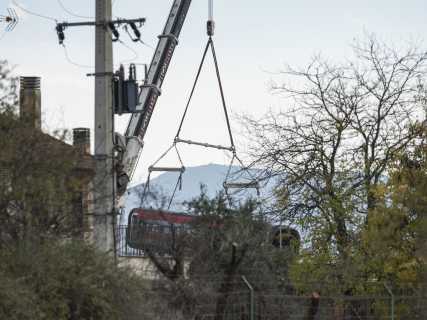

The rail accident that occurred last October 28 near Urda (Toledo) has crossed Spanish borders and has found space in some of the leading international media outlets. Coverage has not been limited to reporting on the incident, which left 69 dead, but has also focused on doubts about the maintenance of the infrastructure, the use of European funds, and citizens’ confidence in Spanish high-speed rail.
In recent days, headlines such as Le Monde and Euronews have highlighted the opening of a new investigation by the European Public Prosecutor’s Office into possible fraud related to community funds intended for the modernization of the Madrid-Seville line. For its part, The Guardian has addressed the consequences of the accident from a broader perspective, focused on the loss of confidence in the rail system.
Le Monde and Euronews focus on European funds
The French newspaper Le Monde published on November 6 an article titled «Catastrophe ferroviaire en Espagne : le parquet européen ouvre une enquête quant à d'éventuelles fraudes sur la ligne accidentée à Urda». The outlet highlights the European Public Prosecutor’s Office investigation into a possible irregular use of community funds intended to renew and improve safety, signaling, and the communication systems of the Madrid-Seville high-speed line.
That same day, Euronews published an article about the investigation under the headline «EU prosecutors probe fraud claims over funds for Spanish rail line hit by deadly crash». The European outlet details that the European Public Prosecutor’s Office is investigating possible fraud related to community investments in railway infrastructure and notes that there was already an earlier investigation into the same line, opened in March 2026 after the accident in Adamuz.
The most recent investigation has the support of the Central Operating Unit (UCO) of the Guardia Civil, which has carried out actions at the headquarters of Adif, the State Railway Safety Agency, and the Court of Auditors.
The European Public Prosecutor’s Office confirmed on November 6 the opening of this second investigation, initiated on its own initiative. However, the organization has not provided any further details about the status of the inquiries.
The Guardian analyzes the loss of confidence in Spanish rail
A different approach is the one offered by the British newspaper The Guardian. In an article published on November 4 and signed by Sam Jones, titled «Spain's deadly train crashes have damaged public confidence in the system», the newspaper analyzes how the two deadly rail accidents recorded in Spain during 2026 have affected the safety perception of the high-speed network.
The publication links the impact of the Urda incident to the prior accident in Adamuz, which occurred in January, and highlights the difficulties in regaining users' trust in a rail system that for years has been considered one of the country's benchmarks.
The article also addresses the political consequences of the accidents and the pressure on the Government to regain that confidence, in a context marked by the proximity of the general elections.
An open investigation, not a proven fraud
International coverage agrees in pointing to the dimension that the Urda accident has taken on, although it is important to distinguish between open investigations and verified facts.
The European Public Prosecutor's Office investigates possible fraud in the use of funds intended for the modernization of the Madrid–Seville line. The opening of these proceedings does not mean that the existence of irregularities has been proven, nor that there is an established causal link between the possible fraud and the accident.
For the moment, the investigations continue to be open and the authorities have not released any new details about their findings.