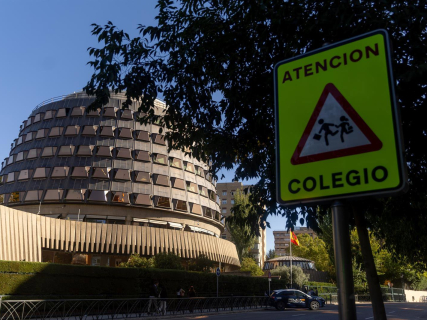

The Supreme Court has decided to archive the complaint filed by the association Hazte Oír for alleged judicial prevarication against the seven justices of the Constitutional Court (TC) who backed the amnesty for the misappropriation linked to the 'procés' in the appeal brought by former Generalitat councillor Dolors Bassa.
In an order to which Europa Press has had access, the Criminal Chamber rejects the action directed against members of the so-called progressive wing of the TC: Cándido Conde-Pumpido, Inmaculada Montalbán, María Luisa Balaguer, Juan Ramón Sáez, María Luisa Segoviano, Juan Carlos Campo and Laura Díez.
The ruling recalls that the Supreme Court itself excluded the misappropriation from the scope of the amnesty law and that, last October, the court of guarantees upheld Bassa's amparo appeal and ordered that the pardon be applied to that crime.
"Conduct which, according to the complainant, is constitutive of a crime of judicial prevarication, subsidiarily of imprudent judicial prevarication, and alternatively, of a crime of usurpation of judicial powers," it indicates.
Despite this, the Supreme Court concludes that the complaint "cannot be admitted" because, according to the Organic Law of the Constitutional Court, the decisions of the court of guarantees "may not be tried by any judicial body of the State".
"The criteria and reasoning contained in the judgments of the Constitutional Court, as in those of this Supreme Court, may or may not be shared by the various legal operators and, ultimately, by the whole of society. However, it does not turn the resolutions against which each person may disagree into an object of the crime of prevarication," it adds.
In this regard, the court states that "an unjust resolution shall be understood to mean one that departs from all legally defensible options, according to the methods usually admitted in law, lacking any reasonable interpretation, and for that reason, an exponent of clear irrationality."
"So a resolution based on an interpretation that may be considered erroneous is not unjust for the purposes of the crime of prevarication, provided that, having been reached through the methods of interpretation usually admitted, it is defensible in law," it adds.
Likewise, the Chamber emphasizes that the distribution of functions between the Supreme Court and the Constitutional Court "is based on criteria of competence and not of hierarchy, insofar as the Constitutional Court does not, in strict terms and in this context, constitute a judicial body (it does not form part of the Judiciary)".
"Nor does it correspond to this Supreme Court either, in accordance with the Constitution which is charged with pointing out, to pronounce the final word on matters of constitutional guarantees," the ruling concludes by dismissing the complaint filed by Hazte Oír.