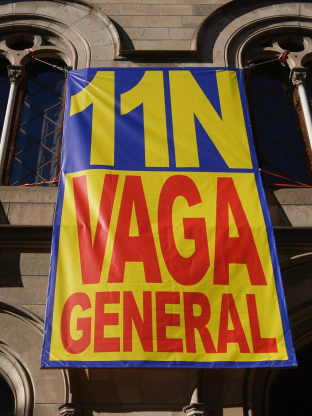

The discount on the payroll for the strike of 11N can exceed a day's salary. Those who support the work stoppage on Wednesday, 11 November, will stop being paid for the work time not carried out and may see the proportional part of other remuneration reduced, including the extra payments and weekly rest. The extra payment does not disappear: the amount corresponding to the strike period is adjusted.
That explains why the economic effect does not always appear in full on a single payslip. One part may be reflected in the ordinary payroll and another when the time comes to be paid an extra payment that is paid separately.
The call raises a practical question for those who are doing the sums before deciding whether to take part: how much money will they stop receiving. The answer requires looking at the payroll and the collective agreement. Two people with a similar monthly income can have different extra payments, supplements, and working days.
What they can deduct from you for going on strike on 11N
The starting point rule is in the regulations on the right to strike. During its exercise, the contract is suspended and there is no right to the salary corresponding to the time of stoppage. The link with the company continues: going on strike is not the same as resigning, being dismissed, or enjoying a paid leave.
From there, the calculation may include three elements: the remuneration for the time not worked, the proportional part of weekly rest, and that of the extra payments. Each concept must be identified to prevent the same amount from being deducted twice.
There is no fixed rate for going on strike. Nor is there a universal figure of 50, 70 or 100 euros applicable to any worker. The discount must correspond to the remuneration and the time of stoppage for each person.
| Concept | Effect of the strike | What to review |
|---|---|---|
| Ordinary salary | You do not get paid for the work time that you do not carry out. | The hours or days recorded and the concepts included. |
| Christmas extra pay | It may be reduced proportionally if the strike coincides with its accrual period. | Its amount and the months during which it is generated. |
| Non-prorated extras | The corresponding adjustment is made when they are paid. | That the discount is not anticipated or duplicated. |
| Prorated extras | The adjustment may appear in the monthly payroll that already includes them. | That the same part is not deducted again afterward. |
| Weekly rest | The proportional part linked to the strike may be deducted. | It does not automatically mean losing the entire weekend. |
| Annual vacations | Legal strike does not reduce its duration or its pay. | No days should be deducted for having joined the strike. |
| Strike of a few hours | The deduction must be proportional to the time carried out. | Do not automatically apply the discount for a whole day. |
| Partial or reduced working hours | The corresponding pay for that working time is used. | Do not calculate based on a full-time salary that is not received. |
| Per diems and transport | The treatment depends on their nature and payment conditions. | Which expense or activity they compensate for and what the collective agreement establishes. |
| Vacation or prior sick leave | They do not automatically turn into a strike because they coincide with N11. | That the absence record remains correct. |
| Additional penalty | It cannot be imposed for participating legitimately in the strike. | Any discount other than the proportional calculation. |
Why dividing your salary by 30 does not always produce the final discount
Dividing a monthly payment by 30 can be used to illustrate the value of a day in certain payroll systems. It does not, by itself, determine how much a strike shift costs, because it leaves other concepts pending and may not be the method that applies.
The first step is to identify what the starting figure includes. A monthly payment with prorated extras is not the same as another one that pays them separately. You also should not use the bank deposit directly, because it already includes withholdings and social security contributions.
Next, you need to know how the work is distributed. A regular Monday-to-Friday workday does not necessarily have the same calculation as a shift calendar with workdays of different lengths. Jurisprudence has examined specific methods for irregular work periods, which prevents presenting a single operation as valid for all workplaces.
An example with 1,800 euros: what it explains and what it does not explain
Let’s suppose, only to understand the arithmetic, a monthly payment of 1,800 euros gross with no extraordinary payments and a system that uses 30 days to obtain daily pay.
The division would be:
1,800 euros ÷ 30 days = 60 euros.
Those 60 euros represent the daily salary in this example. They are not yet a closed estimate of the total discount.
If, in addition, the applicable method distributed two days of weekly rest among five working days, the fraction associated with a day worked would be 0.4 days. In that illustrative case, proportional rest would be equivalent to 24 euros: 60 multiplied by 0.4.
The sum of both components would be 84 euros gross, before studying the effect on the extras and any other concept. This example explains why the factor 1.4 sometimes appears in guides: one day plus a fraction of rest. It does not turn that multiplier into a universal rule nor does it allow you to guarantee that anyone who receives 1,800 euros will have exactly 84 deducted.
To obtain an individual amount, you must confirm that the example’s assumptions match the collective agreement, the calendar, and that person’s salary structure.
How the strike affects the Christmas extra pay
Extraordinary payments are generated during a period of time. Although they are paid on a specific date, the amount corresponds to the accrued amount accumulated during the established months.
If November 11 falls within the accrual period for the Christmas extra pay, the strike may reduce the corresponding proportional part. Participating for one day does not allow you to withdraw the entire payment.
To check the adjustment, you must know how much the full extra pay is worth and during what period it is generated. The Workers’ Statute refers to the collective agreement for setting its amount and allows it to be agreed that it be prorated across the twelve monthly payments.
An annual accrual extra and a semiannual one do not divide their amount across the same number of days. It may also happen that two gratifications have overlapping accrual periods.
That is why the effect of N11 does not have to be limited to December: a payment that is received months later can also be affected if it was being generated during the strike workday. The payment date and the period it remunerates are two different pieces of information.
An example to understand the accrual of the extra
Let’s imagine an extraordinary payment of 1,800 euros whose calculation system distributes the amount across 180 days of accrual.
In that case, each day represents ten euros:
1,800 euros ÷ 180 days = 10 euros.
If the applicable rule exactly excluded one day of that accrual due to the strike, the adjustment to that extra would be ten euros. This is an arithmetic explanation of the mechanism, not a universal formula: there are collective agreements with other periods, bases, and calculation rules.
The example helps you understand the difference between losing the extra pay and reducing its proportional part. It also shows why it does not work to use the amount of the ordinary monthly payment if the extra pay has a different composition.
When the deduction is made: in November or when the extra is paid
When extras are paid separately, the corresponding deduction must be carried out when they are paid. The judicial doctrine collected by the National Court (Audiencia Nacional) rejects anticipating deductions from salary payments that have not yet been advanced.
That is why there may be two adjustments on different dates: one for ordinary pay and another when the extra is paid. They are not necessarily a duplication, as long as they affect different amounts.
With prorated extras, the time of payment changes. Its monthly portion is already included in the payroll, so the proportional adjustment may be reflected in that receipt. The review must ensure that the company does not deduct again afterward an amount it had already reduced.
Weekly rest does not mean losing the whole weekend
The proportional discount for weekly rest is one of the issues that causes the most confusion. Its basis is the relationship between the work performed and the pay for the rest period corresponding to that work.
A strike day does not authorize automatically deducting a full Saturday and Sunday. The company must identify the corresponding fraction, without extending the adjustment to rest periods that are not related.
Public holidays have a different treatment. Judicial doctrine distinguishes those included within the strike period from those outside it: it is not appropriate to apply a reduction indiscriminately to all holidays during the month.
Vacations are not reduced for going on strike
Legal strike does not allow you to remove vacation days or reduce their pay. CCOO expressly includes this protection in its information about N11.
You also have to distinguish between going on strike and already being on vacation. If a person had vacation approved for November 11, the coincidence of dates does not automatically turn that day into a strike day.
The same distinction must be made with a rest day scheduled in the work calendar. Before recording an absence as a strike, there must be an obligation to work that is not fulfilled because of participating in the strike.
What happens if I am on sick leave before N11
Prior temporary disability maintains its own treatment. It should not be recorded as a strike solely because it coincides with the call, nor should the strike’s salary discount be applied for that reason.
It is different if the incapacity occurs when the person is already participating in the strike. Regulations establish specific rules for benefits during that situation. That is why it matters to check the dates and avoid equating prior sick leave with participation in the mobilization.
If I strike for a few hours or I have reduced working hours
The deduction must be proportional to the strike time. Someone who stops working for a few hours should not automatically receive the same adjustment as someone who stops carrying out their entire workday.
In a reduction due to legal childcare duties (guarda legal) or in a part-time contract, the reference is the salary corresponding to that working time. You cannot calculate the deduction as if full-time pay were received.
For example, a person who was supposed to work four hours and joins the strike during those four hours has stopped carrying out their entire scheduled shift, but the calculation must start from their pay and schedule, not from those of an eight-hour coworker.
In night shifts there is another check: the temporal scope of the notice. CGT in Andalucía, Ceuta and Melilla has published rules that include certain shifts started before midnight or that end after the shift that was called. Those who work under those conditions must review the notice that applies to them.
Bonuses, per diems and transport: the name of the concept is not enough
A payroll can include base salary, seniority, job-related supplements, transport, per diems, or expense compensations. Not all of them serve the same purpose.
To review a concept called transport, you have to know whether it compensates for actual travel expenses, whether it is paid for attendance, or whether it has another setup in the collective agreement. Its name alone does not determine how it should be treated.
The legal documentation from CCOO requires analyzing extra-salary supplements on a case-by-case basis. It is not appropriate to automatically add all concepts to the calculation without checking what they pay for or compensate.
A bonus also cannot be used as an indirect way to punish the worker. The legitimate reduction of the pay corresponding to the strike does not authorize an additional penalty for exercising the right to strike.
Gross deduction does not necessarily match what the deposit decreases by
The review must start from the gross concepts of the payroll. The money deposited in the account is the result after withholdings and deductions.
An accounting example helps to understand it. If gross salary decreased by 80 euros and, when recalculating the receipt, the worker’s deductions decreased by 15 euros, the bank deposit would be reduced by 65 euros.
It is an illustration, not a tax forecast of N11. The specific difference depends on how the social security contribution and the withholding turn out in that payroll.
Comparing only the October deposit with the November one can lead to incorrect conclusions. Extra hours, variables, expenses, or regularizations may also have changed. To check the strike, you have to isolate its effect on the receipt.
What happens with social security contributions
During a legal total strike, there is a special situation of being registered (high) and the obligation to contribute is suspended for both the company and the worker during the strike. The contract is not terminated.
Unemployment benefits do not replace the salary lost during the strike. The regulations exclude that payment for the period of participation.
In a partial strike, since activity continues for part of the day, the treatment of contributions also changes. CCOO’s legal note states that high status is maintained during the workday and sets out the corresponding rules for the remuneration and activity effectively maintained.
Social Security includes a special agreement (convenio especial) to complete certain bases during a legal strike. It can be requested within the 90 days following its end and has the scope provided for that modality. It is not used to recover the salary that was deducted.
What changes for civil servants and public employees
The Basic Statute of the Public Employee establishes that those who exercise the right to strike do not generate or receive the pay corresponding to the time during which they remain in that situation.
The deduction is not punitive in nature nor does it affect the respective regime of their social benefits. The calculation must be checked according to the Administration’s rules and the regime of the affected staff, without automatically transferring the example of a private company.
You don’t have to ask permission to strike
UGT reminds that there is no general obligation to individually notify in advance that you are going to join a legal strike. Exercising the right also does not depend on personally justifying the reasons to the company.
That does not eliminate obligations arising from a valid designation of essential services. Anyone who receives communication of that kind must check its scope with the trade union representation and distinguish it from an informal request to go to work.
The corresponding salary deduction is not a sanction. Dismissing, sanctioning, or harming someone for participating legitimately in the strike is a different issue and may violate a fundamental right.
How to claim if the payroll discount does not add up
To review the receipt, the affected payroll, another comparable one, the work calendar, and the collective agreement are needed. If you receive extras separately, you will also have to check their receipt when they are paid.
The payroll department must be able to explain what time was recorded as strike and what concepts were used. A specific request helps detect differences:
- I request a breakdown of the discount applied due to my participation in the November 11 strike, indicating the hours or days counted, the concepts included, the calculation method, and the treatment of extraordinary payments and weekly rest.
- It is especially advisable to review whether a full day was deducted for a partial strike, whether vacations were included, whether extras were duplicated, or whether a salary that does not correspond to the contracted workday was used.
- If the discrepancy persists, the trade union representation or a labor law professional can compare the calculation with the collective agreement. Salary amount claims generally have a one-year period from when they could be demanded. A dismissal or a sanction has different and shorter appeal avenues and deadlines.