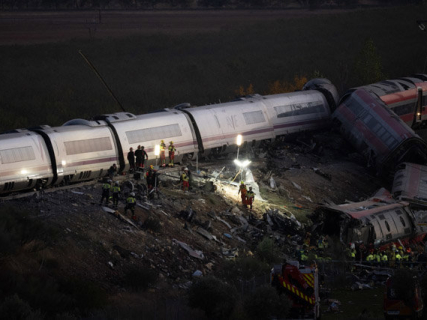
Spain decrees three days of mourning for the Urda accident and the autonomous communities join the mourning

Andalusia, Extremadura, Madrid, Catalonia and Navarra have also declared three days of mourning, while Aragón, Cantabria and La Rioja are joining the national tribute to the victims of the railway tragedy

fotonoticia 20261028194231 1920

fotonoticia 20261028194231 1920

Add DEMÓCRATA to Google

Ask FREN

Published

Last updated

2 minutes

Most read

Elecciones 29N · Encuestas

La media de las encuestas

Media a 27 de octubre de 2026 · 15 institutos

  • PP31,0 %
  • PSOE27,3 %
  • Vox18,9 %
  • Sumar6,3 %
  • Podemos2,9 %
  • ERC2,3 %
010203040ene 2024jul 2024ene 2025jul 2025ene 2026jul 2026

Media del último estudio de cada instituto en 30 días y su evolución semanal desde el 23J. Partidos con al menos un 2 %.

Todas las encuestas

Elecciones generales del 29 de noviembre · Demócrata

The Government of Spain has decreed three days of official mourning for the victims of the Urda (Toledo) railway accident, which occurred this Wednesday after the collision of a Renfe AVE and an Iryo train. The measure will be in force from Thursday the 29th until Saturday the 31st of October and will extend to the entire national territory, while different autonomous communities and town councils have announced their own mourning measures.

Andalusia, Extremadura, Madrid, Catalonia and Navarra have also declared three days of official mourning, while Aragón, Cantabria and La Rioja have announced their adherence to the national tribute. During this period, flags will fly at half-mast on public buildings and numerous administrations will suspend their institutional events.

Andalusia and Extremadura bring forward the start of mourning

The president of the Junta de Andalucía, Juanma Moreno, has announced three days of official mourning from 14:00 hours this Wednesday until 14:00 hours on Saturday the 31st of October, in addition to conveying his solidarity to the victims and their families.

Extremadura, headed by María Guardiola, has also brought forward the start of mourning to this Wednesday, at 15:00 hours, and will keep it until the same time on Saturday.

For their part, the Community of Madrid, Catalonia and Navarra have announced three days of mourning, coinciding with the period established by the central Government. Their respective administrations have conveyed their condolences to the families of the deceased and their support to the affected people.

Aragón, Cantabria and La Rioja join the national mourning

The regional governments of Aragón, Cantabria and La Rioja have also announced their adherence to the three days of official mourning, which will extend until Saturday the 31st of October.

In Aragón, the Executive of Jorge Azcón has suspended its institutional agenda and postponed the presentation of the regional budgets for 2027, while Cantabria has announced the suspension of institutional events, with the exception of those linked to administrative obligations.

La Rioja has also limited institutional activity during these days and has offered resources to collaborate in assisting those affected.

The town councils also join the tribute

The expressions of mourning have spread to numerous municipalities, which have announced the suspension of public events, the placing of flags at half-mast and the holding of gatherings in memory of the victims.

Among them, Las Palmas de Gran Canaria and Aranjuez have announced three days of mourning, while different provincial councils and Andalusian city councils have suspended part of their institutional activity.

In addition, the Federación Española de Municipios y Provincias (FEMP) has called a minute of silence this Wednesday at 20.00 hours in front of the city councils of all Spain, with the aim of expressing the condolences of the local institutions and accompanying the families and relatives of the victims of the railway accident.

More key points, information and questions with FREN

AI-GENERATED CONTENT

What procedures must the Government follow to declare official mourning days in Spain?

The declaration of statewide official mourning is a Government decision, not a law that must be approved by Parliament. To explain its procedures, it is useful to distinguish the adoption of the decision, its formalization and publicity, and the protocol measures it establishes. The consulted documentation does not allow for precise support of all internal steps or the required legal instrument in each case.

1. Defining the declaration

The first step is to distinguish a declaration by the Government of Spain from decisions by an autonomous community, a city council, or another institution. These are not interchangeable actions: to understand the scope of each, one must consider the authority adopting it and the content of its decision.

The public announcement of the intention to declare mourning and the formal declaration must also be differentiated. An announcement alone does not allow knowing all its effects: it is necessary to examine the text that specifies the measure.

2. Preparing and formalizing the decision

To reconstruct the specific procedure, it is necessary to identify who submits the proposal, which body adopts it, and through which instrument it is formalized. It would not be rigorous to state, without proper basis, that any declaration necessarily requires a law, a royal decree, or a simple agreement.

The consulted sources do not show specific regulation that allows detailing here the initiative, prior reports, inclusion of the matter in the Council of Ministers, or a possible urgent procedure. Therefore, I cannot present these steps as mandatory requirements nor assure that there is a special official mourning file.

3. Do not confuse it with a parliamentary procedure

The review of the Congress Regulations has not found a specific procedure to approve an official mourning declaration. It should not be confused with the validation of a decree-law, the authorization of certain treaties, or parliamentary control of exceptional states, which correspond to different procedures.

Consequently, there is no basis in the consulted material to add a vote by the Congress, ratification by the Senate, or authorization by the Permanent Deputation as procedures for this declaration. The fact that the decision has public relevance does not make it a legislative initiative.

4. Check the content and publicity

The text of the declaration is the decisive element to know what has been agreed. In particular, it is advisable to check:

  • The cause: the event or death that motivates the mourning.
  • The duration: the dates and, when necessary, the start and end times.
  • The scope: the territory and institutions to which it is addressed.
  • The measures: the protocol instructions it actually contains.

To determine from when it takes effect, one must consider what the text itself provides and its official publication. It should not be assumed that the count begins with a press conference, nor assign an effective date that has not been verified.

5. Separate mourning from other consequences

A complete response must also verify whether the declaration contains instructions about flags, institutional acts, or other expressions of mourning. It is not appropriate to automatically deduce from the announcement the suspension of activities, closure of establishments, or the existence of a holiday.

In summary: this is not about processing a law in the Cortes. The essential point is to identify the Government's formal decision, its publicity, and its content; the specific internal requirements need additional normative verification that the consulted sources do not allow to conclude.

What are the competencies of an autonomous president in emergency management and official mourning?

An autonomous president exercises the political leadership of the regional Government in an emergency, but does not necessarily have operational command of the intervening services. Regarding official mourning, it may be their responsibility to declare it, or it may be done by the Government Council: the competence and procedure depend on the regulations of each community.

1. Political leadership and operational command

As head of the regional Executive, the president sets priorities, coordinates ministries, promotes resource mobilization, and represents the community in its relations with other administrations. They also assume the political explanation of management before the public and the regional parliament.

However, presiding over the Government does not mean personally directing each operation. Activation of the plan, alerts, evacuations, or technical instructions correspond to the authorities determined by the regional legislation and the applicable plan: these may be the competent ministry, the plan management, or health authorities. To attribute a specific decision, that distribution must be identified, not inferred from the president's rank.

2. Services and coordination with the State

The regional Administration organizes its health, civil protection, and emergency resources and, when they exist, its police forces. Municipal services maintain their competencies, although they may be integrated into coordination mechanisms provided for the emergency.

The president does not have general hierarchical command over the National Police, Civil Guard, or Armed Forces. Cooperation is articulated with the State and the Government Delegation through the corresponding plans and procedures. Requesting state resources does not, by itself, make the emergency an operation directed by the State.

Law 17/2015, of the National Civil Protection System, establishes the cooperation framework. When a national interest emergency is declared, direction and coordination correspond to the State under legal terms, with participation of regional resources.

3. Extraordinary measures and limits

Regional authorities can mobilize means, activate plans, and adopt civil protection or health measures within their competencies and legal authorization. Not all these powers belong personally to the president: some correspond to the Government or sectoral authorities.

An emergency does not grant unlimited powers. Measures must be necessary, proportionate, motivated, and temporary, and are subject to judicial control. Health legislation allows certain limitations, but a regional authority cannot suspend fundamental rights by its own decision.

The president also cannot declare states of alarm, exception, or siege. They can request state intervention and collaborate in its management. The declaration corresponds to state bodies provided for in the Constitution and Organic Law 4/1981; any regional action as delegated authority is subject to the framework of that declaration.

4. Declaration and effects of official mourning

Regional mourning is an institutional decision of mourning and tribute. Depending on the community, it is formalized by presidential decree, Government decree, or Government Council agreement. The declaration sets its duration and effects.

  • Flags at half-mast and other signs of mourning in the corresponding institutional scope.
  • Suspension or modification of official acts.
  • Tributes, moments of silence, and expressions of condolence.

It does not automatically imply a holiday, business closure, suspension of private activities, or interruption of administrative deadlines. State, regional, and local declarations may coexist, respecting the competencies of each Administration.

In short, the specific scope must be verified in the Statute, regional legislation, sectoral laws, and the activated plan. STC 133/1990 explains the concurrence of civil protection competencies and the demands of national interest.

What requirements does the regulation establish for municipalities to adhere to national mourning days?

The consulted state regulation does not establish a special municipal adhesion procedure to national mourning. The essential thing is to distinguish between complying with the mandatory measures of the royal decree that declares it and approving a municipal expression of condolence or additional measures. When the decree orders the national flag to fly at half-mast on all public buildings, that obligation also applies to municipal ones, without being conditioned on the municipality's adhesion.

1. The national declaration determines the obligations

The scope and duration of mourning are set in the corresponding royal decree. For example, Royal Decree 1429/2008, issued after the Madrid-Barajas air accident, expressly established that "the National Flag shall fly at half-mast on all public buildings and Navy ships" during the declared period.

Therefore, a plenary agreement is not necessary for that obligation to apply. Nor can a municipal non-adhesion agreement nullify the state mandate. The necessary municipal action consists of organizing its compliance during the scheduled dates and times.

2. No authorization is required to adhere

The examined state regulations do not include a specific requirement to request authorization from the Government, obtain acceptance from the Government Delegation, or process an adhesion request. Neither is a form, special deadline, or reinforced majority established to institutionally express condolence.

This does not mean that any municipal body can adopt any measure: the rules of competence and functioning of the municipality, as well as applicable regional and municipal provisions, must be respected. It is advisable to separate the symbolic declaration from concrete decisions about acts, facilities, or services.

3. How to formalize a municipal decision

The Local Regime Basic Law provides the general framework for municipal action but does not regulate a specific file for adhesion to national mourning. Therefore, it cannot be stated that it is mandatory for all municipalities to always approve a mayoral decree or always a Plenary agreement.

If the decision is submitted to a collegiate body, article 47 establishes as a general rule a simple majority of members present: more affirmative than negative votes. Adhesion to mourning is not among the matters listed that require an absolute majority. It should not be confused with the adoption or modification of the municipal flag, which does have a reinforced requirement.

As a practical guideline, and not as a list of special state requirements, the municipal decision should identify the national decree, specify the period, describe the agreed measures, and arrange its communication to those responsible for executing them.

4. Flags and municipal activities

The Law 39/1981, on flags requires the Spanish flag to fly outside municipal buildings and regulates its preferred position when it appears with others. It does not itself contain a municipal adhesion procedure to mourning. The order to place it at half-mast comes from the specific decree.

National mourning does not automatically imply suspending all municipal acts. The cited 2008 decree orders half-mast but not a general cancellation of activities. Any additional suspension or adaptation must be agreed upon by the competent body and respect applicable rules.

In short, complying with the national decree is mandatory in its own terms; explicit adhesion and complementary municipal measures are different decisions, subject to local regulations.

Play

Test your knowledge with FREN!

How much do you know about this topic? Answer the following 3 questions.

How many days of official mourning has the Spanish Government decreed for the Urda accident?

Question 1 of 3

Which autonomous communities advanced the start of the mourning days after the railway accident?

Question 2 of 3

What measure has the Spanish Federation of Municipalities and Provinces (FEMP) called to honor the victims of the accident?

Question 3 of 3