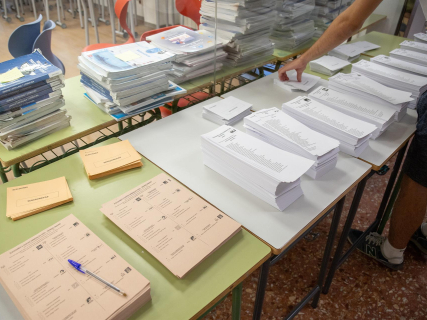

The Official State Gazette (BOE) has made public this Wednesday the candidacies for the Congress of Deputies and the Senate for the general elections on the upcoming November 29. However, these lists are not yet final, as they must pass the review of the electoral boards, which will check requirements such as compliance with the "zip lists" or the correct submission of endorsements by extraparliamentary formations.
Political parties, federations, coalitions, and groups of voters had until midnight last Monday to register their lists with the provincial electoral boards. Those same candidacies, as they were submitted, are the ones that appear this Wednesday in the BOE.
From this moment, the electoral boards have a period of two days to detect and communicate any possible irregularities, whether noticed ex officio or reported. The affected formations will have 48 hours from the notification to correct the indicated defects. Once this process is concluded, the boards will have until next Monday to proclaim the definitive candidacies, which will be published in the BOE the following day, November 3.
First application of strict alternation between men and women
Among the aspects that the boards must supervise is compliance with the principle of electoral parity, which after the last reform obliges for the first time in general elections that the lists for Congress be made up of women and men placed alternately.
In 2023, the electoral regulations only required that each list have at least 40% of people of each sex and that none exceed 60%, a proportion that had to be maintained in each segment of five positions. However, the modification introduced by Organic Law 2/2024, on parity representation, has replaced this model with the so-called "zip lists" for gender reasons.
This balanced composition must be respected throughout the candidacy, without differentiating between main candidates and substitutes, and will also be required when the candidacies for the Senate are presented grouped in lists. The goal is for the final configuration of both Chambers to be practically equal.
Minimum endorsement of 0.1% for formations without seats
Content within pre-cai tagsAnother point to check will be the validity of the guarantees required from the parties, federations, and coalitions that did not obtain representation in either of the two Chambers in the previous general elections. The law requires these candidacies to gather the signatures of at least 0.1% of the registered voters in the census of each constituency in which they wish to compete, and no person can lend their signature to more than one list.
This obligation affects, among others, the party Se Acabó la Fiesta (SALF), of the MEP Luis "Alvise" Pérez, as well as the new party "Democracia 21", constituted as a coalition with Ciudadanos and UCIN, which only plans to run in the constituencies of Madrid and Barcelona.
In the case of voter groups, they can also submit lists, but they are required to have greater support: they must have the signatures of at least 1% of the citizens registered in the census of the corresponding constituency.
Balance of candidacies in 2023 and outlook for November 29
In the elections of July 2023, the Provincial Electoral Boards proclaimed a total of 1,090 candidacies for the Cortes Generales, of which 550 corresponded to the Congress and 540 to the Senate, 186 fewer than in the 2019 elections. In that filter, 66 lists from extra-parliamentary formations were excluded due to formal errors, for not meeting legal requirements, or, above all, for not presenting the required guarantees.
In total, 4,892 candidates competed on July 23, 2023, for the 350 seats in the Congress and the 208 in the Senate —this year one more is elected following the constitutional reform that allowed the creation of a senator for the island of Formentera—, which meant an average of ten candidates for each seat in the Lower House and 5.5 for each position in the Senate.
Looking ahead to the appointment on November 29, nine coalitions have been registered, including that of Frente Amplio, which groups the largest number of parties. In any case, this is three fewer than those that participated in the general elections of 2023.