Feijóo commits to implementing nine saving measures and tax benefits for young people

The leader of the PP announces cuts to the IRPF in the first four years of work, bonuses for self-employed workers, higher deductions for children, and free nurseries. His electoral program adds five tax benefits to facilitate access to housing

feijoo jovenes

feijoo jovenes

Add DEMÓCRATA to Google

Ask FREN

Published

Last updated

6 minutes

Most read

Elecciones 29N · Encuestas

La media de las encuestas

Media a 13 de noviembre de 2026 · 15 institutos

  • PP31,5 %
  • PSOE26,8 %
  • Vox19,1 %
  • Frente Amplio6,4 %
  • ERC2,4 %
01020304050ene 2024jul 2024ene 2025jul 2025ene 2026jul 2026

Media del último estudio de cada instituto en 30 días y su evolución semanal desde el 23J. Partidos con al menos un 2 %.

Todas las encuestas

Elecciones generales del 29 de noviembre · Demócrata

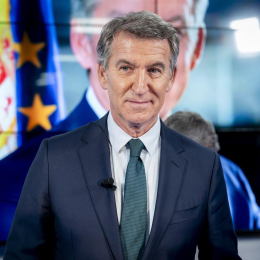
Alberto Núñez Feijóo has devoted his second campaign event together with Nuevas Generaciones to the economic problems of young people, with nine cost-saving measures and tax advantages aimed at making it easier for them to enter the labor market, the creation of companies, the training of families, and access to housing.

Accompanied by Isabel Díaz Ayuso and the president of Nuevas Generaciones of Madrid, Ignacio Dancausa, the PP candidate for the Presidency of the Government, has promised that the young people who leave Spain will do so by their own choice and not due to lack of opportunities.

The meeting, held this Friday at the Zenit space in Madrid, lasted for almost an hour and a half. Feijóo specified four economic commitments: the exemption from IRPF during the first year of work, followed by deductions progressively smaller during the next three tax years; the elimination of the self-employed contribution during the first year of activity and its bonus in certain hiring situations; the increase of tax deductions for children and free nursery schools.

Although he did not develop the proposals on housing during his intervention, the PP electoral program includes five other tax advantages for young buyers and renters.
Four priorities for young people: employment, housing, companies and family

The first proposal affects salary directly. Feijóo has committed himself to ensuring that young people who access their first job do not pay IRPF during the first year of work. The reduction would continue during the next three tax years, with deductions of 75%, 50%, and 25%, respectively. This reduction is aimed at workers and self-employed people between 18 and 35 years old during their first four tax years

The PP president has defended that this tax reduction would make it possible to have an initial savings capacity and to allocate part of the salary to buying a home, the creation of a business, or the training of a family. As he has explained, his intention is for young people to be able to start working without part of their first income being allocated to the income tax.

For those who choose self-employment, he has announced the elimination of the self-employed contribution during the first year of activity. In addition, he has proposed a 50% reduction of that contribution during the first year for those who hire a worker.

The third block of commitments is aimed at families. Feijóo has promised to increase tax deductions for children, to promote more flexible working hours for parents, and to move toward free attendance at nursery schools through cooperation between the central Government and the autonomous communities.

The housing completes the four priorities that the popular candidate has listed. Specifically, in the program, whose presentation was covered by DEMÓCRATA, the following measures appear: a reduction in VAT from 10% to 4% for under-40s who buy their first new home, a cut in the Transfer Tax for the purchase of used homes, 20% deductions for savings earmarked for buying a house, the tax exemption for the returns from that savings, and deductions in the IRPF for renting the habitual residence.

To these measures, public guarantees of up to 20% of the home’s value are added to make it easier to access a mortgage.

Feijóo asks young people to rebel against resignation

During the event with young people, the popular candidate described the difficulties of a generation that, despite having been educated, finds obstacles in accessing a job that would allow it to save, buy a home, or develop its personal project.

"There are many young people resigning themselves to live worse, having been prepared for a future that does not arrive", he said, before reproaching the Government for holding them responsible for their economic problems because of their consumer habits.

Feijóo has rejected the aid that he considers insufficient to resolve those difficulties and has defended a policy that allows “to be young, find a good job, access housing” and develop a life project.

He also had words for Miguel and Daniel, two PP members assaulted in Baracaldo, to whom he expressed his support and assured that his party will respond to violence through the ballot boxes.

In the final stretch, he appealed to young people to take part in the elections of 29 November and asked for the vote for the PP. "I’m not going to let you down", he assured, after acknowledging the dismay of part of Spanish society and mentioning the victims of railway accidents.

Ayuso asserts Madrid as a land of opportunities and attacks socialism

The president of the Community of Madrid, Isabel Díaz Ayuso, has focused a large part of her address on defending individual freedom, effort, and personal responsibility, against what she has described as an attempt by the left to impose a single way of thinking.

Ayuso has warned that communism is reappearing in new forms and has accused her political opponents of using culture, education, and audiovisual platforms to spread their ideas.

"The evils of the twentieth century are happening again with a new communism that seemed to have been eradicated", she said. In her view, these currents seek to create a "group consciousness that nullifies personal freedom, effort, and individual responsibility."

The Madrid leader has also defended the open character of Madrid, a community that, as she has highlighted, receives people from other regions of Spain and from countries such as Venezuela and Colombia. She has claimed her political and economic model as an alternative for those who want to develop their professional career or start a business project.

On an internal level, she has defended the plurality of the PP and the coexistence of different sensibilities within a common project. "Yes, in the PP there are many sensibilities. And thank goodness", she said, before insisting that the party must take advantage of the abilities of its members.

How she incorporated Ignacio Dancausa into Nuevas Generaciones

One of the passages of his speech has been dedicated to Ignacio Dancausa, president of Nuevas Generaciones of Madrid, and today national president, whom she has presented as an example of the profile of young people he wants to incorporate into the Partido Popular.

Ayuso has related that, when the time came to choose the person responsible for the Madrid youth organization, they looked at Dancausa for his activity in the public university and for his willingness to defend his political positions.

"He didn't look for us to ask for a position. We were the ones", the Madrid president has explained, who has recalled how the young man had faced situations of ideological confrontation in the university sphere.

The popular leader has taken advantage of that account to insist that she does not want Nuevas Generaciones to become an organization dedicated to providing positions to its members. Her objective, she has explained, is for young people to participate actively in the party and assume responsibilities based on their capability and commitment.
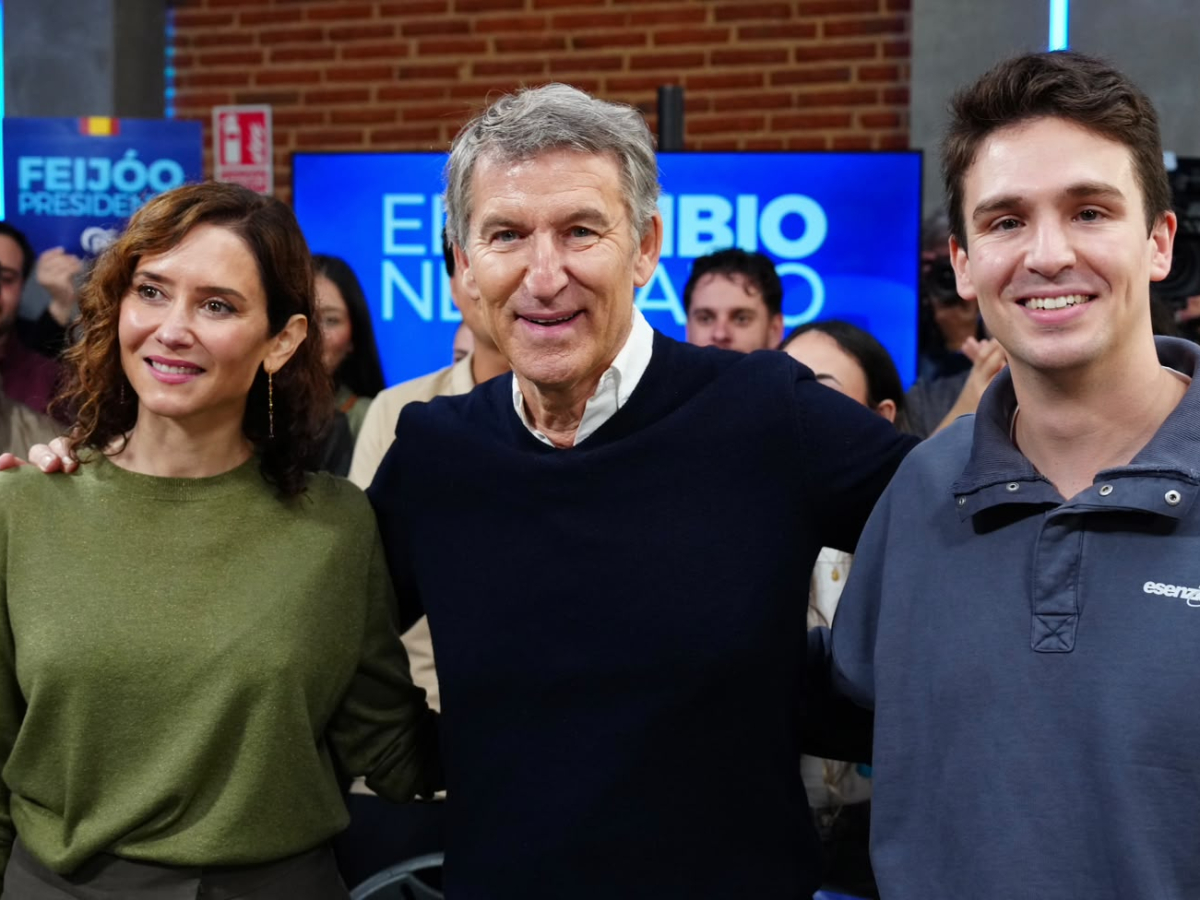
feijoo dancausa ayuso
Isabel Diaz Ayuso, Alberto Núñez Feijóo and Ignacio Dancausa at the campaign event of the PP leader with the young people of Nuevas Generaciones. Photo: Tarek.

Ignacio Dancausa calls for a generation that wants to become independent and work in Spain

Without resorting to a written speech, Ignacio Dancausa has developed an intervention focused on housing, employment, industry, and political coexistence. The president of Nuevas Generaciones of Madrid has linked the economic difficulties of his generation with the need to recover job and business opportunities in Spain.

"Young people have to become independent without ruining ourselves", he said, before calling for a greater construction of homes and defending the goal of building a million new households.

He has also advocated for boosting reindustrialization, attracting data centers, and favoring the installation of companies and factories, with the purpose of expanding employment opportunities for young people.

"In Feijóo's Spain we commit ourselves to the idea that the young people who leave do so because they want to, not because they haven't found opportunities here", he has defended.

Dancausa has devoted another part of his address to political coexistence and has rejected violence against those who defend different ideas. He has expressly mentioned the two Popular Party militants who were assaulted in Baracaldo and has called for zero tolerance in the face of this type of incident.

The youth leader has also defended an immigration policy linked to the needs of the labor market and the capacity of public services, in addition to calling for greater industrial investment and an improvement in infrastructure.

At the close of his speech, he appealed to unity among Spaniards with different political views and has claimed the spirit of concord of the Transition. "Young people do not want a divided Spain; we want to tear down walls; we want concord," he said.

Dancausa has asked his generation to take part in the elections on November 29 and has defended that Feijóo should head the next Government.

More key points, information and questions with FREN

AI-GENERATED CONTENT

What parliamentary phase is the Popular Party's fiscal measures program for young people currently in, and what are the next steps for its approval?

The Popular Party's fiscal measures program for young people is not in a legislative approval phase as a single package. As of November 13, 2026, it is necessary to distinguish between the electoral commitments announced by the party and the political initiatives already approved by the Chambers. The latter do not themselves modify taxes: to apply the reductions, the corresponding regulations must be approved.

What is its current status?

The proposal released on November 10 is part of the PP's electoral program for the November 29 elections, not a law pending final vote. Its central measure is an IRPF discount for workers and self-employed individuals aged 18 to 35 during their first four tax years: 100% the first year, 75% the second, 50% the third, and 25% the fourth. (Demócrata, November 10).

Therefore, there is no single legislative file for this program that places it in the amendment period, committee, commission, or Senate review. There is also no scheduled approval or effective date. It would not be correct to state that only a vote is missing for young people to benefit from these measures.

What has already been approved?

There is a relevant parliamentary precedent: on February 18, 2026, the Congress approved all points of a Popular Group motion on housing. Among them were eliminating or progressively discounting the IRPF for young people during their first four years of working life, reducing VAT on the first new home from 10% to 4%, and allowing the installment payment of certain taxes related to its acquisition. (Congress, February 18).

The difference is decisive: a motion expresses a political request from the Chamber to the Government but is not a tax law. That initiative ended with its approval; it does not automatically proceed to the Senate nor does it later become a tax exemption. Its development requires a different legislative initiative.

Next steps to become law

There is no next scheduled step for the complete program. The process will depend on the instrument presented:

  • Submission of the text. If promoted by the Government, it must approve a bill and send it to Congress. If presented by a parliamentary group, it will be a bill proposal. The electoral program alone does not initiate any of these procedures.
  • Initial decision by Congress. A bill proposal needs to pass the consideration phase: the Plenary decides whether to start processing it. A Government bill does not require this initial vote.
  • Amendments and parliamentary work. The period to propose changes will open. Then, the committee will study the text and the competent commission will approve its report. Approval corresponds to the Plenary or, when appropriate, to a commission with full legislative competence.
  • Senate review. The Chamber may approve the text without changes, introduce amendments, or veto it. If it introduces modifications or a veto, Congress must decide on them.
  • Publication and application. After final approval come sanction, promulgation, and publication in the Official State Gazette (BOE). The regulation must specify beneficiaries, requirements, affected years, and effective date.

In conclusion: there is prior parliamentary support for some proposals, but it does not equate to an approved tax reform. The milestone to watch is the submission of a legislative text that makes them applicable, not an alleged final vote on the electoral program.

What are the powers and functions of Isabel Díaz Ayuso as President of the Community of Madrid according to the Madrid Statute of Autonomy?

Isabel Díaz Ayuso, as President of the Community of Madrid, has the functions of representing the Community, directing its Government, and coordinating the autonomous Administration. These powers correspond to the office, not personally to its holder, and are mainly regulated in articles 17 to 21 of the Statute of Autonomy, approved by Organic Law 3/1983. It is important to distinguish her own powers from those belonging to the Government as a whole or to the Assembly.

1. Institutional representation

Article 17.1 establishes that the Presidency "holds the supreme representation of the Autonomous Community and the ordinary representation of the State within it." Therefore, it has a dual representative function: the highest autonomous representation and ordinary state representation in Madrid. The latter does not make the president the director of state bodies nor grant her general powers of the Government of Spain.

2. Government leadership and administrative coordination

According to the same article, she is responsible for:

  • Presiding over and directing the activity of the autonomous Government.
  • Appointing and dismissing vice presidents and ministers, as also stated in article 22.2. They do not need to be deputies.
  • Coordinating the Administration of the Community of Madrid.
  • Delegating executive and representative functions to vice presidents and other Government members, according to article 17.2.

The institutional distinction is relevant: article 22 attributes to the Government as a collegiate body the direction of autonomous policy, executive and administrative functions, and regulatory power, i.e., approving regulations. Not all are personal powers of the president. Likewise, the legislative initiative of the Executive corresponds to the Government, according to article 15.2.

3. Relations with the Assembly

The president is politically accountable to the Assembly, according to articles 16 and 17. She can propose a vote of confidence: asking deputies to support her program or a general policy declaration. Article 19 requires prior Government deliberation and a simple majority to obtain it; if lost, she must resign.

As a counterbalance, article 20 allows the Assembly to approve a motion of censure by absolute majority, with an alternative candidate. If successful, the president and her Government cease, and the candidate obtains parliamentary confidence.

4. Electoral call and dissolution

Article 10.4 assigns to the Presidency the call for regional elections. Additionally, article 21 allows dissolving the Assembly early, after Government deliberation and under her exclusive responsibility, by decree calling elections.

This power has limits: it cannot be exercised during the first session period, when less than one year remains in the legislature, while a motion of censure is pending, or when a state electoral process is called. No other dissolution is allowed before one year has passed since the previous one. The new Assembly only completes the remaining period of the original legislature.

5. Promulgation and publication of norms

Article 40 provides that the president promulgates, in the name of the King, laws approved by the Assembly and orders their publication in the Official Gazette of the Community of Madrid and in the BOE. She also orders the publication of regulations approved by the Government. Promulgating a law does not mean approving it: that decision corresponds to the Assembly.

Finally, article 47.1 entrusts her with ordering the publication of the appointment of the President of the Superior Court of Justice of Madrid, without granting her the power to choose. These functions appear in the wording resulting from the 1998 statutory reform.

What has been Ignacio Dancausa's political trajectory before assuming the national presidency of Nuevas Generaciones of the PP?

Before assuming the national presidency of Nuevas Generaciones of the PP in July 2026, Ignacio Dancausa developed his trajectory in university activism, Madrid youth leadership, and municipal politics. A PP member since 2018, he presided over the student association Libertad Sin Ira, went on to lead NNGG Madrid in 2022, and joined the Las Rozas City Council in 2023. His national leap came after nearly four years leading the regional organization and an agreement with other candidates to succeed Beatriz Fanjul.

2018: joining the Popular Party

Dancausa, born in 2001, joined the PP in September 2018. In interviews about his beginnings, he explained that his interest in politics was sparked during a high school course in the United States. Upon returning, he began his party participation, initially as a grassroots member linked to Las Rozas. His entry into politics, therefore, preceded his university responsibilities and presidency of the Madrid youth. (Interview in 20minutos)

2021-2022: university leadership at Complutense

His first public projection platform was Libertad Sin Ira, a student association he founded in early 2021 at the Complutense University of Madrid and presided over before leading NNGG. From there, he promoted activities and debates to increase the presence of students sharing his political positions in the public university. That associative experience was one of the central antecedents of his later promotion within the PP. (ABC profile)

During that stage, he came into contact with Isabel Díaz Ayuso: published profiles place a meeting around April 2022, during a visit to the Madrid Assembly with association members. The support of the Madrid leadership would be relevant for his arrival at regional NNGG. (His beginnings in Madrid)

2022-2026: president of NNGG Madrid

In October 2022, he announced his candidacy and, in November, was elected president of Nuevas Generaciones of Madrid at the XIII Extraordinary Congress held in Tres Cantos. He was 21 years old and succeeded Ana Pérez. He reached the position with experience in militancy and university associationism, not from a prior national responsibility in the organization. (2022 election)

At the head of Madrid's NNGG, he strengthened university activity, political training, and digital communication. Initiatives during his term include the Interuniversity Conferences and the Madrid Youth Academy. His profile became linked to ideological confrontation and political support for Ayuso. (Career overview)

2023: entry into municipal politics

After the May 2023 municipal elections, he joined the Las Rozas City Council in June as a PP councilor. Thus, he combined the regional youth presidency with his first elected institutional responsibility, which he maintained when starting the race for national leadership. (Municipal stage)

2026: candidacy and agreement for the national leap

On May 20, 2026, he announced his candidacy to succeed Beatriz Fanjul. On June 4, he reached an agreement with Antonio Landáburu and Candela Anglés to run with a single list, headed by him and with Landáburu as vice president. That pact led to his election at the Valladolid congress in July: culminating a path from militancy and campus to Madrid leadership and municipal representation. (National succession in Demócrata)

Play

Test your knowledge with FREN!

How much do you know about this topic? Answer the following 3 questions.

What is one of the tax measures announced by Feijóo for young people entering their first job?

Question 1 of 3

What percentage of IRPF deduction would be applied in the second year of work for young people according to Feijóo's proposal?

Question 2 of 3

What measure does the PP's electoral program include to facilitate young people's access to housing?

Question 3 of 3