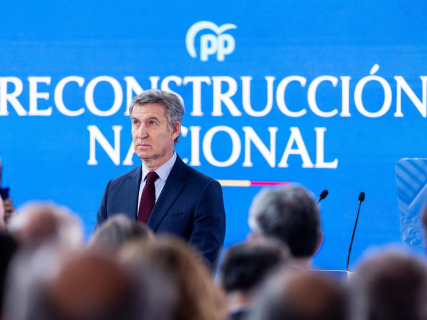

Alberto Núñez Feijóo has presented this Tuesday his electoral program for the general elections of November 29, with a battery of commitments that cover everything from reforming institutions to the economy, public services and public security. Under the title National Reconstruction, the document sets out the measures that the Partido Popular pledges to promote if it comes to Government, with special attention to recovering purchasing power, employment and the operation of essential services.
Among the proposals, five areas stand out that directly affect millions of Spaniards: paying less in taxes, finding employment and improving working conditions, guaranteeing pensions, reducing healthcare waiting lists and strengthening security in the streets. DEMÓCRATA has examined the electoral document to identify which specific commitments Feijóo proposes in each of these chapters.
1. Less taxes: reduction of the IRPF, zero VAT on basic food and benefits for young people
One of Feijóo’s main economic promises is to reduce the tax burden on middle- and low-income earnings. The PP proposes increasing the personal and family minimums of the IRPF, updating the tax rate to prevent inflation from causing an increase in taxation and guaranteeing by law that those who receive the interprofessional minimum wage do not pay this tax.
Young people between 18 and 35 years old would have a specific treatment during their first four years of taxation: a 100% IRPF reduction in the first year, 75% in the second, 50% in the third and 25% in the fourth. The measure would start to be applied from the first tax return after the approval of the law.
In everyday consumption, the program includes applying 0% VAT to basic food, including meat, fish and preserves, while the inflation and purchasing power crisis persists. It also announces tax incentives for saving and business investment.
Este programa es la cura con la que sanar una España herida y la respuesta para reconstruir el país.
— Alberto Núñez Feijóo (@NunezFeijoo) November 10, 2026
Mi propuesta de gobierno pasa por una reconstrucción nacional para recuperar el Estado, regenerar la democracia, reunir a la nación y devolver a España la ambición y la… pic.twitter.com/BtvskuGp6Q
2. Employment: facilities for self-employed workers, incentives for hiring and protection against serious illnesses
On labor matters, Feijóo proposes facilitating the creation of companies and reducing hiring costs. New self-employed workers would not pay a Social Security contribution during their first year of activity and also not during the second if their income does not reach the minimum wage.
Another of the proposals is that self-employed workers with annual billings of less than 85,000 euros do not have to charge or declare VAT. In addition, the obligations to file tax declarations would be reduced, and business contributions for hiring would be subsidized: 100% for one year for the first worker and 50% for the second.
To encourage stable employment, the PP proposes reducing unemployment contributions for companies that keep workforces more stable than the average for their sector. It also contemplates improving the economic protection of workers with serious and long-term illnesses, with benefits that could reach 100% of the regulatory base.
3. Security: more police in neighborhoods, quick trials and measures against repeat offenders
Citizen security occupies a prominent place in the program. Feijóo commits to strengthening the police presence in neighborhoods with the greatest problems of crime and to modifying legislation to combat repeat offenses, especially in theft and squatting offenses.
Among the measures planned are the expansion of quick trials, a harsher criminal response to violent disturbances, and a minimum fine of 3,000 euros for certain acts of vandalism that do not constitute a crime. The PP also proposes facilitating the immediate eviction of drug dens and reinforcing video surveillance in spaces of special risk.
The document includes new measures against youth gangs and the use of minors to commit crimes, as well as recognizing national police officers and Civil Guards as professions of risk. It also proposes expanding “prison without a fixed term subject to review” to certain cases of murder and repeat offenses in sexual crimes.
4. Healthcare: 4,500 more doctors in Primary Care and an urgent plan against waiting lists
The PP proposes a State Pact for Public Health, agreed with the autonomous communities, which allows improving funding and reducing care times. Its main commitment is to drive an urgent plan to reduce waiting lists, respecting autonomous competencies in healthcare management.
Feijóo proposes incorporating more professionals into the National Health System, with at least 4,500 additional doctors in Primary Care, expanding the supply of specialized healthcare training, and improving the working and pay conditions of healthcare personnel.
In mental health, the program announces a National Plan for the period 2027-2037, with guaranteed funding and a reinforcement of psychological and psychiatric care, especially for children and adolescents. It also includes improvements in prevention, early diagnosis, and access to innovative treatments, as well as a health card and interoperable clinical and social history across all of Spain.
5. Pensions: annual increase in line with the CPI and tax advantages for those who prolong their working life
In pensions matters, Feijóo assumes the commitment of maintaining their purchasing power and updating them every year in line with the CPI. The proposal appears expressly in the electoral program and is accompanied by the objective of rebuilding the Toledo Pact to address the system’s sustainability through political agreements.
The PP extends this commitment to the youngest workers, for whom it proposes ensuring that their future pensions also maintain purchasing power. It also proposes deductions in the IRPF to encourage active retirement, so that those who decide to continue working after reaching retirement age can benefit from tax advantages.
The program also argues for preserving the single Social Security fund, so that contributions continue to finance pensions and benefits across the whole of Spain, without splitting resources by autonomous communities.