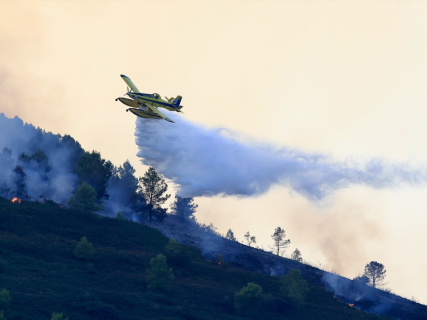
The fire in Tírig evolves favorably after ravaging 810 hectares: Catí remains evacuated

More than 300 personnel and 21 aerial means are working this Monday against the forest fire in Tírig, which maintains a perimeter of about 21 kilometers while the extinguishing teams try to advance towards its stabilization.

EuropaPress 7707492 hidroaviones trabajan tareas extincion incendio tirig agosto 2026 castellon

EuropaPress 7707492 hidroaviones trabajan tareas extincion incendio tirig agosto 2026 castellon

Add DEMÓCRATA to Google

Ask FREN

Published

Last updated

4 minutes

Most read

Elecciones 29N · Encuestas

La media de las encuestas

Media a 13 de noviembre de 2026 · 15 institutos

  • PP31,4 %
  • PSOE26,8 %
  • Vox19,1 %
  • Frente Amplio6,3 %
  • ERC2,4 %
01020304050ene 2024jul 2024ene 2025jul 2025ene 2026jul 2026

Media del último estudio de cada instituto en 30 días y su evolución semanal desde el 23J. Partidos con al menos un 2 %.

Todas las encuestas

Elecciones generales del 29 de noviembre · Demócrata

The Tírig fire, in Castellón, faces this Monday, August 10, a decisive day after weather conditions have allowed for a considerable improvement in the situation during the night. Emergency services describe the evolution of the fire as favorable, although the fire is still not stabilized or controlled.

The latest estimate raises the affected area to approximately 810 hectares, within a perimeter of about 21 kilometers. This figure exceeds the 684 hectares previously counted, although part of this increase is related to the technical fires carried out by the firefighting teams themselves to close and secure the perimeter.

The operation against the Tírig forest fire maintains a significant deployment on land and air this Monday. Around 50 ground units, more than 300 personnel, and 21 aerial resources are participating in the firefighting efforts with the aim of consolidating the progress made during the night and achieving stabilization of the fire.

A favorable night allows progress against the Tírig fire

The evolution of the Tírig fire during the night has been very favorable thanks, among other factors, to the strong increase in relative humidity. The values reached around 90%, conditions that reduced the activity of the flames and facilitated the work of the teams deployed on the ground.

The personnel took advantage of this situation to carry out technical fires in the northern and southern sectors of the fire. These operations consist of burning certain areas in a controlled manner to eliminate vegetation fuel and hinder the fire's ability to continue advancing if its intensity increases again.

The objective during this Monday is to take advantage of the favorable conditions to continue closing the perimeter and advance towards the stabilization of the Tírig fire. The incorporation of aerial resources during the morning has allowed for the reinforcement of the operation after the work carried out exclusively from the ground during the night hours.

Catí remains evacuated due to the forest fire

The situation in the municipality of Catí continues to be one of the main focal points of attention. The town was evacuated preventively on Sunday due to the advance of the fire and, for the moment, its residents remain outside their homes awaiting the evolution of the fire to ensure a safe return.

The evacuation affects a locality of around 700 inhabitants and responds both to the risk for the population and to the presence of numerous livestock farms in the environment. The area has more than 60 farms, whose protection has conditioned part of the operation deployed during the last hours.

The improvement experienced during the night opens the door to reevaluating the situation, although any decision about the return of the neighbors will depend on the emergency officials. As long as the fire does not reach a sufficient level of stabilization and safety, Catí will remain under the established preventive measures.

More than 300 personnel and 21 aerial resources against the flames

The device deployed against the Tírig fire is formed this Monday by more than 300 personnel, around fifty ground units, and 21 aerial resources. The operation combines resources from different administrations to try to secure the sectors where the advance of the flames has been managed to be halted.

The work is especially concentrated on consolidating the perimeter and preventing possible reproductions. Although the conditions of the night have allowed considerable progress, high temperatures and any change in the wind or humidity can quickly modify the behavior of a forest fire.

For this reason, the high number of resources continues to be deployed despite the favorable evolution of the Tírig fire. The priority is to completely stabilize the perimeter before beginning a gradual reduction of the resources allocated to the emergency.

The Tírig fire began on Friday and a lightning strike is the main hypothesis

The Tírig forest fire was declared on Friday, August 7 in the late afternoon. The initial investigations point to the fall of a lightning strike as the main hypothesis regarding the origin of the fire, after the storm activity recorded in different points of the interior of Castellón.

Since then, the affected area has been increasing. During Saturday, estimates placed the burned area at around 395 hectares and 15 kilometers of perimeter. Subsequently, the balance increased to 684 hectares and approximately 19 kilometers before reaching the current estimate.

The latest balance places the fire at about 810 hectares and 21 kilometers of perimeter. The increase does not necessarily imply that there has been an equivalent advance of the flames in the last hours, as the calculation includes areas affected by the technical fires carried out by the extinguishing teams.

The fire in Tírig is still not stabilized

Despite the improvement in the last hours, the fire in Tírig still cannot be considered stabilized or controlled. The extinguishing services continue to work on the ground and maintain the important aerial and ground device deployed in case of possible reactivations.

The meteorological evolution will be decisive in the coming hours. After a night with very high relative humidity, the increase in temperatures during the central hours of the day may again reduce the humidity of the vegetation fuel and complicate the tasks of the personnel.

The scenario is, however, more favorable than during the day on Sunday. The teams face this Monday with the objective of advancing towards the stabilization of the forest fire in Tírig, while surveillance over the perimeter is maintained and Catí remains evacuated as a preventive measure.

More key points, information and questions with FREN

AI-GENERATED CONTENT

What are the legal procedures and necessary steps for evacuated neighbors from Catí to return to their homes after a forest fire?

The return of evacuated neighbors from Catí after a forest fire does not depend on each person carrying out individual procedures, but rather on an administrative decision by civil protection based on technical safety reports. This decision is made by emergency authorities (Generalitat and City Council) within civil protection and forest fire plans. Only when it is considered that serious risks to people have disappeared (active fire, smoke, falling trees, damaged power lines, etc.) is the evacuation order lifted and re-housing authorized. From there, there may be subsequent procedures for aid, compensation, or rehabilitation of damaged homes, but the “returning home” itself is structured as a general order, not as a case-by-case permit.

Basic applicable legal framework

At the state level, the general reference is Law 17/2015, of the National Civil Protection System, which regulates emergency measures and restrictions on rights, establishing that these must be limited “to the strictly necessary time to deal with emergencies” and be proportionate to their severity, including evacuation and access control (Law 17/2015). For forest fires, there is also:

  • Royal Decree 893/2013, which approves the Basic Guideline for civil protection emergency planning for forest fires, requiring plans to include procedures for confinement, evacuation, shelter, and end of emergency, as well as local organization for firefighting and return to normality (Basic Guideline for Forest Fires).
  • State Civil Protection Plan for Forest Fire Emergencies, approved by resolution of October 31, 2014, which articulates coordination between the State and autonomous communities and provides for an Evacuation and Shelter Plan for the affected population (State Forest Fire Plan).

In the Valencian Community, the specific framework is set by:

  • Law 13/2010, on Civil Protection and Emergency Management, which assigns the competent conseller the sole command of the emergency, with functions to declare emergency levels, order population protection measures (including evacuation), and declare the end of the emergency (Law 13/2010 CV).
  • Law 7/2011, on Fire Prevention, Extinction, and Rescue Services, regarding the organization of firefighters and their intervention in these scenarios (Law 7/2011 CV).
  • Decree 58/2013, Territorial Forest Action Plan of the Valencian Community (PATFOR), which integrates forest policy and fire risk reduction as a matter of public interest (Territorial Forest Action Plan).

Who decides that it is possible to return and how?

Competent authority

In a fire like the one affecting Catí, the usual chain is:

  • Technical direction of the emergency (firefighters / Advanced Command Post), which reports on the fire situation and residual risks.
  • Single command of the Generalitat in civil protection matters (competent conseller), who declares emergency levels and phases and can decide the end of the emergency and lifting of the evacuation, according to Law 13/2010 (Law 13/2010 CV).
  • Catí City Council, which is usually the closest administration to communicate the decision (notices, municipal website, social media, loudspeaker announcements) and coordinate the practical return.

If the emergency acquires a state dimension (national interest), the bodies of the State Forest Fire Plan and the Directorate General of Civil Protection and Emergencies would come into play (State Forest Fire Plan).

Pre-return checks

Before authorizing the return, regulations and plans require a series of technical verifications, which usually include:

  • Extinction and cold perimeter: the fire must be controlled and without active fronts that put the urban core at risk.
  • Structural and infrastructure safety: inspection of affected homes, risk of collapses, falling trees, poles, power lines, or gas tanks.
  • Basic services: status of electricity supply, drinking water, and road access, at least at a minimum safety level.
  • Environmental conditions: assessment of smoke, ashes, and other factors that may affect health, especially vulnerable groups, in line with the requirements of the Basic Guideline (Basic Guideline for Forest Fires).

These reports are provided by firefighters, Civil Guard or autonomous/local police, municipal technicians, and, if applicable, supply company personnel.

Practical procedure for neighbors

From the point of view of evacuated neighbors from Catí:

  • No individual procedure is required to enter the home: the evacuation and its lifting are general orders from the civil protection authority, under Law 17/2015 (Law 17/2015).
  • Return communication is usually made through 112, official notes from the Generalitat, City Council notices, and media.
  • There may be partial restrictions: only some streets or farmhouses, limited access hours, obligation to follow emergency services instructions.
  • If a specific home presents serious damage, municipal technical services may declare it uninhabitable until repaired, which is managed case by case.

Once back, other administrative procedures open (not linked to the return permit but to recovery): applications for aid for damage to homes or farms, possible IBI tax exemptions when mandatory re-housing has occurred, provided in Law 17/2015 itself (Law 17/2015), or specific measures that the Consell or central Government may approve through subsequent decrees or orders.

In summary, the key “procedure” to return home after the fire is the official declaration of the end of the emergency and lifting of the evacuation, adopted by civil protection authorities based on technical reports. Neighbors must pay attention to those official communications and, while evacuation orders remain in force, they are legally obliged to comply with them.

Who exactly has the final say to lift the evacuation order in a municipality like Catí and in which document is it recorded? What types of economic and fiscal aid can Catí neighbors request if their homes have suffered damage from the fire? What role do the Catí City Council and the Generalitat play in the development of evacuation and self-protection plans against forest fires?

What competencies and functions does the person responsible for declaring the preventive evacuation of a municipality in the Valencian Community have?

In the Valencian Community, the decision to order or declare a preventive evacuation is framed within the civil protection system: at the regional level, it is exercised by the competent conseller as Single Command of the emergency, and even the president of the Generalitat in case of catastrophic emergency; at the local level, the municipal authority adopts measures within the municipal term according to its emergency plans. Fire services can agree on punctual and provisional evacuations while the competent authority acts. All this is articulated through territorial plans (PTECV and municipal plans) and special civil protection plans. The regulations do not literally speak of “preventive evacuation of an entire municipality,” but clearly assign who decides and how an evacuation as a protection measure is executed.

Basic regulatory framework

The central references are:

  • Law 13/2010, on Civil Protection and Emergency Management of the Valencian Community, accessible in the BOE.
  • Territorial Emergency Plan of the Valencian Community (PTECV), approved by Decree 119/2013.
  • Law 7/2011 on Fire Prevention, Extinction, and Rescue Services, in the BOE and the DOGV.

Other contextual instruments include Law 9/2016 on citizen emergency procedures (BOE, DOGV, with correction at [link]), the Territorial Action Plan against flood risk (flood decree), as well as other sectoral and land-use regulations (Law 5/2014 on territory, its amendment by Law 1/2019 and Legislative Decree 1/2021, also published in the BOE).

Regional competencies: Single Command and evacuation

Law 13/2010 establishes that the competent conseller in civil protection and emergency management exercises the Single Command of the emergency. Among their functions, according to the legal extract, are:

  • Declare the levels, phases, or emergency situations foreseen in the plans.
  • Determine the most appropriate protection measures for people, property, and the environment.

The law itself lists population protection measures, among others, removal or evacuation. Therefore, when an emergency (forest fires, floods, etc.) exceeds the strictly local scope or requires supramunicipal coordination, it is the regional Single Command who can agree on the evacuation (including preventive) of zones, nuclei, or, if applicable, an entire municipality, according to the PTECV and applicable special plans.

Additionally, if the situation reaches special severity, the president of the Generalitat can declare a “catastrophic emergency situation,” directly assuming sole command and direction of all emergency activities, including the capacity to order general evacuations.

Municipal competencies in evacuation

The same Law 13/2010 recognizes that municipalities must:

  • Develop and approve their Municipal Territorial Emergency Plan and plans against specific risks.
  • “Make available to the Single Command the municipal-owned means and resources.”

And it specifies that the municipal authority is responsible for adopting necessary measures within the municipal term in situations of serious risk, catastrophe, or calamity, as well as constituting the CECOPAL (Municipal Coordination Center) when emergencies require it. Within those “necessary measures,” and always according to municipal plans and the PTECV, is the possibility to decide or execute preventive partial evacuations (neighborhoods, urbanizations, flood zones, etc.), especially when the emergency is still local in scope.

Operational functions of fire services

Law 7/2011 assigns to the Fire Prevention, Extinction, and Rescue Services the power to:

  • “Adopt extraordinary and provisional safety measures (…) regarding the closure and evacuation of premises and public establishments, and the evacuation of the building and properties in emergency situations, while circumstances make it essential,” and limit or restrict circulation and presence in public roads and places in cases of fire, catastrophe, or public calamity.

That is, firefighters can order immediate and limited evacuations for operational safety reasons, but “pending the decision of the competent authority.” The strategic decision to evacuate preventively a municipality or a large part of it corresponds to the civil protection authority (regional Single Command and mayor, depending on the emergency level).

Specific plans and other related regulations

The PTECV (annex of Decree 119/2013) and special plans — for example, against floods, supported by the Flood Risk Action Plan — specify procedures to declare emergency phases, activate preventive evacuations, and coordinate resources. At the state level, references include the former Basic Guideline for forest fires (RD 893/2013, partially repealed by the Basic Civil Protection Standard 2023) and other regulations such as Order TES/443/2022 or RDL 15/2022 on forest fires, which complete the general framework.

Other regional or state provisions cited in the sources — such as the Territorial Forest Action Plan, the Decree-law 1/2023 on the municipal strategic fire prevention fund and its ratification at [link], or training regulations and various university and ministerial resolutions on emergencies (Order ECD/1527/2015, RD 906/2013, RD 1031/2011, delegation of powers resolution, correction, master’s in emergencies, master’s in forest fires Lleida, master’s in firefighting techniques, master 2015, fishing seasons, 5G emergency subsidy) — do not directly modify who decides the evacuation but reinforce the civil protection system in which that decision is inscribed.

At what levels or phases of emergency in the PTECV are preventive evacuations foreseen to be ordered, and how is this differentiated from confinement? What specific role does the mayor of a Valencian municipality have when the regional Single Command orders a preventive evacuation? How do the Generalitat, the Government Delegation, and the provincial councils coordinate in a preventive evacuation affecting several municipalities?

What regional and state regulations govern the actions of emergency devices in forest fires in Spain?

The actions of emergency devices against forest fires in Spain are supported by a “layered” set of regulations: a state base of civil protection and forestry, a specific guideline and state plan for forest fires, and then the regulations and special plans of each autonomous community. On that general basis, Andalusia, Castilla y León, or Catalonia develop their own operations (INFOCA, INFOCAL, etc.) and annual plans for prevention, surveillance, and extinction. Additionally, forestry regulations condition the organization of devices and the obligations of regional planning.

1. State framework of civil protection and forestry

The core of civil protection is Law 17/2015, of July 9, of the National Civil Protection System, which defines civil protection as a public service, sets the planning system (territorial, special, and self-protection plans), and the distribution of competences between the State, autonomous communities, and local entities (Law 17/2015). On this basis, the Basic Civil Protection Standard has been updated, approved by Royal Decree 524/2023, of June 20, which partially replaces and repeals several previous basic guidelines and acts as a common planning framework (Basic Civil Protection Standard).

In the forestry sector, the general regime is set out in Law 43/2003, of November 21, on Forests (Forest Law 2003), later amended by Law 10/2006 (Law 10/2006) and more extensively by Law 21/2015, of July 20 (Law 21/2015). The latter explicitly states, among other things, the powers of the General State Administration in coordinating forest fire fighting, developing guidelines, and deploying state support resources.

After the 2022 crisis, Royal Decree-law 15/2022, of August 1, on urgent measures regarding forest fires reinforces the integral approach “prevention–extinction–restoration” and obliges autonomous communities to have annual prevention, surveillance, and extinction plans covering their entire territory and operating year-round (RDL 15/2022).

2. Specific state planning for forest fires

Specific planning is articulated in two parts:

  • Basic guideline for civil protection emergency planning for forest fires, approved by Royal Decree 893/2013, of November 15 (RD 893/2013). It establishes minimum requirements for special forest fire plans (foundations, structure, organization, operational and response criteria) and foresees four planning levels: state plan, regional plans, local action plans, and self-protection plans against forest fire risk. Although partially repealed by Royal Decree 524/2023, the text itself indicates that the guideline will continue to apply until the new planning instrument that replaces it is approved.
  • State Civil Protection Plan for Forest Fire Emergencies, approved by Council of Ministers Agreement of October 24, 2014, and published by Resolution of October 31, 2014 (State Forest Fire Plan). It organizes State resources and services to ensure an effective response to emergencies of “national interest” and sets support mechanisms for regional plans when requested or lacking sufficient capacity.

3. Representative regional regulations

3.1. Andalusia (INFOCA)

Andalusia has its own special plan, the Andalusian Forest Fire Emergency Plan (Plan INFOCA), approved by Decree 371/2010, of September 14 (Decree 371/2010). The decree regulates the organizational structure and intervention procedures for extinction, as well as protection of people and non-forest property, and requires certain municipalities to develop their Local Forest Fire Emergency Plan.

Following the experience of major fires and other emergencies, Decree-law 2/2023, of April 11, adopts measures on emergencies and management, prevention, and extinction of forest fires and authorizes the creation of the Andalusian Agency for Safety and Comprehensive Emergency Management, integrating 112, civil protection, the Emergency Institute, and the INFOCA operation into a single command and comprehensive management device (Decree-law 2/2023 Andalusia).

3.2. Castilla y León

In Castilla y León, Decree-law 2/2023, of April 13, on Urgent Measures on Forest Fire Prevention and Extinction, adapts regional legislation (particularly Law 3/2009 on Forests of Castilla y León and Order FYM/510/2013) to the obligations of Royal Decree-law 15/2022, reinforcing planning, operations, and preventive measures in high-risk situations (Decree-law 2/2023 Castilla y León).

Additionally, Order FYM/478/2012, of June 22, sets the high danger period (July 1–September 30), establishes rules on fire use and preventive measures, and determines prohibited or authorized and communicated activities (burning, bonfires, rocket launching, etc.), based on Law 3/2009, Law 43/2003, and the INFOCAL civil protection plan (Order FYM/478/2012).

3.3. Catalonia

In Catalonia, the sectoral base is Law 6/1988, of March 30, on Forests of Catalonia, which regulates forest regime and defense against fires, in coordination with regional civil protection regulations and special emergency plans (such as the INFOCAT plan, not detailed in the sources) (Catalonia Forest Law). This forestry regulation interweaves with emergency planning to define prevention and extinction devices and coordination with civil protection.

4. Relationship between forestry regulations and emergency devices

Overall, state and regional forestry regulations establish who is responsible for organizing forest fire defense and what planning instruments (forest plans, high-risk zones, etc.) must exist; civil protection regulations (Law 17/2015, Basic Standard, and basic fire guideline) establish the architecture of special and self-protection plans; and regional regulations specify the operations (INFOCA, INFOCAL, etc.), command centers, single command, and preventive measures for the population. On this basis, the coordinated action of emergency devices in Spain against forest fires is articulated.

Could you detail how the State Plan and regional plans (for example INFOCA or INFOCAL) coordinate in practice during a large forest fire? What specific obligations does Royal Decree-law 15/2022 impose on autonomous communities regarding annual plans and adaptation of their operations? What are the main differences between Andalusian and Castilla y León regulations in prevention (danger periods, fire use, prohibitions)?

Play

Test your knowledge with FREN!

How much do you know about this topic? Answer the following 3 questions.

What is the main hypothesis about the origin of the Tírig forest fire?

Question 1 of 3

Approximately how many inhabitants does the municipality of Catí, which has been evacuated, have?

Question 2 of 3

What technique have the firefighting teams used to help stop the fire's advance?

Question 3 of 3