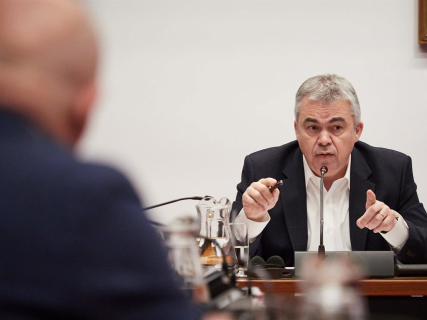
From secretary of the PSOE to truck driver: the new life of Santos Cerdán

According to 'La Razón', the former Secretary of Organization of the PSOE would prepare a new professional stage away from the front line of politics while continuing to be investigated for the judicial causes that led to his departure from the party.

1 minute

fotonoticia 20260717172136 1920

fotonoticia 20260717172136 1920

Add DEMÓCRATA to Google

Ask FREN

Published

Last updated

1 minute

Most read

Santos Cerdán, one of the men who for years held positions of maximum responsibility within the PSOE, is now preparing a radical turn in his professional trajectory. According to what La Razón would have reported, the former secretary of the PSOE would have obtained the heavy vehicle driving license and plans to start working as a truck driver in August.

The change represents a contrast with the position that Cerdán held until June 2025, when he was secretary of Organization of the PSOE and deputy in the Congress. His exit from politics came amid judicial investigations affecting his environment that subsequently led to his provisional imprisonment.

From leader of socialist politics to the road

The fact that Santos Cerdán had obtained the license to drive heavy vehicles would imply for the former secretary a definitive abandonment of politics. His political career led him to become one of the relevant figures in the socialist structure and one of the leaders who participated in the negotiations that allowed Pedro Sánchez to advance his investiture.

Now, the former leader seeks to rebuild his professional life outside of offices and institutions. The decision comes while the judicial process of the investigations affecting the former leader remains pending.

The UCO estimates the investigated benefits at more than 323,000 euros

The decision to become a truck driver coincides with a report from the Central Operational Unit (UCO) of the Civil Guard in which it estimates 323,178.41 euros as the benefits that Cerdán and members of his family environment would have received between 2015 and 2024 through companies related to the investigated plot. The investigation also analyzes the alleged relationship of Cerdán with the Navarre company Servinabar and possible income that would not have been declared.

More key points, information and questions with FREN

AI-GENERATED CONTENT

What is the usual parliamentary procedure for replacing a deputy who leaves their seat in the Congress?

The replacement of a deputy in the Congress is organized by combining internal decisions of the Chamber and actions of the Electoral Administration. The Congress Regulations mainly regulate how the status of deputy is acquired and lost and what internal steps follow a resignation, incompatibility, or death. The appointment of the person who occupies the vacant seat corresponds to the Electoral Administration body, which issues the credential of the newly elected. No fixed deadlines are set for the entire replacement process, but there are key moments: resignation or cause of loss, issuance of the credential, oath or promise, and taking office.

1. Loss of the seat: causes and internal decision

The starting point is the loss of the status of deputy. Article 22 of the Congress Regulations establishes that it is lost due to:

  • Final judicial decision annulling the election or proclamation of the deputy.
  • Death or incapacitation declared by a final sentence.
  • End of the mandate due to expiration of the term or dissolution of the Chamber.
  • Resignation submitted to the Board of the Congress.

Additionally, Article 19 provides for indirect loss of the seat due to incompatibility. The Deputies' Statute Commission submits proposals on incompatibilities and, once the incompatibility is declared and notified, the affected person has eight days to choose between the seat and the incompatible position. If they do not choose, it "will be understood that they resign their seat." In practice:

  • The Board acknowledges the resignation (express or tacit due to incompatibility) or the objective cause (death, electoral nullity).
  • The vacancy is declared and communicated to the competent Electoral Administration.

2. Role of the Electoral Administration and issuance of the credential

Article 20.1 of the Regulations indicates that the deputy acquires full status after presenting “the credential issued by the corresponding Electoral Administration body.” The Regulations do not specify whether this is the Central Electoral Board or a Provincial Electoral Board in each specific case, nor do they reproduce the content of the Organic Law of the General Electoral Regime (LOREG). It only makes clear that:

  • It is the Electoral Administration that proclaims the person elected to replace the outgoing deputy.
  • It is this electoral body that issues the new credential, which the substitute must present to the General Secretariat of the Congress.

The LOREG rules on who corresponds to the vacant seat (next on the list, substitute, etc.) do not appear in the Regulations; therefore, in the consulted sources, no further information is available about the internal order of the list or the possible differentiated role of the Provincial Electoral Boards compared to the Central Electoral Board.

3. Acquisition of deputy status by the substitute

Once the credential is issued by the Electoral Administration, the Regulations set the requirements for the substitute to acquire full deputy status (Article 20.1):

  • Present the credential to the General Secretariat of the Congress.
  • Submit the declaration of activities under the terms provided in the LOREG.
  • Take the oath or promise to uphold the Constitution at the first plenary session they attend.

Rights and prerogatives apply from the moment the person is proclaimed elected by the Electoral Administration (Article 20.2). However, if three plenary sessions pass without fulfilling all the above requirements, “they will have no rights or prerogatives until such acquisition occurs.”

Once the status is acquired, Article 26 requires those joining after the constitutive session to integrate into a Parliamentary Group within five days. If no Group accepts them, they join the Mixed Group.

4. Key moments and indicative deadlines

With the above, the usual scheme is:

  • Moment 1: Loss of the seat due to resignation before the Board, death, unresolved incompatibility favoring the seat, or sentence annulling the election.
  • Moment 2: Intervention of the Electoral Administration, which proclaims the new elected according to LOREG rules and issues the credential.
  • Moment 3: Presentation of the credential and declaration of activities to the General Secretariat of the Congress.
  • Moment 4: Oath or promise in Plenary at the first session the new deputy attends and full acquisition of status.
  • Moment 5: Incorporation into a Parliamentary Group within a maximum of five days from acquiring status.

The Regulations do not establish a total deadline for filling the vacancy from when it occurs, nor do they distinguish by type of constituency. They also do not contain regulation on the replacement procedure in the Senate nor, in particular, on senators appointed by autonomous communities, who follow their own rules outside the Congress. Consequently, in the consulted sources, no further information is available on specific differences between peninsular, insular, or overseas constituencies.

Could you detail exactly what the LOREG says about who corresponds to the vacant seat (next on the list, substitutes, etc.)? At what moment and in what way is the resignation or loss of a deputy's seat officially communicated in the Diario de Sesiones? What practical effects does it have, in terms of voting and internal bodies, that a seat remains vacant for several weeks?

What are the functions and competencies of the PSOE's Secretary of Organization according to the party's statutes?

The current Federal Statutes of the PSOE after the 41st Congress are not fully available in the consulted sources, and in particular, the article that literally defines the functions of the Secretary of Organization is not located. However, it is possible to reconstruct quite precisely their field of competencies based on how the statutes and their Regulations are applied in practice and how the party describes the Organization area in its public communications. Below I summarize those functions, clarifying when they expressly come from Statutes/Regulations and when from recent organizational practice.

General statutory framework and position in the Executive

The Federal Statutes place the Secretary of Organization as one of the main officials of the Federal Executive Commission, the party's daily management body. Since the 41st Congress, the idea of a collegiate Executive is reinforced, but the Organization area is configured as the party's “number three,” responsible for the organizational apparatus, as inferred from the description of the remodeling approved at the 41st Congress and news such as the new Federal Executive and subsequent changes in Organization reported by Demócrata ([link], [link], [link]).

The Secretary of Organization therefore directs the Organization department and coordinates its deputy secretariats (Territorial Coordination, Electoral Action, Transparency and Democratic Action, etc.), a structure detailed by the newspaper Demócrata when explaining the reorganization of the area after the leadership change in the socialist top echelon ([link]).

Application of Statutes and Regulations in internal life

The competencies of the Organization area are also deduced from how the Federal Statutes and Development Regulations are applied. For example, when a regional secretary general elected in primaries resigns, the Statutes provide for the automatic constitution of a Management Committee; the PSOE's official note on the Madrid case explains that this committee “will temporarily assume the management functions” until the new congress, “in accordance with the Federal Statutes and the Federal Development Regulations” ([link]). In practice, it is the Federal Secretary of Organization who promotes and coordinates these committees, as also seen in Extremadura ([link], [link]).

The federal Regulations attribute to the Federal Committee the final approval of electoral lists and to the organizational apparatus the prior preparation of those candidacies, based on proposals from the membership. This is reflected, for example, in internal rules on regional and federal lists cited in PSOE-A and PSOE news ([link], [link], [link]). In practice, these tasks of designing procedures, coordinating with federations, and monitoring compliance with the Statutes fall to the Secretary of Organization.

Territorial organization, congresses, and internal currents

Another key competency, inferred from the sources, is the coordination of the territorial structure and congress processes. The Secretary of Organization is usually the general coordinator of the organizing committees of federal congresses, as happened with Santos Cerdán in the 41st Congress, as detailed by the PSOE itself ([link], [link]).

Regarding currents of opinion, the Demócrata news about the statutes ratified in 2024 recalls that the Federal Committee decides their recognition, at the proposal of the Federal Executive, and that the documentation of each current must be submitted to that Executive ([link]). Although the statutory article is not reproduced, due to the nature of its functions it is reasonable to frame the administrative and organizational management of those currents within the Organization area, under the Secretary's direction.

Internal control, transparency, and regulatory compliance

Internal reforms promoted after corruption cases have explicitly strengthened the role of Organization in integrity matters. Pedro Sánchez explained that the July 2025 Federal Committee approved thirteen organizational changes, including new controls, audits, and transparency requirements, completed in less than a year ([link], [link]). The Secretary of Organization herself, Rebeca Torró, has publicly presented the transparency and control measures adopted “during her first year in office” ([link]), confirming that monitoring compliance with statutes and internal codes is a central part of her competencies.

Limits of available information

In summary, the sources allow us to state that the Secretary of Organization of the PSOE, according to the Statutes and Regulations framework, directs the federal organizational apparatus, coordinates the territorial structure, promotes and executes internal processes (primaries, congresses, lists, and management committees), and assumes a role of control over compliance with internal rules and transparency standards. However, the literal text of the statutory article listing their functions is not available, so it is not possible to reproduce its exact wording or guarantee that there are no additional competencies or nuances not reflected in the consulted news.

Where can I consult the full and updated text of the Federal Statutes of the PSOE approved at the 41st Congress? What differences are there between the functions of the federal Secretary of Organization and those of the regional Secretaries of Organization of the PSOE? What specific changes in internal controls and transparency has the PSOE's Secretary of Organization promoted since 2025?

What were the electoral results of the PSOE in the last general elections and how many deputies did they obtain?

In the last general elections held in Spain on July 23, 2023, the PSOE obtained 121 deputies in the Congress and around 31.7 % of the votes at the national level. These results placed the Socialist Party as the second force in seats, behind the PP, but allowed it to form the current investiture majority together with Sumar and several nationalist and independentist parties. Various subsequent analysis pieces by Demócrata repeatedly confirm that figure of 121 seats as a reference to compare polls with the actual result of 23J.

PSOE results on 23J 2023

Although the consulted sources are mainly post-election polling analyses, all use the 23J result as a comparison point and include the key data: the PSOE achieved 121 seats in the Congress of Deputies in the July 2023 general elections.

For example, the average of polls compiled by Demócrata recalls that, compared to current projections, in the July 2023 elections “PSOE and Sumar totaled 152 seats (121 for PSOE and 31 for Sumar),” as detailed in the analysis of the September 2025 polling average in this polling average.

Several subsequent surveys emphasize the same figure when comparing the current situation with the previous election:

  • NC Report's analysis highlights that “in 2023 it obtained 121 seats” and that current estimates would lower that figure, as noted in this NC Report survey.
  • Another NC Report piece recalls that “the PSOE would go from the 121 deputies obtained in the 2023 general elections to around one hundred,” in this polling analysis.
  • The Target Point model highlights that the socialists “would go from 121 to a maximum of 112 deputies” compared to 23J, again confirming the starting reference in this CIS review by Target Point.
  • The GESOP survey for Prensa Ibérica explicitly states that “the PSOE obtained 31.7 % and 121 seats in the last general elections,” data used as a comparison with their current projections, according to this GESOP study.

Regarding the vote percentage, these same surveys consistently indicate that the PSOE achieved around 31.7 % in the 2023 general elections. This is mentioned, for example, in the June 2026 polling average, which compares the then estimated 27.1 % average with “the 31.7 % achieved in the 23J general elections,” according to this polling average analysis. Other polling pieces – such as the laSexta barometer modeled by Invymark – also start from that 31.7 % as a historical reference (link to Invymark).

Subsequent confirmation of the number of seats

Besides polling analyses, the figure of 121 deputies also appears in parliamentary information referring to seat replacements within the Socialist Group itself. After José Luis Ábalos's resignation, Demócrata explains that the arrival of the next candidate for Valencia allowed the group to “reach 121 votes in the Plenary,” thus recovering the number of parliamentarians with which it left the 23J polls. This is detailed in two pieces about Ábalos's resignation and the entry of his substitute, Ana María González Herdaro, in this parliamentary chronicle and this profile of the new deputy.

In terms of governability, that result of 121 seats placed the PSOE behind the PP (137 deputies) but allowed it, through an agreement with Sumar and other partners (ERC, Junts, EH Bildu, PNV, BNG, CC, among others), to assemble the 179 votes that made Pedro Sánchez's investiture and the start of the XV Legislature possible, as contextualized in the analysis of the new parliamentary arithmetic published by Demócrata in this report on the investiture bloc.

Numerical summary

  • Date of the last general elections: July 23, 2023 (23J).
  • Deputies obtained by the PSOE: 121 seats in the Congress.
  • Approximate percentage of national vote: 31.7  %.
  • Position in the Chamber: second force in seats, main base of the current coalition government with Sumar and investiture agreements.
How are those 121 PSOE seats territorially distributed by constituencies in the 23J elections? What difference is there between the PSOE results in 23J and those obtained in the 2019 general elections? How have polls on voting intention for the PSOE evolved from the 2023 general elections until now?

Play

Test your knowledge with FREN!

How much do you know about this topic? Answer the following 3 questions.

What new profession does Santos Cerdán plan to pursue after leaving politics?

Question 1 of 3

What political position did Santos Cerdán hold until June 2025?

Question 2 of 3

What is the amount of profits investigated by the UCO related to Santos Cerdán and his circle?

Question 3 of 3

Hola, soy Fren. ¿Cómo te ayudo?