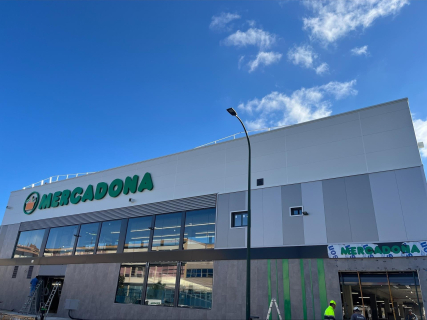

Mercadona is transforming its supermarkets in Spain with a new store format called Store 9, an initiative that will change both the distribution of products and the way its customers shop. The chain chaired by Juan Roig has launched a renovation plan of 3.700 million euros through 2033, with the aim of progressively replacing the current Store 8 format with a more efficient organization, with greater emphasis on fresh food, prepared meals, and self-service.
The transformation has already begun in different autonomous communities and will continue over the next few years. Mercadona expects to close 2026 with approximately 60 establishments adapted to the Store 9 model, before rolling it out across its entire commercial network in Spain and Portugal. The company, which had 1,672 supermarkets at the end of 2025, believes that the new design will make it possible to simplify consumers’ routes and reduce certain movements and restocking tasks for its workers.
The main difference from current stores will be apparent from the moment you enter the supermarket. Instead of maintaining a traditional layout by independent sections, products will be grouped in a more logical way according to their storage needs and preparation processes, while staffed counters for fish, meat, and other fresh foods will lose prominence in favor of trays ready to take away.
Goodbye to the traditional counters: more self-service and prepared foods
One of the most significant changes of the Store 9 model will be the progressive disappearance of the traditional counters staffed by workers, especially in sections such as fishmonger, butchery, and delicatessen. Mercadona is betting on offering a higher proportion of prepared, cut, and pre-packaged products, so that customers can choose them directly from refrigerated shelves without having to wait to be served.
This modification entails a change in the shopping experience. Consumers will find more references available in trays, while handling tasks will be moved to specific areas outside the customer service space. The chain’s goal is to reduce waiting times and simplify restocking, although the new system also limits the personalized attention offered by traditional counters, such as requesting certain quantities or product cuts at the moment.
The change is related to one of the major novelties of the project: the Obrador Central, a space where cutting, cooking, and packaging activities that previously took place in different sections will be grouped. In this way, product preparation will be concentrated in a single work area, which will make it possible to free up commercial space and improve coordination among employees.
The company will also strengthen its "Ready to eat" section, one of the business lines that has grown the most in recent years. The new format includes more space for prepared dishes, a distribution of products that makes choosing them easier, and the addition of tables and chairs in those establishments that still do not have an enabled area for consuming food.
This change responds to the evolution of consumption habits. According to the data presented by Mercadona in March, sales of prepared food and refrigerated dishes exceeded 1,000 million euros in 2025, with growth of 20%, which explains the importance of this section within the company’s commercial strategy.
How the aisles and product layout will change
In addition to self-service, Store 9 will completely reorganize the location of numerous products. The new design will concentrate in nearby areas refrigerated foods, frozen foods, and fresh product trays, with the aim of facilitating both the shopper’s route and the restocking of merchandise.
For example, frozen vegetables will no longer necessarily be next to the fruits and vegetables section in order to be placed near the rest of the frozen foods. Similarly, refrigerated products will share more continuous spaces, while fruits and vegetables will have a larger surface area and prepared food will gain prominence.
The president of Mercadona, Juan Roig, explained during the presentation of the company’s results that the goal is to achieve a “more agile and simpler” purchase. The new organization involves moving from a commercial structure divided by businesses to one based on processes—an adjustment that also seeks to increase the productivity of the stores.
The changes do not, for the moment, entail the widespread implementation of self-checkout cash registers. The Tienda 9 project does not consider as a central element replacing traditional cash registers with self-checkout systems, so the transformation is fundamentally focused on the internal organization, the preparation of products, and the supermarket’s operational functioning.
Mercadona expects to save up to 40% of water and 10% of energy
The renovation also includes modifications aimed at reducing resource consumption. According to the company’s estimates, the Tienda 9 model will make it possible to save up to 10% of energy and 40% of water thanks to the reorganization of processes and the modernization of the facilities.
Among the planned actions, the updating of the machine rooms stands out and the incorporation of more efficient technologies in refrigeration systems. The new cold murals include solutions called Aerofoil, designed to reduce losses of cold air toward the aisles, while the company also opts to use CO₂ as a refrigerant to lessen the environmental impact of the facilities.
These measures seek to reduce the stores’ operating costs, although Mercadona has not announced that the energy savings will automatically translate into a price reduction for consumers. The figures released by the company correspond to its efficiency targets and estimates.
When will Tienda 9 reach all supermarkets in Spain?
The rollout of the new format began with a pilot project in Xirivella (Valencia), where Mercadona started testing the model in November 2025. After the first trials, the chain announced in March 2026 its intention to extend it progressively across its entire network.
Since then, Tienda 9 stores have been arriving in different cities. In the Community of Madrid, the first establishment of this type opened on Valdemoro last June 15, following an investment of six million euros. Subsequently, the company launched another supermarket with the new design on Joaquín María López street, in the Madrid district of Chamberí, whose construction involved an investment of 9.2 million.
The expansion also reaches other autonomous communities. In October, a Tienda 9 store was inaugurated in Tudela (Navarra) and during November new openings and refurbishments have been announced, including the reopening of the establishment of Gáldar, in Gran Canaria, last day 9, following an investment of more than 4.7 million euros.
Additionally, next Monday, November 16, the opening of new Tienda 9 supermarkets in Figueres (Girona) and Aranda de Duero (Burgos) is planned. In the Burgos municipality, the establishment will have a retail area of 1,885 square meters and a workforce of 52 workers, after an investment of 5.8 million euros.
The transformation will also involve temporary closures in certain establishments that need renovations. As Juan Roig explained, the works to adapt a store to the new format may force it to suspend its activity between 15 days and a month, although circumstances will depend on the characteristics of each supermarket.
Mercadona’s goal is to complete the rollout of Tienda 9 by 2033, progressively replacing the Tienda 8 model that began being introduced in 2016. The transformation will modify a significant part of the usual shopping experience, with more prepared products for self-service, more space for fresh produce and a distribution designed to reduce waiting times and simplify the route through the supermarkets.