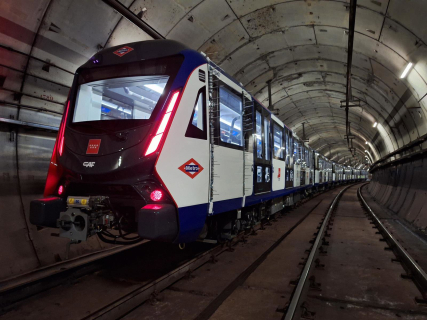
Metro line 6 will run all night: from when and which stations it connects

The Madrid Circular will introduce automatic operation in March 2027 and will run 24 hours during weekends from April. Check the 28 stations on the line, their main connections, and the details of the night service that are still pending.

fotonoticia 20261107081415 1920

fotonoticia 20261107081415 1920

Add DEMÓCRATA to Google

Ask FREN

Published

5 minutes

Most read

Elecciones 29N · Encuestas

La media de las encuestas

Media a 10 de noviembre de 2026 · 15 institutos

  • PP31,5 %
  • PSOE26,8 %
  • Vox19,1 %
  • Frente Amplio6,2 %
  • ERC2,5 %
01020304050ene 2024jul 2024ene 2025jul 2025ene 2026jul 2026

Media del último estudio de cada instituto en 30 días y su evolución semanal desde el 23J. Partidos con al menos un 2 %.

Todas las encuestas

Elecciones generales del 29 de noviembre · Demócrata

Line 6 of Metro de Madrid will operate throughout the night on weekends starting in April 2027, according to the schedule announced this Wednesday by the Comunidad de Madrid. The so-called Circular, which connects some of the main interchange stations in the capital, will expand its hours after completing its transformation into the network’s first fully automated line.

The novelty will allow using the Metro during the early hours from Friday to Saturday and from Saturday to Sunday without depending on the usual closing schedule. The uninterrupted service will begin with Friday’s operations and will run until the end of Sunday, although the stopping frequencies during the night or the exact launch day have not yet been communicated.

Another major change will come earlier. The Comunidad de Madrid plans to put the first driverless trains into circulation at the end of March 2027, once the safety tests have been completed and the platform screen doors have been installed.

When will Metro line 6 open for 24 hours

The schedule announced by the regional government distinguishes two phases. The first corresponds to the line’s automation and the second, to the expansion of the night service.

Expected date News
End of March 2027 Start of the automatic circulation of the driverless trains.
April 2027 Planned start of the uninterrupted weekend service.
End of 2027 Progressive incorporation of the 48 automatic trains planned for the line.

Night opening will apply exclusively to line 6. For now, it has not been announced that the rest of the Metro lines will expand their usual hours on weekends.

This means that passengers will be able to travel the Circular during the early hours, but they will need to check the schedules of the other lines if they need to make a transfer. Connections with other transport services will not necessarily be available throughout the night.

The Comunidad de Madrid has announced the uninterrupted operation of the entire line, although it will need to specify whether all stations will keep their usual access during the early hours and how the security, passenger assistance, and maintenance services will be organized.

Main connections of line 6 with other transport

One of the main attractions of the Circular is its ability to connect other Metro lines, Cercanías stations, and bus interchanges. These are some of its most important connections:

Line 6 station Main connections
Cuatro Caminos Metro L1 and L2
Guzmán el Bueno Metro L7
Moncloa Metro L3 and bus interchange
Argüelles Metro L3 and L4
Príncipe Pío Metro L10, Branch line, Cercanías, and interchange
Laguna Cercanías C5
Oporto Metro L5
Plaza Elíptica Metro L11 and bus interchange
Legazpi Metro L3
Méndez Álvaro Metro L1, Cercanías, and Estación Sur de Autobuses
Pacífico Metro L1
Sainz de Baranda Metro L9
Manuel Becerra Metro L2
Diego de León Metro L4 and L5
Avenida de América Metro L4, L7, and L9 and interchange
Nuevos Ministerios Metro L8 and L10 and Cercanías

These connections describe the network links, but they do not mean that trains on the other lines, Cercanías, or buses also run 24 hours. The night service announced corresponds only to the Circular.

What schedules will Metro have during the early hours of the weekend

The regional Government has confirmed that line 6 will remain open from the start of service on Friday until the end of Sunday. In this way, the usual closures during the early hours from Friday to Saturday and from Saturday to Sunday will disappear.

However, there are still details pending clarification:

  • Exact launch date: April 2027 is announced, but the first weekend of operation has not been communicated.
  • Night frequency: it has not been specified every how many minutes the trains will pass during the early hours.
  • Access to stations: it is pending confirmation on whether all entrances and exits will remain open.
  • Complementary services: an equivalent extension of the schedule for the rest of the Metro lines or for Cercanías has not been announced.
  • Fares: specific changes have not been communicated in the ticket price for using the Circular during the night.

The Community of Madrid expects to move the main maintenance tasks, which are currently carried out during the early hours of the weekend, to the night from Sunday to Monday.

What will the new driverless trains for line 6 be like

The nighttime opening will be possible thanks to the full automation of line 6, a project that includes the renewal of the tracks, adaptation of the electrical system, new signaling technologies, and the installation of safety doors on the platforms.

The new trains, manufactured by CAF, will have six cars and a capacity of around 1,385 passengers, approximately 17% more than the current units. By doing away with the traditional driving cab, the interior space is used more effectively.

The new technology will make it possible to increase the passing frequencies up to one train every two minutes under maximum capacity conditions. It will also reduce the time needed to complete the turnaround on the Circular, which will go from around 54 to 46 minutes.

The total investment planned for the transformation of the line is around 920 million euros. The Community of Madrid estimates that, once the project is completed, the infrastructure will be able to serve up to 730,000 passengers per day, compared with the current approximately 430,000.

Where the works and tests of the Circular are at

The Community of Madrid announced this 11 November that it has already concluded the first phase of the night tests of the automatic trains, developed between Cuatro Caminos and Lucero.

During these trials, the joint operation of the trains, the platform doors and the new signaling system has been verified. The second phase is already under way between Arganzuela-Planetario and Ciudad Universitaria and will subsequently be extended to the rest of the route.

Technicians test the accuracy of the stops and the synchronization between the train doors and those of the platform. They also carry out trials with simulated loading using several tons of concrete to check how the convoys behave under different conditions.

Currently, five of the 48 trains acquired are being used for the Circular. The rest will be incorporated progressively, as the adaptations of the Laguna depot and of the control center in charge of supervising the automatic operation advance.

The installation of the platform doors in the line’s 70 platforms must be completed by the end of 2026, before the new system is put into service.

The official forecast is that the driverless trains will begin running in March 2027 and that, one month later, Line 6 can be used throughout the night on weekends. The exact date and the night frequencies will have to be announced before the launch.

More key points, information and questions with FREN

AI-GENERATED CONTENT

What steps remain for the approval of the extension of night service hours on other lines of the Madrid Metro?

To extend the night service hours to other lines of the Madrid Metro, it is still necessary to specify which lines would be included, approve their service planning, and secure the necessary resources. There is no calendar for extension to the entire network in the sources consulted. The scheduled action is Line 6: April 2027, after completing its automation, according to information published on November 11 by Demócrata.

What has been announced and what remains pending

The Community of Madrid has announced that the Circular line will operate continuously from the start of service on Friday until its end on Sunday. This means opening during the early mornings from Friday to Saturday and from Saturday to Sunday, not offering permanent 24-hour service every day. The commitment also appears in the official communication of October 21.

For the other lines, no equivalent decision has been found that identifies scope, date, and conditions. Therefore, this is not a general extension pending only a final vote: a concrete service proposal for those corridors is missing. It should also not be assumed that the opening of Line 6 will automatically extend the schedule of its connections.

What decisions are needed for other lines
  • Define the night offer. Determine the lines and stations included, the nights of operation, frequencies, and available connections. Without this definition, costs cannot be specified nor can service provision be organized.
  • Approve the service planning. The Law 5/1985 of the Consortium assigns the Regional Transport Consortium the planning of services and coordinated operation programs. Its Board of Directors has the authority to approve plans related to services within its scope.
  • Specify financing. Additional costs of operation, surveillance, customer service, cleaning, and maintenance must be covered. The Board approves program contracts and agreements with transport companies; when their nature or economic commitments require it, further approval by another regional body is needed.
  • Organize operation. Metro must adjust shifts, technical means, and maintenance work to maintain safety and infrastructure availability. These are execution requirements, not a list of independent authorizations already announced for each line.
  • Communicate the final schedule. Before service starts, schedules and connections must be specified. The Passenger Regulations require informing about service characteristics and include timetables with first and last trains.
What remains specifically for Line 6

The published schedule distinguishes two milestones: first automatic trains by end of March 2027 and night opening on weekends in April 2027. Before that, operational and safety tests must be completed, platform doors on 70 platforms—planned for the end of 2026—must be finished, and adaptations of the Laguna depot and control center must progress.

The first weekend of opening, night frequencies, and which entrances will remain open are still unspecified. The Community plans to concentrate mainly on Sunday to Monday night the maintenance currently performed on Friday and Saturday early mornings.

In conclusion: for other lines, a concrete extension decision is first missing, followed by planning, financing, and operational preparation. The consulted regulations do not establish that each schedule change requires a law or a specific vote by the Madrid Assembly.

What are the competencies of the regional Government of the Community of Madrid regarding public transportation?

The Government of the Community of Madrid has broad competencies to plan, organize, finance, and control regional public transportation, but it does not manage all services operating in Madrid. Responsibilities over Metro and interurban buses, municipal competencies over urban transport, and state competencies over Cercanías must be distinguished.

1. Legal basis and territorial scope

Article 26.1.6 of the Statute of Autonomy grants the Community exclusive competence over railways, roads, and paths whose itinerary runs entirely through its territory and, under the same terms, over land and cable transport.

This attribution corresponds to the Community as an institution: the Assembly approves laws and the Government issues regulations and executes them. Additionally, it may exercise transferred or delegated state functions. Therefore, territorial criteria are fundamental but do not automatically assign any railway service located in Madrid to it.

2. Organization through the Consortium

Much of these functions are exercised through the Madrid Regional Transport Consortium (CRTM). Law 5/1985 concentrates in it the regional competencies over regular public passenger transport and those of voluntarily adhering municipalities. Its main responsibilities are:

  • Plan infrastructures: define guidelines, program investments, and supervise projects. Final approval of the general infrastructure and service plan corresponds to the Government Council.
  • Organize the offer: plan services and coordinated operation programs, articulating routes, schedules, frequencies, and connections between operators.
  • Integrate fares: approve a common fare framework, manage combined tickets, and distribute revenues among companies.
  • Authorize and control: process authorizations and concessions, inspect services, and sanction non-compliance within its scope.
  • Attend to travelers: develop information, publicity, and relations with users.

3. Metro and interurban buses

The Consortium law expressly declares that the Madrid Metro service is supra-municipal and assigns the Community competence over it and its future expansions. The maintenance of the network directly operated corresponds to Metro de Madrid, S.A., including necessary maintenance, repair, and renewal actions.

On roads, Law 5/2009 assigns the Community ownership of permanent regular public services of general use developed entirely within the region, except urban ones. It may manage them directly or through authorized companies, establish their conditions, and supervise compliance. It must also promote coordination between modes, accessibility, and environmentally efficient transport.

4. Financing and compensations

The regional administration provides financing to the system and participates in determining fares and compensations. The Consortium may compensate operators when the fare paid by the user is lower than necessary to balance the service, control revenues and costs, and distribute integrated collection. Financing a service does not equate to owning it: state and municipal contributions also exist.

5. Limits: municipalities and State

According to Law 20/1998, municipalities generally have the regulation, management, inspection, and sanction of urban transport. Their adhesion to the CRTM allows joint exercise of functions without converting all municipal services into regional ones.

Cercanías Madrid is under state competence, although it participates in integrating the regional system. Fare coordination or agreements with Renfe do not by themselves transfer its management. Likewise, transport crossing several communities corresponds to the State, without prejudice to delegations and agreements.

What legal requirements must the automation of a Metro line in Spain comply with?

The automation of a Metro line in Spain requires authorizing changes and demonstrating that the whole system can operate safely, in addition to complying with obligations regarding workers, accessibility, and personal data. It is not enough to acquire automatic trains or install signaling. The exact list of permits depends on the network, the competent Administration, and whether staff remain onboard.

1. Identify the applicable regime

The first legal check is to determine which state or regional regulations govern the line and who authorizes its modifications. It should not be assumed that any Metro is subject to the same regime as the General Interest Railway Network.

Law 38/2015, of the railway sector and Royal Decree 929/2020 are fundamental state references, but their procedures should not be automatically applied to a metropolitan network. It is also necessary to distinguish supervised automatic driving from driverless operation: the functions to be assumed by equipment and personnel change.

2. Obtain the corresponding authorizations

The project must identify the approvals required to modify infrastructure, signaling, communications, trains, stations, and control center, as well as conditions to start commercial service.

Within the scope of Royal Decree 929/2020, the State Railway Safety Agency authorizes the commissioning of new fixed subsystems; for improvements or renewals, it decides if a new authorization is needed. The file must justify technical compatibility and safe integration and provide corresponding verifications and reports. In a metropolitan network with its own regime, procedures of its competent authority must be followed, without presuming that state authorization replaces them.

3. Prove the safety of the complete system

The demonstration must cover the interaction between train, track, signaling, doors, electrical supply, and remote control, not just each component separately. Failures, communication loss, track intrusions, fires, evacuation, maintenance, and degraded operation—i.e., when some equipment stops functioning normally—must be analyzed.

When the cited state regime applies, documentation includes the safe integration assessment by an evaluating body and required verification declarations. Tests must prove that modified functions and their connections with existing equipment operate safely.

A common technical solution—such as platform doors—should not be confused with a universal legal obligation: its specific requirement must be linked to applicable regulations, the authorized project, and risk control measures.

4. Adapt operation, emergencies, and personnel

Automation requires updating circulation rules, responsibilities, maintenance, training, and incident response. Article 13 of Royal Decree 929/2020, within its scope, requires risk assessment procedures, training, incident investigation, auditing, and emergency plans coordinated with authorities.

Removing the driver does not remove the operator's responsibility. It must be resolved who attends to travelers, intervenes in breakdowns, and organizes evacuation. Occupational risk prevention obligations must also be met when tasks and working conditions change.

5. Comply with cross-cutting obligations

  • Accessibility: ensure boarding, information, emergency communication, and assistance to people with disabilities.
  • Personal data: apply the GDPR and Organic Law 3/2018 when cameras, recordings, or information processing about travelers exist.
  • Cybersecurity: protect communications and remote control and integrate digital failures into safety evaluation.
  • Works and contracting: comply with permits, environmental requirements, and applicable public procurement rules.

In short, the file must connect permits, tests, and operational organization. To turn this framework into a closed list of requirements, it is necessary to specify the city, the line, and the degree of automation.

Play

Test your knowledge with FREN!

How much do you know about this topic? Answer the following 3 questions.

What feature will allow Madrid Metro's line 6 to operate all night on weekends?

Question 1 of 3

How many automatic trains are planned to be progressively added to line 6?

Question 2 of 3

What is the total planned investment for the transformation and automation of Madrid Metro's line 6?

Question 3 of 3