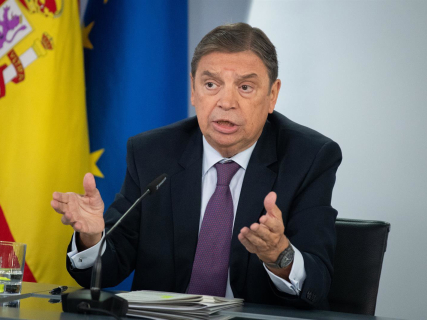

The Minister of Agriculture, Fisheries and Food, Luis Planas, defended this Saturday the Government’s decision to temporarily withdraw 12% of the production of olive oil from the current campaign from the market to contain the excess supply, stabilize prices, and protect the profitability of producers. The head of Agriculture described the intervention as “absolutely necessary, timely, and based on European law,” and said that its purpose is to prevent a particularly abundant campaign from ending up harming farmers.
The measure comes in a year in which production forecasts point to a harvest of around 1.6 million tonnes, to which are added inventories from the previous campaign of 357,000 tonnes. Taken together, the available volume comes to close to two million tonnes—an accumulation that, according to the Ministry’s assessment, makes it necessary to act to avoid imbalances between supply and demand.
Planas explained that the objective of the intervention is “to ensure that the entire sector is profitable,” with special attention to primary producers, whose margins may be put at risk when the abundance of product pushes prices down at origin. The minister defended that the withdrawal will allow commercialization to be synchronized with the evolution of the market and will provide greater stability to an activity that is especially relevant for many rural areas.
Traditional olive groves, at the center of the intervention
The head of Agriculture placed traditional olive groves as one of the main beneficiaries of the measure, as it is a production model that bears higher costs than intensive and super-intensive farms. The difference in productive structure and costs means that price drops have an especially sharp impact on traditional farms, many of them linked to municipalities whose economic activity depends to a large extent on cultivation.
“The measure is designed to provide stability to the market and to support those who need it most,” Planas said, who highlighted the importance of olive groves for maintaining economic activity and employment in rural areas.
The minister has also recalled that the intervention responds to a request forwarded by the professional farming organizations and the agri-food cooperatives. The decision is therefore intended to address a concern shared by different links in the sector about the risk that a high supply will end up undermining the profitability of farmers.
Planas made these statements during his participation in the Fiesta del Primer Aceite, held in Úbeda (Jaén), an event dedicated to promoting early oils and recognizing olive-oil-related activity. The choice of this setting has allowed the minister to defend the measure before representatives of a region especially linked to olive-oil production.
The Government cites the European framework to justify the withdrawal
The decision is implemented through a resolution of the Directorate-General for Agricultural Production and Markets, published on Friday in the Boletín Oficial del Estado (BOE). Planas defended that the mechanism has legal backing both in the national legal system and in the Community framework, and he assured that its design has been preceded by an analysis of the sector’s evolution.
"It is the result of rigorous work, carried out over months, in which the olive-oil campaigns of the last 20 years have been analyzed," the minister explained, insisting that the action complies with European and national law.
The Community basis lies in the operating regulation of the Common Organisation of Markets (OCM) of the European Union, which includes instruments to intervene in situations of market imbalance and to manage scenarios of high production. This framework makes it possible to activate product immobilization mechanisms when the conditions laid down in the regulations are met.
The reference to Community law is relevant because the withdrawal is not an isolated decision by the Spanish market, but rather relies on the regulatory instruments provided for the operation of the European agricultural markets. The Executive argues that the action responds to a specific supply situation and seeks to prevent excess product from jeopardizing the economic viability of farms.
Planas warns against speculation and rules out passing the measure on to the consumer
One of the central messages from the minister has been that the immobilization of part of production must not be turned into an argument to make olive oil more expensive on supermarket shelves. Planas has asked operators not to use the intervention to justify unjustified price increases and has warned that the Executive will be on the lookout for possible speculative behavior.
The withdrawal is intended to act on the balance between supply and demand and to protect producers’ margins, not to cause an artificial increase in cost for consumers. "Let no one take advantage of this opportunity to speculate," the head of Agriculture has demanded, who has assured that the Government "will be behind to prevent it".
The message introduces a second dimension in the application of the measure. Along with the objective of stabilizing the market at origin, the Executive intends to prevent the effects of the intervention from being passed on to the marketing chain and ending up being reflected in the final price.
The evolution of quotations and the behavior of operators will therefore be relevant elements for assessing the scope of the withdrawal. The Ministry argues that the mechanism should help to sustain the sector’s profitability without generating additional distortions in the market.
China, Mercosur and India: the sector seeks to expand its markets
Beyond the regulation of domestic supply, Planas has highlighted the growth possibilities for Spanish olive oil in international markets. The minister recalled that during the past year, a little more than a million tons were commercialized abroad—an amount that reflects Spain’s weight in worldwide trade of this product.
Among the opportunities he has mentioned is the forthcoming reduction of the tariffs applied by China to olive oil, which will move from 10% to 5%. The cut may facilitate access for the Spanish product to one of the major international markets and improve the competitive conditions for exports.
Planas has also mentioned the trade agreements reached by the European Union with Mercosur and India, which open up new prospects for Community producers. The expansion of trading destinations thus appears as a complementary route to absorb Spanish production and reduce dependence on traditional markets.
Therefore, the Government’s strategy combines, a short-term intervention on supply with the search for new commercial opportunities abroad. While the withdrawal of 12% aims to prevent the abundance of the harvest from pushing prices down and harming especially traditional olive groves, the opening of markets seeks to strengthen the export capacity of a strategic sector for Spanish agriculture.