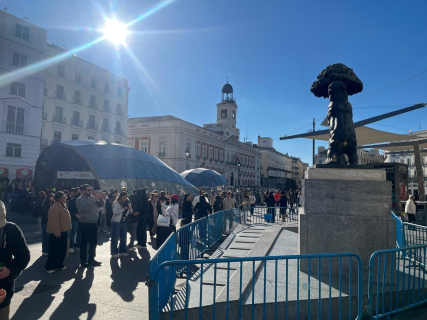

Puerta del Sol has once again "been what it was" after the National Police and the Municipal Police of Madrid cleared out at dawn nearly 300 people who were still in the encampment and after the cleaning services carried out the removal of waste.
Since September 26, this spot had been transformed into a focus of protest over the housing problem that arose after the eviction of Maricarmen Abascal -- the 87-year-old woman who would die days later at Hospital Gregorio Marañón --. In the early hours of the day, the square saw how the camp that had been set up was completely dismantled.
During the morning, the statue of the bear and the strawberry tree remained cordoned off while the SELUR removed the graffiti and stickers attached, and the equestrian monument of Carlos III continued without water in the fountain that surrounds it. The access known as 'the whale' to the Sol station for carrying out its cleaning also remains fenced off, although the entrance and the rest of the Metro openings remain open to the public.
The area where, for almost a month and a half, hundreds of tents were concentrated, with improvised streets, supply areas, and information tables, as well as access to the Sol Metro, had already by the afternoon shown an image close to the usual normality of the area.
Excavators, waste-collection trucks, and SELUR vehicles, with about 50 municipal workers, have removed throughout the morning of this Tuesday, after the police action, the remains that were still left of the camp, including the tarpaulins that covered the square and sheltered from the rain those who have lived there during this time. According to Madrid City Hall, 36 tons of waste have been counted.
"A COMPLETELY DIFFERENT SCENE"
Now the capital's 'kilometer zero' offers "a completely different scene," in Sergio's words, 28 years old, who this Tuesday arrived in Sol from Villaverde Alto "with the usual traffic," without knowing what he was going to find.
For those who have spent these weeks in the encampment, like Alejandro, 27 years old, seeing the square full of tourists again and without tents causes "shock." "The truth is that it brought a tear to my eye a bit," he admitted.
Although the encampment has concluded, and "regardless of whether it could have been extended," Alejandro believes that "it is important to demand recognition for the protest itself" and that the public "protests wherever it wants to."
Among the tourists who this Tuesday have returned to walk around the square were Sol, 30, and Cecilia, 29, both Uruguayans. Earlier this same morning, after learning about the camp being lifted, they have decided to go over “to see if everything was really evacuated.” “I thought we were going to find more damage,” the first one said, who believed that “it was going to be more messier.” Despite this, both have highlighted “the amount of security” that there is still in Sol.
Also “out of curiosity,” Marcos, 52, who lives nearby, has come over and claims to have witnessed “all the phases.” In his view, the damage at Puerta del Sol after more than a month of camping is not serious. “The defects, if there are any, are not visible,” he said, before specifying that the only thing he has seen are “three or four stickers.”
Several businesses in the surrounding area have told Europa Press that this past month has been especially complicated, since the camping has caused a notable drop in customers in the square and in the nearby streets. The mayor of Madrid, José Luis Martínez-Almeida, has estimated “more than 30 million euros in losses for the commerce in the area” due to “38 days of occupation” with the camping in Sol.
Salam, from the ice cream shop 'Palazzo', located in one of the ground-floor units of the building topped by the emblematic Tío Pepe sign, has celebrated “seeing the square like this again.” “I’m very happy,” he said, because this past month “sales have dropped a lot.”