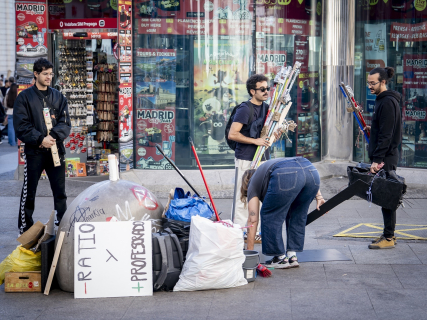
The Police evict the encampment at Puerta del Sol after more than five weeks

The Government Delegation maintains that the protest had lost its reivindicative character and that there were risks to people and property; the campers denounce blows and the use of pepper spray

desalojo sol

desalojo sol

Add DEMÓCRATA to Google

Ask FREN

Published

Last updated

2 minutes

Most read

Elecciones 29N · Encuestas

La media de las encuestas

Media a 2 de noviembre de 2026 · 16 institutos

  • PP30,5 %
  • PSOE27,4 %
  • Vox19,1 %
  • Frente Amplio6,4 %
  • ERC2,4 %
  • Podemos2,4 %
010203040ene 2024jul 2024ene 2025jul 2025ene 2026jul 2026

Media del último estudio de cada instituto en 30 días y su evolución semanal desde el 23J. Partidos con al menos un 2 %.

Todas las encuestas

Elecciones generales del 29 de noviembre · Demócrata

The National Police have evicted during the early hours of this Tuesday the Encampment of the Puerta del Sol in Madrid, set up since last September 26 to demand the right to housing. The operation, carried out in coordination with the Municipal Police, has brought to an end more than five weeks of protest in the center of the capital.

The intervention has caused conflicting versions between the Government Delegation and the participants in the encampment. In a statement, the institution explained that it initially protected the right of assembly by considering that there was a common claim-making purpose. However, it maintains that, after more than a month of protest, the circumstances had changed: the main participating organizations had withdrawn and an important part of the people who spent the night in the square were homeless people and vulnerable groups.

From the Delegation it is also alluded to various allegedly criminal acts and incidents recorded inside and around the encampment, reported by the Madrid Superior Police Headquarters. According to its version, these circumstances generated a risk for people and property that justified the intervention.

They assure, moreover, that the eviction was the result of a gradual process and several prior communications with the encamped people. On October 26, the then Government delegate, Francisco Martín, sent an initial written communication in which he considered that a reasonable time had elapsed to convey the protest's demands. Three days later, on October 29, he sent a second requirement to demand the dismantling of the encampment.

According to the chronology provided by the Delegation, on October 30 the interlocutors of the encampment communicated the dissolution of all organizing committees and the end of the initial demand. Despite this, a group of participants remained in the square and refused to leave it.

Faced with this situation and the police reports about the incidents recorded in the surroundings, the delegate issued an order to request the restoration of normality through the necessary actions, with criteria of proportionality and appropriateness and paying special attention to vulnerable people.

The encamped people denounce blows and use of pepper spray

The organization of the Acampada 26S has denounced that the police intervention was violent and that the officers used pepper spray against the participants. It has also asserted that several people were injured during the eviction.

The Government Delegation maintains that the operation was carried out without violence, although its statement makes no explicit reference to the complaints about the use of gas or police charges. 

The eviction took place after the High Court of Justice of Madrid rejected last October 7 the precautionary measure requested by the Community of Madrid to dissolve the encampment. The court did not then see the legal requirements to consider that the Government Delegation had engaged in inactivity.

The judicial ruling referred to the request submitted by the regional government at that time. The intervention this morning responds to the subsequent decision of the Government Delegation, which bases its action on the change in circumstances and on the incidents reported by the Police.

More key points, information and questions with FREN

AI-GENERATED CONTENT

What powers does the Government Delegation in an autonomous community have regarding the protection of the right of assembly and intervention in protests?

The Government Delegation has a dual responsibility: to protect the exercise of the right of assembly and to adopt, within its powers, the necessary measures to preserve citizen security. It does not grant permission to demonstrate: peaceful and unarmed assemblies are a fundamental right. Its decisions are subject to legal limits, must be justified, and can be reviewed by the courts.

1. Guarantee the right, not authorize it

Article 21 of the Constitution recognizes the right to peaceful and unarmed assembly without the need for prior authorization. For assemblies in public transit areas and demonstrations, it requires prior notification to the authority. This notification allows organizing the protection of participants and third parties, managing traffic, and coordinating necessary services; it does not transform the right into an activity subject to licensing.

Organic Law 9/1983 regulates this notification: it must ordinarily be submitted between ten and thirty calendar days in advance; when extraordinary and serious causes justify urgency, it can be done with a minimum of twenty-four hours' notice.

2. Process notifications and establish restrictions

When acting as the competent governmental authority, the Delegation receives notifications and may gather information to assess the conditions of the event. It can also propose changes to the date, place, duration, or itinerary, or prohibit the call, but not for mere political convenience nor due to disagreement with its demands.

Prohibition or modification requires well-founded reasons of public order disruption with danger to persons or property. The resolution must be justified and notified within seventy-two hours following the notification. Ordinary inconveniences, traffic difficulties, or the critical nature of a protest do not by themselves justify preventing it.

Organizers can challenge these decisions through an urgent judicial procedure. Therefore, the Delegation does not have the final word on the legitimacy of the restriction.

3. Organize protection and coordinate police action

The Delegation directs the State Security Forces and Corps within its territorial scope, with the corresponding functional dependence, and coordinates security actions. This includes preparing devices to protect the protest, prevent assaults, facilitate emergency services, and reconcile the mobilization with the rights of other people.

It does not automatically direct all police forces present in the autonomous community. The distribution of functions depends on autonomous competencies, the existence of local police, and coordination mechanisms. In certain territories, administrative functions over demonstrations correspond to autonomous authorities; local police exercise their own powers, especially in urban traffic.

4. Intervene or disperse: a limited power

Police intervention must respect the principles of legality, necessity, and proportionality. Organic Law 4/2015 requires that measures to maintain or restore security in assemblies and demonstrations be gradual and proportionate; dispersal is the last resort.

Organic Law 9/1983 contemplates cases such as criminally illicit assemblies, public order disturbances with danger to persons or property, and certain uses of paramilitary uniforms. As a rule, participants must be warned beforehand, with exceptions in cases of risks requiring immediate response. The violence of specific individuals does not automatically make all attendees responsible.

5. Sanction without punishing the protest

The Delegation can also process and resolve sanctioning procedures within its powers. However, participating in a protest is not, by itself, sanctionable: a specific infraction and individual responsibility must be proven, with guarantees of defense and possibility of appeal. Nor does every administrative infraction justify dispersing a gathering.

What has been the political and professional trajectory of Francisco Martín, former Government Delegate in Madrid?

Francisco Martín Aguirre has developed a trajectory combining engineering, PSOE management, and responsibilities in the Presidency of the Government. His career moved from environmental and international reconstruction projects to trusted positions in La Moncloa, before serving as Government Delegate in Madrid between March 2023 and October 2026.

Education and early work

Born in Madrid in 1981, he is a Forestry Engineer from the Polytechnic University of Madrid since 2007 and holds an MBA in International Trade from ICEX-CECO. The biographical reference published with his appointment highlights that he worked as an engineer in both the public and private sectors (La Moncloa reference).

His first experiences were related to civil, forestry, and environmental engineering. Between 2007 and 2008 he worked at Tragsatec in environmental impact assessment; in 2011 he was head of the Presidency Cabinet of the Tragsa Group and, in 2012, responsible for actions in the civil reconstruction project of Badghis, Afghanistan. This stage preceded his dedication to party and government administration (profile in La Vanguardia).

From PSOE to the Presidency of the Government

A socialist member since 2000, his connection with Pedro Sánchez gained special relevance during the 2017 primaries. He presided over Bancal de Rosas, the association that channeled contributions from members and sympathizers for that candidacy; later he was director of Administration and Finance of the PSOE between 2017 and June 2018 (trajectory collected by Demócrata).

After Sánchez's arrival to government, he held three responsibilities in La Moncloa. The sequence shows his transition from technical management to administrative direction of the Presidency:

  • June 2018-January 2020: director of the Technical Cabinet of the General Secretariat of the Presidency of the Government, in the structure led by Félix Bolaños.
  • January 2020-July 2021: director of the Department of Planning and Monitoring of Government Activity.
  • July 2021-March 2023: secretary general of the Presidency of the Government.

During this period he also was part of the Board of Patrimonio Nacional and the Board of Trustees of the FIIAPP (professional chronology). In the party, he assumed in November 2021 the Secretariat of Strategy and Electoral Action of the PSOE of Madrid (political profile).

Government Delegation and departure from office

The Council of Ministers appointed him Government Delegate in Madrid on March 28, 2023, replacing Mercedes González. From this position, he assumed representation of the central government and coordination of state services and the State Security Forces and Corps in the region (official appointment and biography).

His term had greater political exposure than his previous responsibilities, with frequent confrontations with Isabel Díaz Ayuso and José Luis Martínez-Almeida, especially regarding security and demonstrations. He was also investigated in 2025 for hiring an advisor linked to Begoña Gómez; proceedings against him were dismissed due to lack of evidence (assessment of his mandate).

He resigned on October 25, 2026, after being left out of the socialist candidacies for the November 29 general elections. He stated that conditions to continue were not met; the relation to other internal tensions was attributed by socialist sources, not confirmed as an official explanation (information about the resignation). His dismissal was published on October 28 by Royal Decree 935/2026, and Pilar Trinidad Núñez was appointed successor (dismissal in the BOE; appointment of his successor).

What legal requirements does Organic Law 9/1983 establish to authorize or dissolve assemblies and demonstrations in public spaces in Spain?

Organic Law 9/1983, of July 15, regulating the right of assembly, does not require prior authorization to meet or demonstrate. For assemblies in public transit places and demonstrations, it establishes a prior notification; their prohibition, modification, suspension, or dissolution requires the reasons and guarantees explained below.

1. A right that does not need permission

Article 3.1 expressly states: "No assembly shall be subject to prior authorization." Therefore, notifying a demonstration is not equivalent to requesting permission. Additionally, Article 3.2 obliges the governmental authority to protect assemblies and demonstrations against those who try to prevent or disturb their lawful exercise.

Article 1 protects peaceful and unarmed assemblies and defines, for the purposes of this law, an assembly as the concerted and temporary gathering of more than twenty people with a specific purpose.

2. Notification: deadlines and content

According to Article 8, organizers or promoters must notify in writing the holding to the corresponding governmental authority with an advance of at least ten calendar days and at most thirty. If there are extraordinary and serious causes justifying urgency, the minimum advance is reduced to twenty-four hours. In legal entities, their representative notifies.

Article 9 requires including:

  • Name, surname, address, and official identification of the organizers or their representative; for legal entities, also their name, nature, and address.
  • Place, date, time, and expected duration.
  • Purpose of the assembly or demonstration.
  • Projected itinerary, if it will circulate through public roads.
  • Security measures planned or requested from the authority.

Except for urgent calls, the authority forwards this data to the affected municipality, which has twenty-four hours to report on objective circumstances of the route: security, condition of places, or coincidence with other events. The report must be justified, is not binding, and if it does not arrive on time, it is considered favorable.

3. When can it be prohibited or modified

Article 10 allows prohibiting the call when there are "well-founded reasons to believe that public order disturbances may occur, with danger to persons or property." It is not enough to invoke public order generically: these reasons and the anticipated danger must be justified.

Instead of prohibiting it, the authority may propose changes to the date, place, duration, or itinerary. The resolution must be justified and notified within a maximum of seventy-two hours from the notification.

4. When can it be suspended or dissolved

Article 5 establishes four cases for the governmental authority to suspend and, if applicable, dissolve assemblies or demonstrations:

  • That they are illicit according to criminal laws.
  • That public order disturbances occur with danger to persons or property.
  • That attendees use paramilitary uniforms.
  • That they are organized by members of the Armed Forces or the Civil Guard infringing the specific legal limitations identified by the provision.

The resolution must be communicated beforehand to the attendees in the legally established manner. The lack of communication of the call does not appear, by itself, among these four causes for dissolution.

5. Responsibility and judicial defense

Article 4 holds organizers responsible for good order and requires them to adopt measures for the proper development of the event. Article 11 allows judicial appeal against prohibition or unaccepted modifications within forty-eight hours, forwarding a copy of the appeal to the governmental authority.

These requirements appear in the BOE text; the 1999 reform modified articles 9 and 10.

Play

Test your knowledge with FREN!

How much do you know about this topic? Answer the following 3 questions.

Since when was the Puerta del Sol camp installed that was evicted by the Police?

Question 1 of 3

What fact did the Government Delegation use to argue the change of circumstances that led to the eviction?

Question 2 of 3

What did the 26S Camp organization denounce regarding the police action during the eviction?

Question 3 of 3